Zing Forum

Reading

Scala-MLX: Natively Run Large Language Models on Apple Silicon with Scala Native

An LLM inference framework based on Scala Native and Apple Metal, enabling developers to efficiently run large language models on Mac using the Scala language.

ScalaScala NativeApple SiliconMetalLLM大语言模型本地推理Apple Silicon GPU
Published 2026-04-30 04:44Recent activity 2026-04-30 04:55Estimated read 6 min
Scala-MLX: Natively Run Large Language Models on Apple Silicon with Scala Native
1

Section 01

Scala-MLX: Scala Native LLM Inference Framework on Apple Silicon

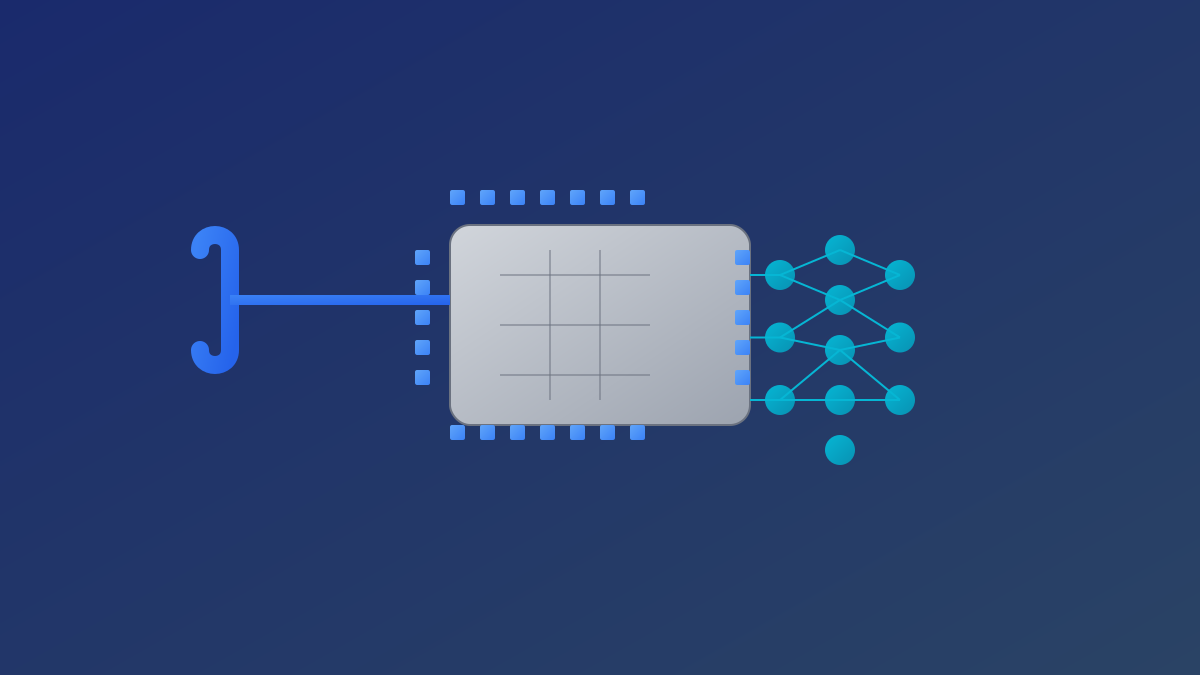
Scala-MLX is an LLM inference framework based on Scala Native and Apple Metal, designed to enable Scala developers to efficiently run large language models on Apple Silicon. It fills the gap in the Scala ecosystem for local LLM inference, with core advantages like native compilation and Metal GPU acceleration, supporting end-to-end native processing from text input to model output.


2

Section 02

Project Background: The Gap in Scala Ecosystem for Apple Silicon LLM Inference

With the popularity of Apple Silicon chips among developers, more and more machine learning workloads are migrating to the Mac platform. However, mainstream LLM inference frameworks are mostly built on Python and CUDA, leaving Scala developers without native development options on Apple Silicon. The scala-mlx project was born to fill this gap, allowing Scala developers to efficiently run local LLMs using their familiar language.

3

Section 03

Core Technologies: Efficient Combination of Scala Native + Metal

Scala Native Compilation Advantages

scala-mlx uses Scala Native to compile to machine code, bringing advantages like fast startup (no JVM warm-up needed), low memory usage, and seamless calling of C/C++ libraries.

Metal Backend Tensor Operations

Deeply integrated with the Apple Metal framework, it enables GPU-accelerated tensor operations (matrix multiplication, attention calculation), unified memory access (avoiding data copying), and optimizations for Apple Silicon's Neural Engine and GPU computing power.

Native Tokenizer Support

Implements native text tokenization functionality, with end-to-end processing from input to output without relying on external Python libraries.

4

Section 04

Target Users and Practical Application Scenarios

Who Is It For?

  • Scala developers: Want to integrate LLM capabilities into existing Scala projects
  • Apple Silicon users: Make full use of Mac's local computing power
  • Edge deployment scenarios: Low-dependency native binary solutions
  • Learning and research: Understand the underlying implementation of LLM inference

Practical Application Scenarios

  1. Local development tools: Code assistants, document generators
  2. Privacy-sensitive applications: Local data processing without uploading to the cloud
  3. Embedded systems: Deployment in resource-constrained environments
5

Section 05

Technical Details: Memory Management and Computational Graph Optimization

Memory Management Strategy

  • Region allocator for managing temporary tensors
  • Memory-mapped file loading of weight data to reduce memory usage
  • Support for INT8/INT4 quantized models to reduce VRAM requirements

Computational Graph Optimization

  • Operator fusion: Merge small operations into a single Metal kernel
  • Memory reuse: Reuse intermediate result buffers
  • Attention optimization: Adopt the efficient Flash Attention algorithm
6

Section 06

Solution Comparison: scala-mlx vs Other Mainstream Solutions

Feature scala-mlx llama.cpp Python + PyTorch
Language Scala C++ Python
Apple Silicon Optimization Native Metal Metal Backend MPS Backend
Dependencies Very few Few Many
Startup Speed Fast Fast Slow
Ecosystem Integration Scala Ecosystem General Python Ecosystem
7

Section 07

Future Outlook and Conclusion

Future Outlook

  • Support more model architectures (Mistral, Llama 3, Qwen, etc.)
  • Improve quantization schemes (GPTQ, AWQ, GGUF formats)
  • Expand multimodal capabilities (image understanding, speech processing)
  • Provide integration examples with mainstream Scala web frameworks

Conclusion

scala-mlx opens the door for Scala developers to high-performance LLM applications on Apple Silicon, proving that non-Python ecosystems can also build efficient LLM inference capabilities. It is a direction worth paying attention to for developers pursuing native performance and low-dependency deployment.

