Zing Forum

Reading

Salesforce Multi-Agent System: Coordinator-Expert Pattern Practice for E-commerce Workflows

A multi-agent orchestration system implemented based on LangGraph, using the Coordinator-Expert design pattern to optimize Salesforce e-commerce business processes

多代理LangGraphSalesforce电商自动化协调者模式工作流编排Commerce CloudAI代理
Published 2026-04-11 00:11Recent activity 2026-04-11 00:20Estimated read 8 min
Salesforce Multi-Agent System: Coordinator-Expert Pattern Practice for E-commerce Workflows
1

Section 01

[Introduction] Salesforce Multi-Agent System: Coordinator-Expert Pattern Optimizes E-commerce Workflows

This article introduces a Salesforce multi-agent orchestration system built on the LangGraph framework, using the Coordinator-Expert design pattern to provide a scalable and maintainable automation solution for Salesforce Commerce Cloud e-commerce business processes. By decomposing complex workflows into collaborative professional agents, the system addresses the tight coupling and maintainability issues of traditional monolithic automation solutions, offering new ideas and practical references for e-commerce automation.


2

Section 02

Complexity Challenges of E-commerce Automation and Value of Multi-Agent Architecture

The order process of modern e-commerce platforms involves multiple links such as inventory checking, price calculation, promotion rules, and payment processing. Traditional monolithic automation solutions tend to fall into the predicament of tight coupling and poor maintainability. The multi-agent architecture decomposes complex workflows into collaborative professional agents, maintaining module independence while ensuring smooth overall processes through coordination mechanisms, providing a new direction to address this challenge.

3

Section 03

Core of the Architecture: Analysis of the Coordinator-Expert Pattern

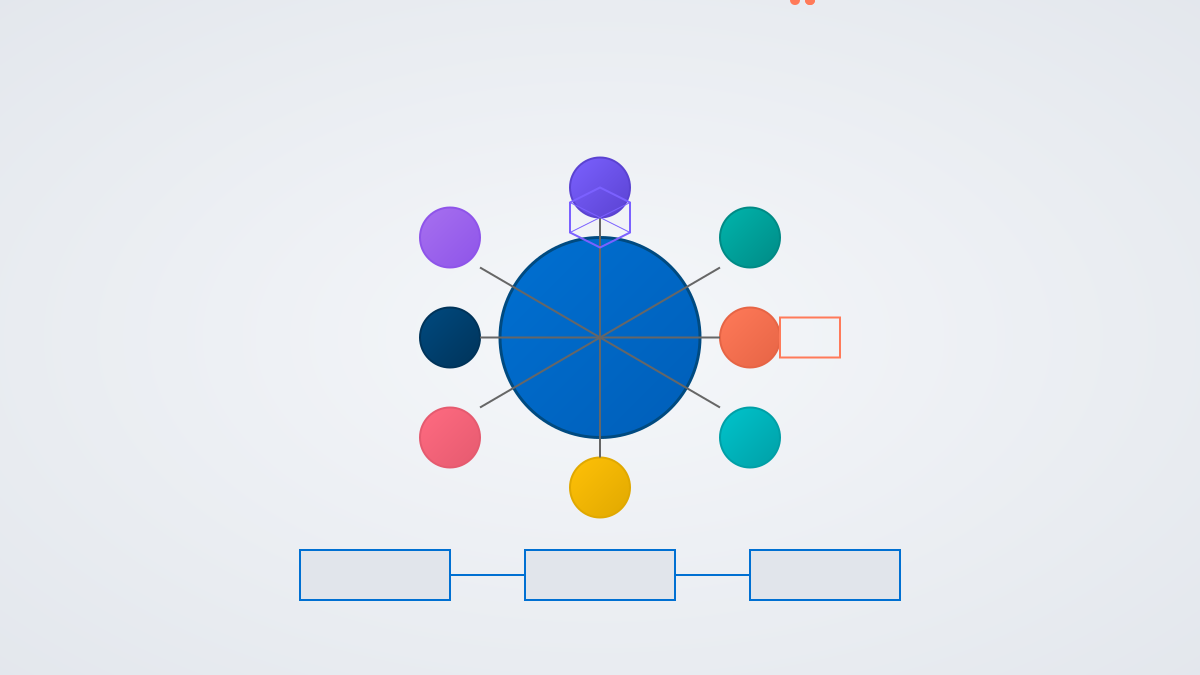
Coordinator Agent

As the central command of the system, it is responsible for intent recognition, task decomposition, agent scheduling, dependency management, and result integration. It does not perform specific business operations, focusing instead on process orchestration and decision-making.

Expert Agents

Experts in various fields who perform specific tasks:

  • Product Catalog Expert: Product query, inventory check, etc.
  • Pricing and Promotion Expert: Price calculation, discount application, etc.
  • Order Management Expert: Shopping cart operations, order status tracking, etc.
  • Inventory and Logistics Expert: Inventory management, shipping cost estimation, etc.
  • Customer Data Expert: Customer information query, points calculation, etc. Each expert has a clear capability boundary and communicates with the coordinator through standardized interfaces.
4

Section 04

LangGraph Implementation: State-Driven and Dynamic Orchestration

State-Driven Process

The system maintains a shared state object that传递s conversation context, intermediate results, and execution progress. The state structure is hierarchically organized, type-safe (using Pydantic models), and supports version control and rollback.

Conditional Edges and Dynamic Routing

Conditional edges determine the workflow direction based on runtime state, supporting complex branching logic and avoiding unnecessary computational overhead.

Parallel Execution and Result Aggregation

For independent subtasks, experts are scheduled in parallel. LangGraph has built-in parallel support—for example, a product detail page request can call the product, inventory, and pricing experts simultaneously, reducing response time.

5

Section 05

Deep Integration with Salesforce Commerce Cloud

API Encapsulation Adapter Layer

Interact with Salesforce APIs through an adapter layer. Each expert corresponds to a set of API encapsulations, handling rate limits (token bucket algorithm), authentication management (OAuth2.0), batch optimization, and caching strategies to reduce API load.

Real-Time Event Processing

Subscribe to Salesforce platform events to respond to events such as inventory changes and order status updates in near real-time, with relevant experts handling them promptly.

6

Section 06

Practical Application Scenarios: Intelligent Assistant, Exception Handling, and Personalized Recommendations

Intelligent Shopping Assistant

Understand natural language needs (e.g., finding an outdoor waterproof backpack). The coordinator decomposes the request and schedules product, pricing, and inventory experts to return accurate results.

Order Exception Handling

Automatically diagnose exceptions such as payment failures and insufficient inventory, and call corresponding experts to perform remedies (e.g., recommending alternative products, guiding address updates).

Personalized Recommendations

Combine customer data experts and product experts to generate personalized recommendations based on historical behavior and preferences. The coordinator integrates multi-dimensional information to ensure alignment with customer interests and business strategies.

7

Section 07

System Expansion and Customization Guide

Adding New Experts

  1. Define capability descriptions and input/output schemas
  2. Implement core business logic
  3. Register in the coordinator's routing table
  4. Configure communication protocols

Customizing Coordination Strategies

Customize decision logic through prompt engineering or fine-tuning models to adapt to enterprise business characteristics, better understanding industry terminology, rules, and customer preferences.

8

Section 08

Summary: Reference Value of Multi-Agent Architecture for E-commerce Automation

The salesforce-multi-agent project provides a clear multi-agent architecture reference for e-commerce automation. By decomposing complex business processes into manageable and reusable agent components through the Coordinator-Expert pattern, it balances system flexibility and code maintainability, making it a worthwhile open-source practice for AI agent applications in the e-commerce field.