Zing Forum

Reading

Ruflo: A Multi-Agent Orchestration and Federated Collaboration Platform for Claude Code

Ruflo is a multi-agent orchestration platform specifically designed for Claude Code, supporting collaboration among over 100 professional agents. It features distributed swarm coordination, a self-learning memory system, and zero-trust federated communication capabilities.

Claude Code多智能体AI编排联邦学习智能体协作MCP零信任开源工具
Published 2026-04-30 07:14Recent activity 2026-04-30 09:57Estimated read 8 min
Ruflo: A Multi-Agent Orchestration and Federated Collaboration Platform for Claude Code
1

Section 01

Introduction: Ruflo—A Multi-Agent Orchestration and Federated Collaboration Platform for Claude Code

This article introduces Ruflo, an open-source multi-agent orchestration platform specifically designed for Claude Code. It supports collaboration among 100+ professional agents, with features like distributed swarm coordination, a self-learning memory system, and zero-trust federated communication. Its core philosophy is "orchestrate rather than replace" developers' work—through intelligent routing and task distribution, agents collaborate in the background, reducing coordination costs and enabling secure cross-organizational collaboration.


2

Section 02

Project Background and Positioning

Ruflo evolved from its predecessor Claude Flow, renamed by developer Ruv. The "Ru" in the name comes from the author's name, while "flo" represents workflow flow. Its underlying layer uses a Rust-written WASM kernel to drive the strategy engine, embedding models, and proof system, balancing performance and security. Unlike other AI programming assistants, Ruflo's core philosophy is "orchestration" rather than "replacement": it does not replace developers' coding work, but instead automatically handles task routing, pattern learning, and agent coordination through a hook system, allowing developers to use Claude Code as usual.

3

Section 03

Core Architecture and Swarm Coordination Mechanism

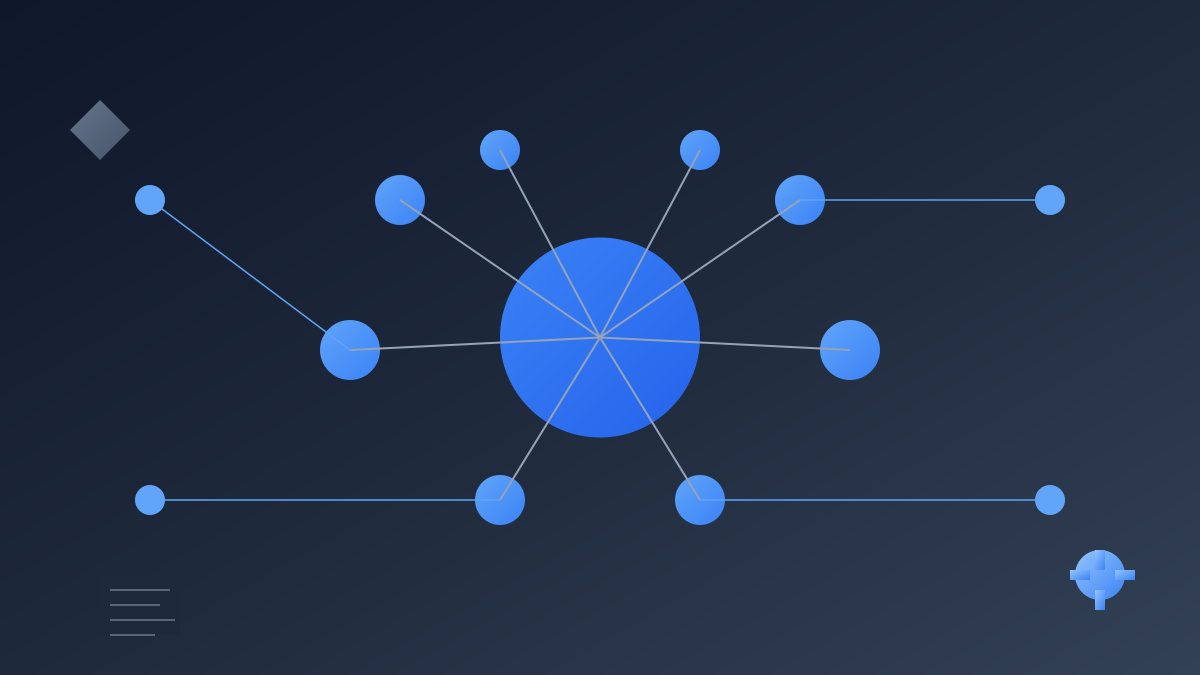
Ruflo adopts a layered architecture: User → Ruflo (CLI/MCP) → Router → Swarm → Agent → Memory → LLM Provider, forming a closed loop with a learning cycle (the system extracts successful patterns from task execution to optimize routing, achieving an accuracy rate of 89%). The swarm system supports three topologies: hierarchical topology (suitable for clear reporting relationships like code reviews), mesh topology (suitable for multi-party negotiation of complex decisions), and adaptive topology (dynamically adjusting patterns); internal consensus mechanisms prevent conflicts and duplicates.

4

Section 04

100+ Professional Agent Ecosystem

Ruflo has built-in 100+ professional agents covering all stages of the software development lifecycle:

Agent Type Key Responsibilities
Code Generator Generates runnable code based on requirements
Test Engineer Identifies test gaps and generates test cases
Security Auditor Scans for CVE vulnerabilities and potential risks
Documentation Writer Maintains technical documentation and detects deviations from code
Architect Evaluates long-term impacts of design decisions and technical debt
Reviewer Performs code reviews and provides improvement suggestions
Agents collaborate through shared memory: For example, after a security auditor discovers a vulnerability, the information is stored in shared memory, and the code generator will automatically avoid similar issues in subsequent work.
5

Section 05

Federated Communication and Zero-Trust Security Mechanisms

Ruflo's "Agent Federation" mechanism addresses sensitive data protection in cross-team/organization collaboration, based on zero-trust principles:

  1. Authentication: Remote agents prove their identity via mTLS and ed25519 challenge-response without sharing API keys;
  2. PII Protection: 14 sensitive information detection pipelines automatically desensitize data before messages leave the node;
  3. Behavior Scoring: Dynamic trust scores based on success rate, online duration, threat level, and integrity;
  4. Audit Trail: Compliance logs meeting HIPAA, SOC2, GDPR standards, with all federated events traceable. Application scenario example: Team A needs to analyze transaction anomalies but lacks data; Team B has the data but cannot share it directly → Team A's agent initiates a request (PII automatically stripped) → Team B's agent performs local analysis and returns pattern features → Both parties' actions are audited, achieving "collaboration without leakage".
6

Section 06

Memory and Self-Learning System

Ruflo's memory system is based on HNSW vector indexing, with search speeds 150 to 12500 times faster than traditional methods, allowing agents to quickly find relevant context. The learning system uses the SONA (Self-Organizing Neural Architecture) model to optimize decision paths through trajectory learning: the router extracts patterns from each task's success/failure, gradually forming optimal strategies for specific scenarios instead of relying on static rules.

7

Section 07

Summary and Outlook

Ruflo represents the evolution of AI-assisted programming tools from single assistants to multi-agent collaboration networks. Its core values include:

  1. Reduce Coordination Costs: No need to manually manage agent task allocation;
  2. Cross-Boundary Collaboration: Federated mechanisms support secure cross-team/organization collaboration;
  3. Continuous Self-Optimization: Learning system improves agent performance;
  4. Developer-Led: Agents assist rather than replace human decisions. For teams exploring AI-driven development processes, Ruflo is an open-source solution worth attention—it not only solves current efficiency issues but also provides a technical foundation for future human-AI collaboration.

