Zing Forum

Reading

robocollab: A Structured Workflow for Collaborating with AI Programming Assistants

This article introduces an open-source project called robocollab, which provides a structured workflow to help developers collaborate more effectively with AI programming assistants such as GitHub Copilot and Cursor. The article analyzes its design philosophy and practical methods in detail.

AI编程助手人机协作工作流提示工程代码生成开发效率最佳实践
Published 2026-05-17 22:45Recent activity 2026-05-17 22:52Estimated read 4 min
robocollab: A Structured Workflow for Collaborating with AI Programming Assistants
1

Section 01

robocollab: A Structured Workflow for Collaborating with AI Programming Assistants (Introduction)

This article introduces the open-source project robocollab, which provides a structured workflow to help developers collaborate more effectively with AI programming assistants (such as GitHub Copilot, Cursor, etc.), solve efficiency and quality issues in human-AI collaboration, and maximize the value of AI-assisted programming.


2

Section 02

Why Do We Need a Structured Workflow? (Background)

AI programming assistants have great potential but also limitations: limited context understanding, fluctuating output quality, lack of verification mechanisms, and low collaboration efficiency. Many developers initially use AI assistants casually, making it difficult to consistently produce high-quality outputs. robocollab believes that efficient collaboration requires clear goal definition, context management, iterative feedback loops, and knowledge accumulation.

3

Section 03

robocollab Core Workflow (Methodology)

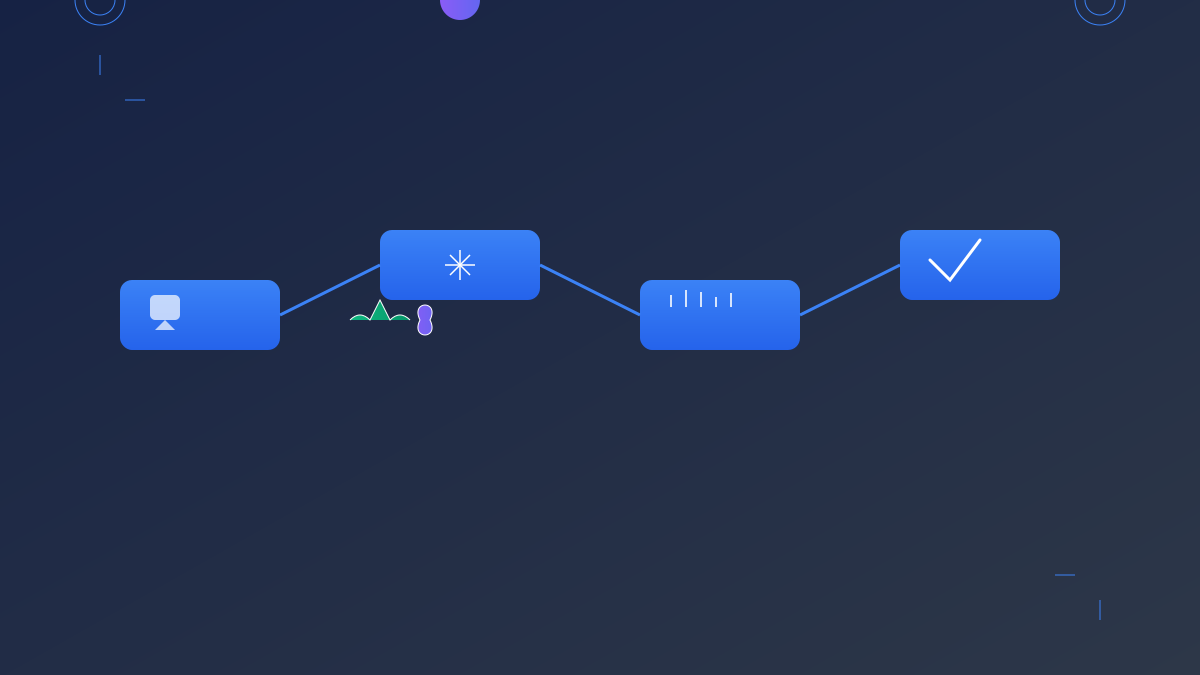
The core workflow of robocollab is divided into four phases:

  1. Task Decomposition and Planning: Clarify goals, split subtasks, sort out dependencies;
  2. Context Preparation: Provide relevant code snippets, interface definitions, reference examples, constraint descriptions;
  3. Collaborative Execution: Incremental development, active guidance, solution discussion, code review;
  4. Verification and Iteration: Automated testing, integration verification, performance evaluation, document updates.
4

Section 04

Practical Tips and Patterns (Methods/Recommendations)

Best Practices for Prompt Engineering: Role setting, output format specification, example-driven approach, constraint prioritization; Common Pitfalls and Avoidance Strategies: Avoid over-reliance on AI, prevent context drift, do not compromise quality standards, pay attention to security issues.

5

Section 05

Team Collaboration Considerations (Recommendations)

Teams using AI assistants need to establish norms: clarify AI usage policies, maintain strict code review standards, encourage knowledge sharing; at the same time, integrate with existing workflows such as agile development, mark AI-generated parts in code reviews, and record collaboration decisions.

6

Section 06

Implications for Developers (Conclusions/Recommendations)

The popularization of AI brings skill changes: developers need to improve their abilities in prompt engineering, review and verification, architecture design, and domain knowledge; balance efficiency and quality, avoid blind pursuit of speed; maintain continuous learning to adapt to the development of AI technology.

7

Section 07

Conclusion

robocollab provides a practical framework to help turn AI assistants from toys into productivity tools. The best workflow needs to be adjusted according to actual situations, and mastering collaboration skills is a required course for developers in the AI era.

