Zing Forum

Reading

RNet Inference: Decentralized P2P Small Language Model Inference Network

Explore how the RNet Inference project enables decentralized small language model inference, using P2P network technology to build a distributed AI inference infrastructure.

P2P网络去中心化小型语言模型分布式推理边缘计算隐私保护Swarm Inference
Published 2026-06-11 21:11Recent activity 2026-06-11 21:31Estimated read 7 min
RNet Inference: Decentralized P2P Small Language Model Inference Network
1

Section 01

Introduction / Main Floor: RNet Inference: Decentralized P2P Small Language Model Inference Network

Explore how the RNet Inference project enables decentralized small language model inference, using P2P network technology to build a distributed AI inference infrastructure.

2

Section 02

Original Author and Source

3

Section 03

Project Background

The inference of Large Language Models (LLMs) usually relies on centralized cloud service platforms, such as OpenAI, Anthropic, or APIs provided by cloud vendors. While convenient, this model brings several issues:

  • Privacy Risk: User data needs to be sent to third-party servers
  • Cost Issue: API call fees increase with usage
  • Availability Dependency: Service outages or restrictions affect applications
  • Centralized Control: A few companies control key AI infrastructure

At the same time, Small Language Models (SLMs) like Phi-3, Gemma 2B, Llama 3 8B have made significant progress in performance and can run on consumer-grade hardware. This provides a technical foundation for decentralized inference.

The RNet Inference project was born in this context. It aims to build a decentralized P2P network, allowing users to run SLM inference locally or on nearby nodes, enabling distributed and privacy-preserving AI services.

4

Section 04

What is Swarm Inference?

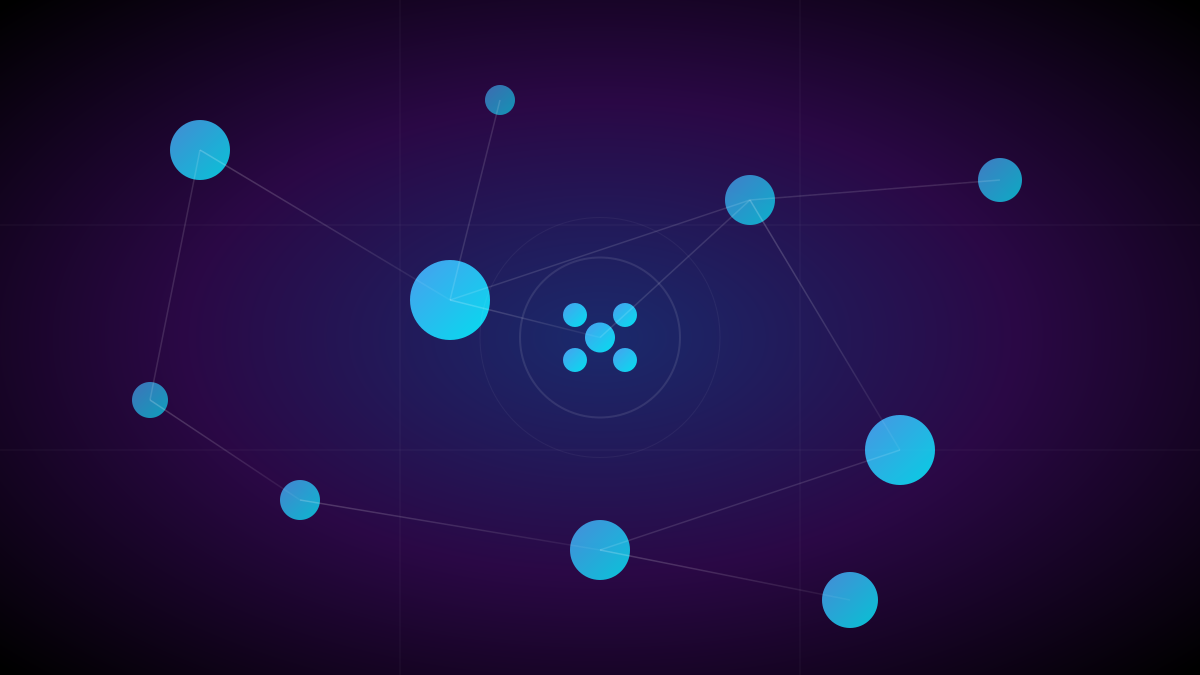
Swarm Inference is the core concept of the RNet project, drawing inspiration from swarm intelligence in nature:

  • Distributed Processing: Inference tasks are distributed across multiple nodes in the network
  • Load Balancing: Dynamically allocate tasks based on node capabilities and network conditions
  • Fault Tolerance: Single node failure does not affect overall service
  • Scalability: New nodes joining automatically enhance network capabilities
5

Section 05

P2P Network Architecture

The project is built on rnet-p2p, adopting a decentralized peer-to-peer network architecture:

  • No central server or single point of failure
  • Direct communication between nodes without intermediaries
  • Use Distributed Hash Table (DHT) for node discovery and routing
  • Support NAT traversal to connect nodes in different network environments
6

Section 06

Network Layer

P2P Protocol Stack

Implemented based on libp2p or similar frameworks:

  • Transport Layer: Supports multiple transport protocols like TCP, UDP, QUIC
  • Security Layer: Uses TLS or Noise protocol for encrypted communication
  • Multiplexing: A single connection supports multiple concurrent streams
  • NAT Traversal: Uses STUN/TURN and hole punching techniques

Node Discovery

  • Use bootstrap nodes for initial network access
  • Node address publication and query based on DHT
  • Support mDNS for LAN node discovery
  • Regularly maintain neighbor lists to keep network connectivity
7

Section 07

Inference Layer

Model Management

  • Model Registration: Nodes can publish the models they support
  • Model Discovery: Clients can query which nodes support a specific model
  • Model Caching: Popular models are cached on multiple nodes to improve availability
  • Version Control: Supports coexistence of multiple model versions

Task Scheduling

  • Task Splitting: Split large tasks into parallelizable subtasks
  • Node Selection: Choose optimal nodes based on latency, load, and reputation
  • Result Aggregation: Collect and merge distributed inference results
  • Failure Retry: Automatically detect failures and redirect to backup nodes

Supported Models

The project focuses on small language models, supporting:

  • Microsoft Phi-3 series (3.8B)
  • Google Gemma series (2B, 7B)
  • Meta Llama 3 (8B)
  • Mistral 7B
  • Other open-source models in GGUF format
8

Section 08

Incentive Mechanism

To encourage nodes to contribute computing resources, the project designs a token incentive mechanism:

  • Proof of Inference: Nodes submit verifiable proof of inference workload
  • Token Rewards: Earn tokens based on contributed computing power and service quality
  • Reputation System: Establish node reputation scores; high-quality services get more tasks
  • Staking Mechanism: Prevent malicious behavior; nodes need to stake tokens


