Zing Forum

Reading

Revive: A Swarm Intelligence Framework for Distributed LLM Inference on iOS Devices

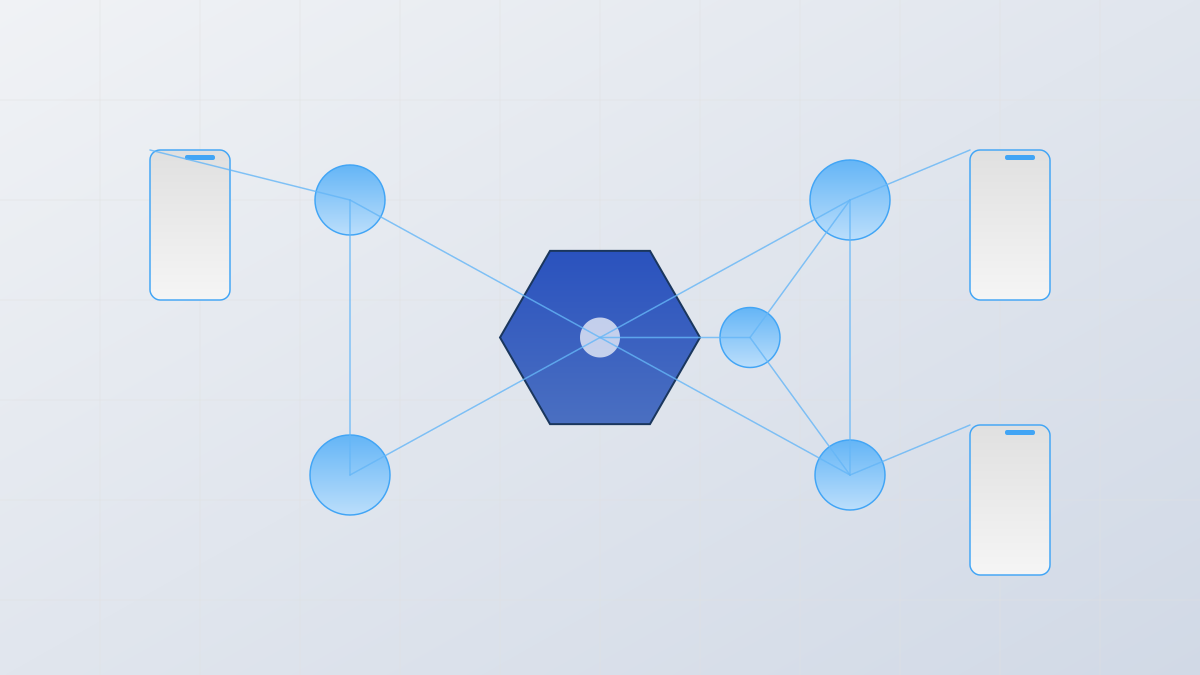
The Revive project explores an innovative edge computing paradigm, combining multiple iPhones into a distributed inference cluster via the Mixture of Agents architecture, opening up new possibilities for mobile AI applications.

分布式推理边缘计算Mixture of AgentsiOS移动AI群体智能LLM优化
Published 2026-04-19 18:12Recent activity 2026-04-19 18:17Estimated read 5 min
Revive: A Swarm Intelligence Framework for Distributed LLM Inference on iOS Devices
1

Section 01

Revive: Introduction to the Swarm Intelligence Framework for Distributed LLM Inference on iOS Devices

The Revive project explores an innovative edge computing paradigm, combining multiple iPhones into a distributed LLM inference cluster using the Mixture of Agents architecture. It addresses issues like latency, privacy, cost, and network dependency associated with cloud-based inference, opening up new possibilities for mobile AI applications and marking a crucial turning point in the democratization of AI infrastructure.


2

Section 02

Background: Paradigm Shift in AI Inference from Cloud to Edge

Current mainstream large model applications rely entirely on cloud data centers, leading to issues such as latency, privacy concerns, high costs, and network dependency. The core insight of Revive is that the neural engine of modern high-end iPhones has sufficient computing power to run models with billions of parameters, and multiple devices can collaborate to build a cloud-free distributed inference network.

3

Section 03

Methodology: Mixture of Agents Architecture Design

Revive adopts the Mixture of Agents (MoA) architecture, combining multiple smaller models to handle different aspects of a task and integrating outputs via intelligent routing. Each iPhone acts as an intelligent node running a lightweight expert model. User queries are decomposed into subtasks for parallel processing, and results are aggregated to generate answers. The framework also has fault tolerance (individual device offline does not affect the overall system).

4

Section 04

Key Challenges and Preliminary Solutions in Technical Implementation

Revive faces challenges such as model compression and optimization (quantization, pruning, etc., to adapt to mobile device memory and computing power), low-latency and high-bandwidth communication between devices, dynamic task scheduling and load balancing (considering device model, battery level, network status), and the project has provided preliminary solutions for these issues.

5

Section 05

Application Scenarios and Potential Value

The Revive model has unique value in scenarios such as privacy protection (data never leaves the device), offline AI capabilities in areas with unstable networks, and reducing developers' reliance on cloud APIs. In the future, millions of idle phones forming a global inference network could create an unprecedented pool of computing resources, driving the diffusion of AI capabilities from giant data centers to ordinary users.

6

Section 06

Limitations and Future Outlook

Revive is currently in the experimental stage, constrained by mobile device battery life, heat dissipation, and iOS sandbox mechanisms. It also needs to address issues like incentives for user computing power contributions and network security. However, its technical direction is inspiring, proving that edge devices can form a powerful intelligent network through architectural design and collaboration, making it an innovative case worth studying in the fields of mobile AI, edge computing, and decentralized technology.

