Zing Forum

Reading

ReadingDNA: An Intelligent Recommendation System Where Two AI Models "Duel" for Your Reading Taste

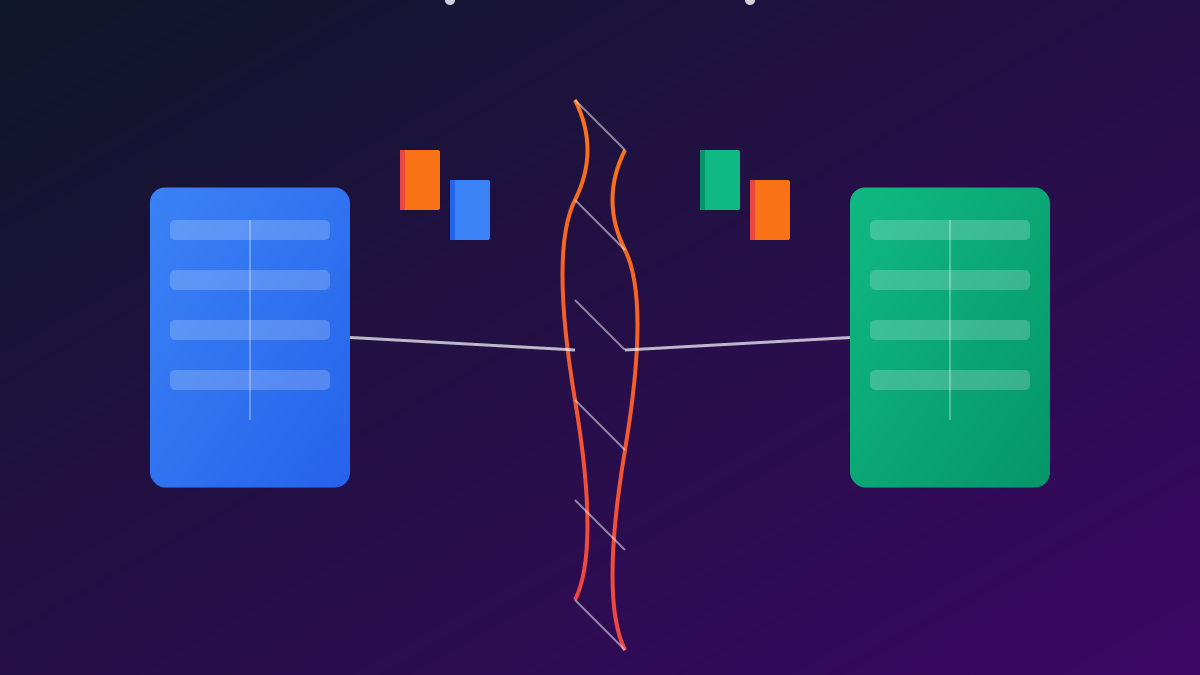
ReadingDNA is an innovative reading recommendation platform that builds a personal reading DNA by analyzing Goodreads reading history, and lets two large models—GPT-OSS 120B and GLM 4.7—duel in recommendations, visually showing which one understands your preferences better.

ReadingDNAGoodreads书籍推荐AI推荐系统GPT-OSSGLMCerebras大语言模型模型评估个性化推荐
Published 2026-07-13 06:51Recent activity 2026-07-13 07:01Estimated read 6 min
ReadingDNA: An Intelligent Recommendation System Where Two AI Models "Duel" for Your Reading Taste
1

Section 01

ReadingDNA Project Introduction: An Intelligent Reading Recommendation System Where Two AI Models Duel

ReadingDNA is an innovative reading recommendation platform that builds a personal reading DNA by analyzing Goodreads reading history, and lets two large models—GPT-OSS 120B and GLM 4.7—duel in recommendations, visually showing which one understands users better. It solves the "information cocoon" problem of traditional recommendation algorithms, making users active participants in evaluating AI performance.


2

Section 02

Project Background and Core Concepts

The creator of ReadingDNA is a technical project manager related to AI evaluation at Microsoft. The core question is "how two models reason differently given the same context and how to measure the differences". Traditional model evaluation relies on benchmark tests that are detached from real scenarios, while ReadingDNA embeds evaluation into practical applications: through real reading recommendation tasks, users can experience the differences in reasoning styles and quality between different models.

3

Section 03

System Workflow: A Closed Loop from Reading History to Recommendation Visualization

The system includes seven steps:

  1. Import a Goodreads public profile link or CSV file;
  2. Generate book embeddings using the local all-MiniLM-L6-v2 model, perform UMAP dimensionality reduction + KMeans clustering, and generate cluster labels with GPT-OSS;
  3. The two models independently recommend 5 books based on the reading profile, highlighting consensus and adventurous recommendations;
  4. Use D3.js interactive map to display the reading universe;
  5. Generate a shareable reading personality card;
  6. Optionally run Qwen 2.5 7B locally via Ollama as a third-party judge to evaluate recommendation quality;
  7. Query OverDrive/Libby library borrowing status.
4

Section 04

Technical Architecture and Unique Advantages of the Cerebras Platform

Tech stack: Frontend Next.js14 + TypeScript + Tailwind + D3.js; Backend FastAPI + Python; Embedding model all-MiniLM-L6-v2 (local); Dimensionality reduction and clustering UMAP + KMeans; Large models GPT-OSS120B and GLM4.7 from Cerebras Cloud; Evaluation model Qwen2.5 via Ollama. Cerebras wafer-scale chips eliminate memory bottlenecks: GPT-OSS120B takes a total of 1347ms, GLM4.7 takes 11759ms, showing significant optimization effects for dense models.

5

Section 05

Key Design Decisions: Balancing Reproducibility and User Experience

  1. Set temperature to 0 to ensure reproducible results;
  2. Local embeddings avoid latency costs;
  3. UMAP after book sorting ensures consistent map layout;
  4. Parse user_review tags from RSS to improve clustering quality;
  5. Optional evaluation function balances speed and depth requirements.
6

Section 06

Reading Personality System and Practical Value of Model Evaluation

ReadingDNA generates unique reading personalities (e.g., Emily May's "The Darkly Curious Intellectual") by integrating dimensions such as rating distribution and review themes. Model evaluation has perceptibility (users directly experience style differences), quantifiability (metrics like response time and consensus rate), and interpretability (with recommendation reasons attached). This approach can be extended to other personalized recommendation scenarios.

7

Section 07

Project Limitations and Future Improvement Directions

Limitations: Only supports Goodreads (threshold for Chinese users), language optimization is for English, local evaluation has high hardware requirements, and requires public Goodreads data. Improvements: Integrate Chinese platforms like Douban Books, enhance multilingual support, optimize evaluation costs, and improve privacy protection.

8

Section 08

Conclusion: Integration of Technological Innovation and User Experience

ReadingDNA not only solves the problem of "what book to read next" but also provides a window to observe differences between AI models. Users transform from passive recipients to active participants, making it a practical and interesting exploration tool suitable for reading enthusiasts and those interested in AI technology.