Zing Forum

Reading

RAGrade: An Intelligent Exam Grading System Based on RAG and LLM

RAGrade is an intelligent exam grading system that integrates OCR, RAG (Retrieval-Augmented Generation), and large language models, aiming to automate and enhance the fairness, transparency, and efficiency of academic assessments.

RAGLLMOCREducationAssessmentAI GradingExaminationRetrieval-Augmented Generation
Published 2026-06-14 15:12Recent activity 2026-06-14 15:23Estimated read 8 min
RAGrade: An Intelligent Exam Grading System Based on RAG and LLM
1

Section 01

【Introduction】RAGrade: An Intelligent Exam Grading System Based on RAG and LLM

RAGrade: An Intelligent Exam Grading System Based on RAG and LLM

RAGrade is an intelligent exam grading system that integrates OCR, RAG (Retrieval-Augmented Generation), and large language models, aiming to automate and enhance the fairness, transparency, and efficiency of academic assessments.

Project Source Information:

2

Section 02

Project Background and Motivation

Project Background and Motivation

Traditional exam grading faces many challenges: manual grading is time-consuming and labor-intensive, grading standards are hard to unify, subjective questions have evaluation biases, and the cost of organizing large-scale exams is high. With the expansion of education scale and the popularization of online exams, these problems have become more prominent.

The RAGrade project emerged to try to integrate OCR, RAG, and LLM technologies into a unified grading system to solve the above pain points. Its core vision is to make exam grading more fair, transparent, and efficient.

3

Section 03

Technical Architecture Analysis

Technical Architecture Analysis

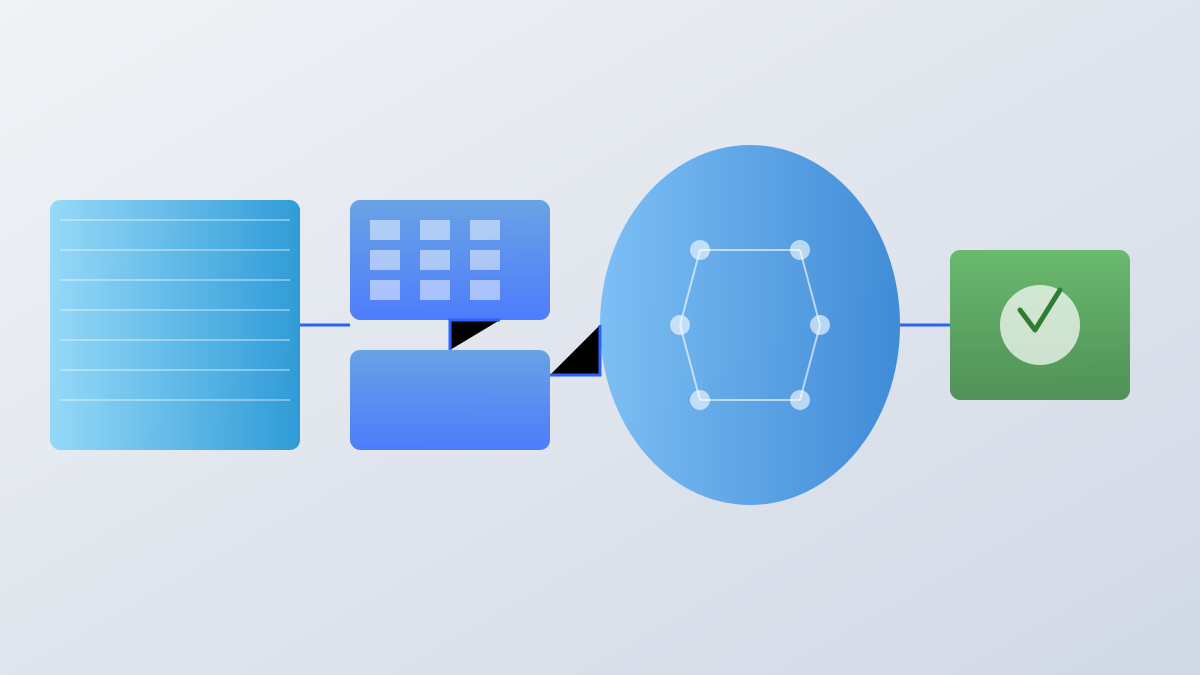
OCR Layer: Digitization of Handwritten Answers

Responsible for converting students' handwritten answer sheets into machine-readable text, handling various handwriting styles, paper quality, and shooting angles—it is the foundation for subsequent processing.

RAG Layer: Knowledge Retrieval and Context Enhancement

As the core innovation point, during grading, it retrieves standard answers, grading rules, and reference materials related to the questions, builds rich context, ensures the transparency and traceability of grading basis, and solves the "hallucination" problem of pure LLMs.

LLM Layer: Intelligent Grading and Feedback Generation

Responsible for final grading decisions and natural language feedback generation. Combining RAG context, it understands question requirements, evaluates the completeness and accuracy of answers, generates personalized improvement suggestions, and maintains consistent grading standards.

4

Section 04

Core Advantage Analysis

Core Advantage Analysis

Fairness Improvement

Eliminates human factors such as fatigue, emotion, and cognitive bias in manual grading, ensuring that each student is evaluated according to the same standard through standardized algorithms.

Transparency Enhancement

The RAG architecture provides interpretability, showing reference materials and reasoning processes based on which grades are given, and building trust in the AI grading system.

Efficiency Improvement

Processes a large number of answer sheets in a short time, shortens the score release cycle, and is suitable for scenarios requiring quick feedback such as mock exams and in-class quizzes.

Feedback Quality Optimization

Generates detailed text feedback, pointing out the advantages and disadvantages of answers and specific improvement suggestions, helping students learn and grow.

5

Section 05

Application Scenario Outlook

Application Scenario Outlook

  • Standardized Exams: Assists manual grading, improves efficiency, and serves as a quality control line (e.g., college entrance exams, civil service exams).
  • Daily Homework Assessment: Automatically corrects homework, saving teachers' time for teaching activities.
  • Language Learning Assessment: Provides consistent evaluation standards for language exams (writing, speech-to-text).
  • Professional Qualification Certification: Assists in the automated grading of written parts of various professional qualification exams.
6

Section 06

Technical Challenges and Considerations

Technical Challenges and Considerations

  • Accuracy Boundaries: Clarify the boundary of capabilities; edge cases (creative answers, unconventional solutions) require a manual review mechanism.
  • Data Privacy: Strictly protect students' sensitive information and establish compliance processes.
  • Technical Dependency: Avoid over-reliance, and establish backup and manual takeover mechanisms.
  • Fairness Disputes: Continuously audit and adjust algorithms to ensure no bias against specific groups.
7

Section 07

Project Significance and Industry Impact

Project Significance and Industry Impact

RAGrade represents an important direction of integration between educational technology and AI, demonstrating how LLMs combined with RAG can solve pain points in education.

Its design ideas emphasizing transparency, interpretability, and human-machine collaboration provide a reference framework for the responsible application of AI in education.

In the future, intelligent grading systems will play a more important role, but they should be positioned as auxiliary tools to achieve human-machine collaboration: AI handles large-scale standardized tasks, while humans focus on complex cases and system supervision. This makes educational assessment more efficient and fair, while retaining the warmth and depth of human education.



