Zing Forum

Reading

Intelligent Document Q&A System Based on RAG and Llama 3: Complete Implementation from PDF to Accurate Answers

This article introduces an open-source intelligent document Q&A system that combines Retrieval-Augmented Generation (RAG) technology with the Llama 3 large language model to enable intelligent parsing of PDF documents and natural language Q&A functionality. The article details the system architecture, technology selection, implementation process, and the key value of RAG technology in practical applications.

RAG检索增强生成Llama 3PDF问答向量数据库FAISSOllamaStreamlit文档智能大语言模型应用
Published 2026-06-14 17:45Recent activity 2026-06-14 17:49Estimated read 7 min
Intelligent Document Q&A System Based on RAG and Llama 3: Complete Implementation from PDF to Accurate Answers
1

Section 01

Introduction: Core Overview of the Intelligent Document Q&A System Based on RAG and Llama3

This article introduces an open-source intelligent document Q&A system maintained by siddhik15 (released on June 14, 2026, GitHub link: https://github.com/siddhik15/Intelligent-Document-Question-Answering-System-using-RAG-and-Large-Language-Models-). The system combines Retrieval-Augmented Generation (RAG) technology with the Llama3 large language model to implement intelligent parsing of PDF documents and natural language Q&A functionality. Its core goal is to address the limitations of traditional document retrieval and the "hallucination" problem of pure large language models, providing accurate and reliable answers. The key tech stack includes FAISS vector database, Ollama local model framework, Streamlit interactive interface, etc.


2

Section 02

Background: Emergence and Need for RAG Technology

In the era of information explosion, quickly extracting valuable information from documents has become a challenge. Traditional keyword retrieval struggles to understand users' true intentions; while pure large language models have strong language comprehension capabilities, they suffer from outdated knowledge and the "hallucination" problem. Retrieval-Augmented Generation (RAG) technology combines the accuracy of information retrieval with the flexibility of generative AI, allowing AI to refer to specific knowledge bases when answering, thus providing more accurate and reliable answers. This project is a typical application example of RAG technology.

3

Section 03

Project Overview: Core Functional Features

This Python-developed system supports users to upload PDF documents and obtain accurate answers through natural language questions. Core features include:

  1. PDF upload and parsing: automatically extract text content;
  2. Intelligent text chunking: split text fragments to adapt to vector retrieval;
  3. Semantic vector storage: use FAISS to store text embeddings for efficient similarity search;
  4. Context-aware Q&A: generate answers by combining retrieved fragments with Llama3;
  5. Interactive web interface: build a user-friendly visual interface based on Streamlit.
4

Section 04

Technical Architecture: Modular Design and Data Flow

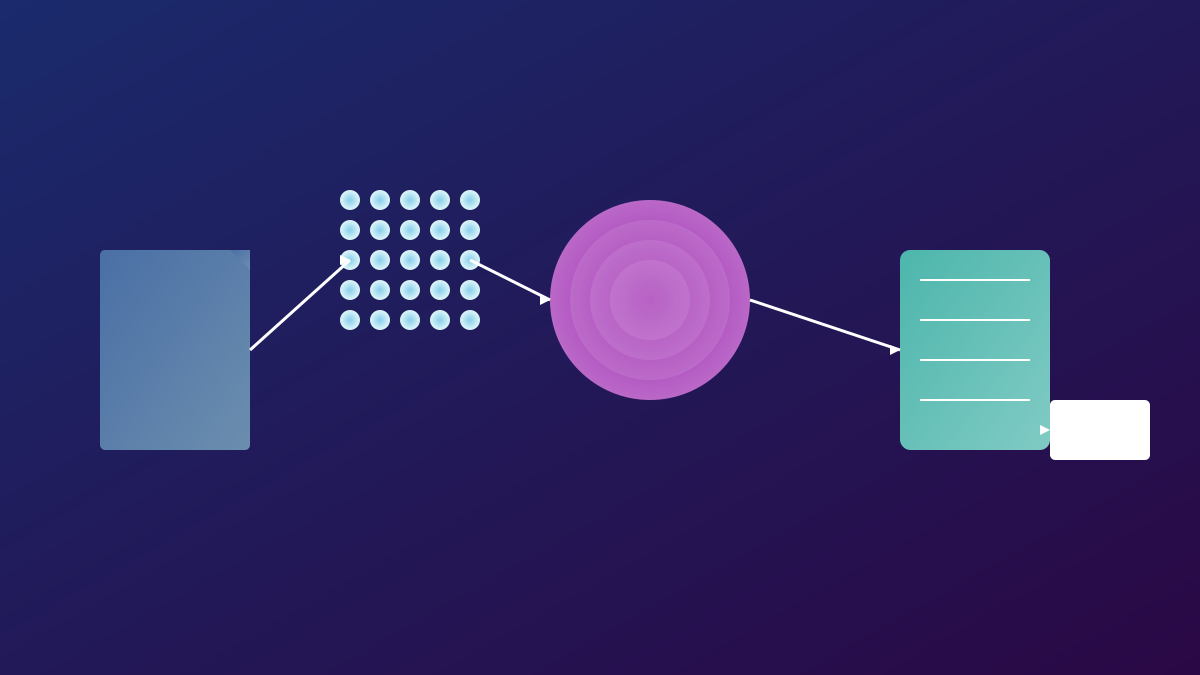
The system adopts a modular architecture, with core tech stack including Python, Streamlit, FAISS, Sentence Transformers, Ollama, Llama3, and Transformers. The data processing flow consists of 8 steps:

  1. Document upload;
  2. Text extraction;
  3. Text chunking;
  4. Embedding generation (Sentence Transformers);
  5. Vector storage (FAISS index);
  6. Query processing (convert question to vector);
  7. Semantic retrieval (FAISS finds relevant fragments);
  8. Answer generation (Llama3 generates answers combining context).
5

Section 05

Core Value and Advantages of RAG Technology

The RAG architecture has significant advantages over pure large language models:

  1. Solve knowledge timeliness: dynamically retrieve external knowledge bases, enabling answers to the latest document questions without retraining the model;
  2. Improve answer accuracy: use retrieved fragments as context to reduce "hallucinations" and ensure answers are evidence-based;
  3. Support domain customization: use internal enterprise documents as knowledge bases to meet professional scenario needs;
  4. Optimize cost-effectiveness: run Llama3 locally via Ollama to reduce cloud API costs, and vector retrieval reduces model input length, saving computing resources.
6

Section 06

Key Practice: Analysis of Technical Points

Key technical points in project practice:

  1. Text chunking strategy: balance context integrity and retrieval precision, avoid overly large or small chunks;
  2. Embedding model selection: use pre-trained models from Sentence Transformers to accurately capture text semantics;
  3. Vector database application: FAISS supports efficient approximate nearest neighbor search, quickly finding similar candidates among massive vectors to meet real-time Q&A needs.
7

Section 07

Future Directions and Summary Insights

Future improvement directions of the project include: multi-document support, conversation history and memory, source citation display, advanced chunking strategies (semantic segmentation, etc.), and cloud deployment. Summary: This project demonstrates the complete path of RAG technology from concept to practice, providing a reference implementation that developers can learn and expand on. For developers getting started with RAG, they can learn about RAG architecture, vector database applications, combination of LLM and knowledge bases, etc. RAG is expected to become the mainstream solution for enterprise knowledge management and intelligent customer service, and this project contributes valuable learning resources to the community.

