Zing Forum

Reading

Hands-On Multi-Modal RAG System: A Local Document Intelligent Q&A Solution Based on Qwen2-VL and CLIP

This article introduces an open-source multi-modal Retrieval-Augmented Generation (RAG) system that combines the Qwen2-VL vision-language model and CLIP encoder. It supports mixed text-image retrieval for PDF documents and provides a complete technical solution for building localized, privacy-controllable intelligent document Q&A systems.

多模态RAG视觉语言模型Qwen2-VLCLIP文档问答PDF处理向量检索本地部署Streamlit
Published 2026-07-13 04:09Recent activity 2026-07-13 04:29Estimated read 5 min
Hands-On Multi-Modal RAG System: A Local Document Intelligent Q&A Solution Based on Qwen2-VL and CLIP
1

Section 01

[Introduction] Hands-On Multi-Modal RAG System: A Local Document Intelligent Q&A Solution Based on Qwen2-VL and CLIP

The open-source multi-modal RAG system introduced in this article combines the Qwen2-VL vision-language model and CLIP encoder. It supports mixed text-image retrieval for PDF documents and provides a complete technical solution for localized, privacy-controllable intelligent document Q&A. The project is from GitHub, authored by dy1325577-ctrl, with the original project name MULTI-MODAL_RAG_SYSTEM.


2

Section 02

Background: Evolution and Challenges of RAG Technology

Traditional RAG systems mainly handle plain text content and ignore visual information such as charts and images in documents. Multi-modal RAG expands the boundaries of traditional RAG, enabling simultaneous processing of text and images, solving the retrieval problem of mixed text-image content, and improving the quality of document Q&A.

3

Section 03

Technical Architecture and Core Methods

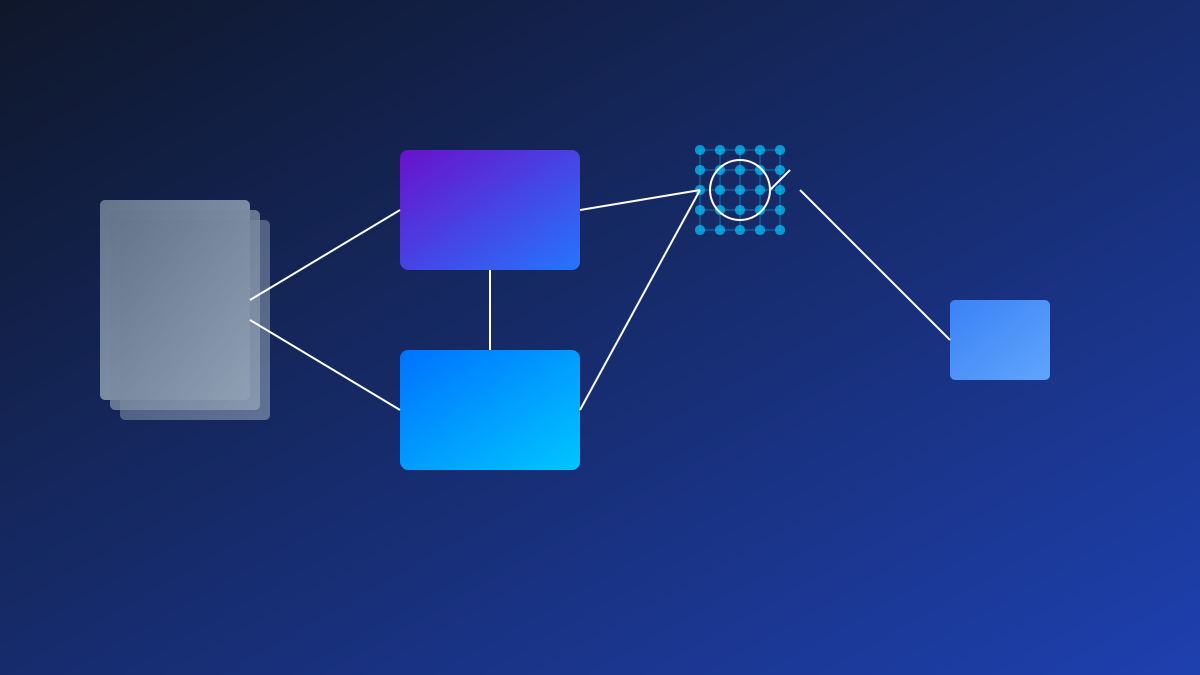
Core components include: Qwen2-VL (responsible for document understanding and answer generation), CLIP (multi-modal embedding and cross-modal retrieval), ChromaDB (vector storage and similarity search), and Streamlit (interactive interface). The system workflow is divided into the indexing phase (document parsing → content chunking → multi-modal embedding → vector storage) and the query phase (query encoding → mixed retrieval → context assembly → answer generation).

4

Section 04

Deployment and Usage Guide

The environment requires Python 3.8+ and dependencies such as PyTorch, Transformers, ChromaDB, and Streamlit. Installation steps: clone the repository → install requirements.txt → configure the .env file → launch the Streamlit app. Full local deployment is supported, no external API required.

5

Section 05

Application Scenarios

Applicable scenarios include technical document Q&A (understanding architecture diagrams), academic paper analysis (locating experimental charts), product manual queries (retrieving operation flowcharts), digitization of historical archives (processing scanned images), etc.

6

Section 06

Technical Advantages and Challenge Solutions

Advantages: Fully localized (friendly for privacy-sensitive scenarios), open-source ecosystem integration, highly customizable, and progressive adoption. Challenges and solutions: Text-image association (preserving spatial positional relationships), computational resource requirements (model quantization and multi-size selection), retrieval accuracy (CLIP unified embedding + re-ranking).

7

Section 07

Summary and Future Directions

The project provides a practical open-source solution for multi-modal document Q&A, suitable for mixed text-image document processing and privacy-sensitive scenarios. Future directions include model upgrades (integrating stronger VLMs), format expansion (supporting Word/PPT, etc.), advanced retrieval (mixed retrieval/multi-hop reasoning), and enhanced dialogue capabilities.