Zing Forum

Reading

RAG-based Intelligent Teaching Assistant: Let LLM Be Your Personal Tutor

An open-source AI teaching assistant project that combines large language models with custom learning materials using Retrieval-Augmented Generation (RAG) technology to provide intelligent answers to students' personalized questions.

RAG教育AI大语言模型智能问答开源项目个性化学习
Published 2026-05-17 03:15Recent activity 2026-05-17 03:21Estimated read 7 min
RAG-based Intelligent Teaching Assistant: Let LLM Be Your Personal Tutor
1

Section 01

【Introduction】RAG-based Intelligent Teaching Assistant: Let LLM Be Your Personal Tutor

The open-source AI teaching assistant project AI-teaching-Assistant uses RAG technology to combine large language models with custom learning materials. It addresses the problems of scattered materials in traditional education and the "hallucinations" often generated by general-purpose LLMs, enabling precise answers to students' personalized questions and allowing each student to have an AI tutor that understands their own course materials.


2

Section 02

Project Background and Educational Pain Points

In traditional education scenarios, students struggle to quickly locate relevant content among scattered learning materials (textbooks, lecture notes, PDFs, personal notes, etc.). While general-purpose large language models (such as ChatGPT and Claude) have strong question-answering capabilities, they lack deep understanding of specific course materials and are prone to "hallucinations", leading to answers that may not align with teaching content. RAG technology combines external knowledge retrieval with text generation, allowing AI to consult relevant materials before generating answers, significantly improving accuracy and credibility.

3

Section 03

Project Overview

AI-teaching-Assistant is an open-source intelligent teaching assistant project created by developer swayamprabha287. Students can upload learning materials such as PDF documents, class notes, and textbooks. The system automatically builds an index, and then students can ask questions in natural language to get precise answers based on these materials. Core design concept: Let each student have an AI tutor that "understands" their own course materials, distinguishing it from general-purpose chatbots.

4

Section 04

Technical Architecture and Core Mechanisms

How RAG Architecture Works

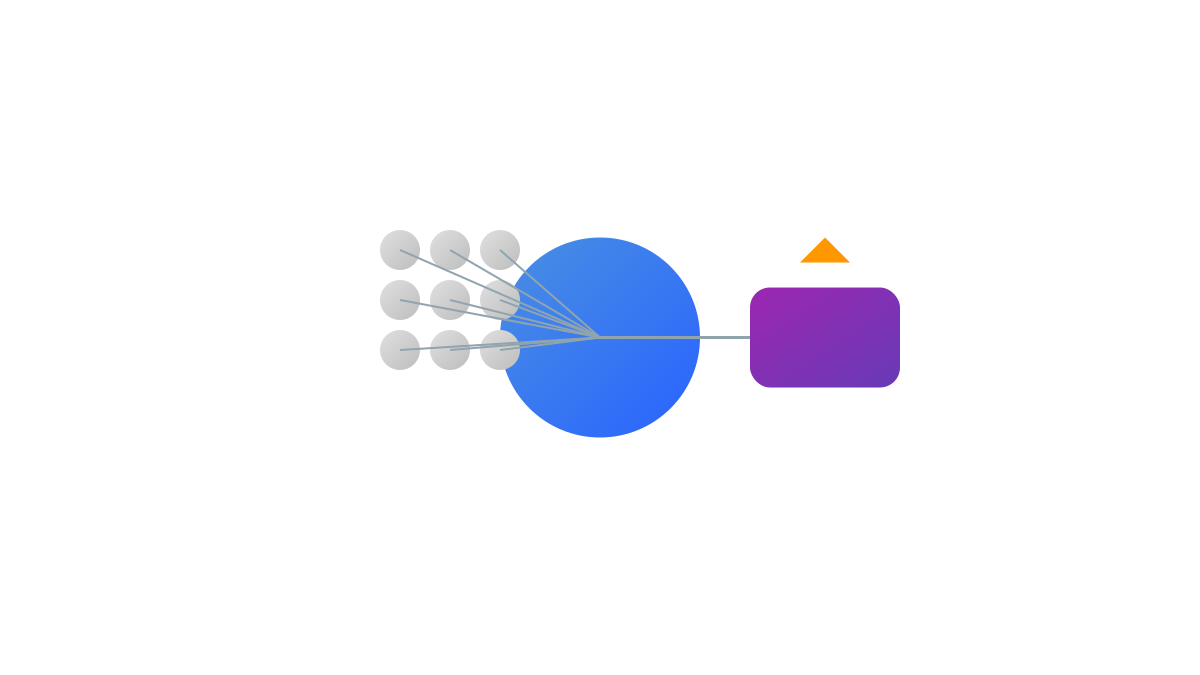
  1. Document Processing and Vectorization Module: Parse uploaded documents into text chunks, convert them into high-dimensional vectors using embedding models (such as OpenAI text-embedding-ada-002 or open-source Sentence-BERT), and store them in a vector database;
  2. Retrieval Module: Convert the student's question into a vector, then search the vector database for the most semantically relevant text fragments;
  3. Generation Module: Input the retrieved text fragments and the question into a large language model to generate a context-based answer.

Typical Tech Stack

  • Document loading: PyPDF2, pdfplumber, or LangChain document loaders;
  • Text splitting: Recursive character splitting or semantic splitting strategies;
  • Vector storage: FAISS, ChromaDB, or Pinecone;
  • Large model interfaces: OpenAI GPT series, Anthropic Claude, or open-source models (such as Llama, Mistral);
  • Web interface: Streamlit or Gradio.
5

Section 05

Application Scenarios and Practical Value

For Students

A 24/7 available intelligent question-answering partner that answers based on official course materials, avoiding misguidance from general AI, and solving problems related to review, concept understanding, homework, etc., in real time.

For Teachers

Reduces the burden of repetitive question-answering, allowing more energy to be invested in teaching design and high-value one-on-one tutoring.

For Educational Institutions

Scalable knowledge services that provide personalized learning support to a large number of students, realizing the popularization of high-quality educational resources.

6

Section 06

Project Limitations and Improvement Directions

  • Multimodal support: Extend to functions like handwritten note recognition and chart understanding;
  • Conversation memory: Add multi-turn conversation capabilities to understand references and continuous questions in context;
  • Answer traceability: Clearly mark which page or paragraph the answer comes from to facilitate students' verification;
  • Personalized learning path: Recommend relevant review content or advanced materials based on students' question history.
7

Section 07

Conclusion and Insights

The AI-teaching-Assistant project demonstrates the great potential of RAG technology in the education field, representing a new paradigm of personalized education through human-machine collaboration. With the advancement of large language models and retrieval technology, more similar tools will make high-quality education more accessible and efficient. For developers, this project is an introductory example of RAG technology, showing how to build a practical AI application with a simple architecture (document processing + vector retrieval + LLM generation), which is worth referencing.

