Zing Forum

Reading

RAG Forge: An Intelligent Tool for Systematic Evaluation of RAG Pipeline Configurations

This article introduces the RAG Forge project, an intelligent tool for systematically evaluating the effects of various chunking, embedding, and retrieval combinations in RAG (Retrieval-Augmented Generation) pipelines, helping developers find optimal configurations without manual testing.

RAGRetrieval-Augmented GenerationBenchmarkVector DatabaseEmbedding ModelsChunking StrategyInformation RetrievalLLM Evaluation
Published 2026-06-15 20:22Recent activity 2026-06-15 20:32Estimated read 8 min
RAG Forge: An Intelligent Tool for Systematic Evaluation of RAG Pipeline Configurations
1

Section 01

[Introduction] RAG Forge: An Intelligent Tool for Systematic Evaluation of RAG Pipeline Configurations

This article introduces the RAG Forge project, an intelligent tool for systematically evaluating the effects of various chunking, embedding, and retrieval combinations in RAG (Retrieval-Augmented Generation) pipelines, helping developers find optimal configurations without manual testing.

  • Original Author/Maintainer: Dyinu
  • Source Platform: GitHub
  • Original Title: rag-forge
  • Original Link: https://github.com/Dyinu/rag-forge
  • Source Publication/Update Date: 2026-06-15

Core Idea: By automating configuration combination testing and quantifying evaluation results, it solves the trial-and-error dilemma in RAG system configuration selection and promotes optimization from experience-driven to data-driven.


2

Section 02

Background: Configuration Dilemma of RAG Systems

Retrieval-Augmented Generation (RAG) is the mainstream architecture for enterprise-level LLM applications, which can combine external knowledge bases to reduce hallucinations. However, building high-performance RAG faces multiple configuration choices:

  • Document Chunking Strategies: Fixed-length, semantic, recursive, structure-aware
  • Embedding Models: OpenAI text-embedding-ada-002, Sentence-BERT, etc.
  • Retrieval Algorithms: Vector search, hybrid search, re-ranking
  • Parameter Tuning: Chunk size, overlap, top-k, etc.

These choices interact in complex ways; traditional trial-and-error is time-consuming and labor-intensive, making it hard to find the optimal combination.

3

Section 03

Core Solutions and Features of RAG Forge

RAG Forge solves configuration problems through systematic benchmarking, with core features including:

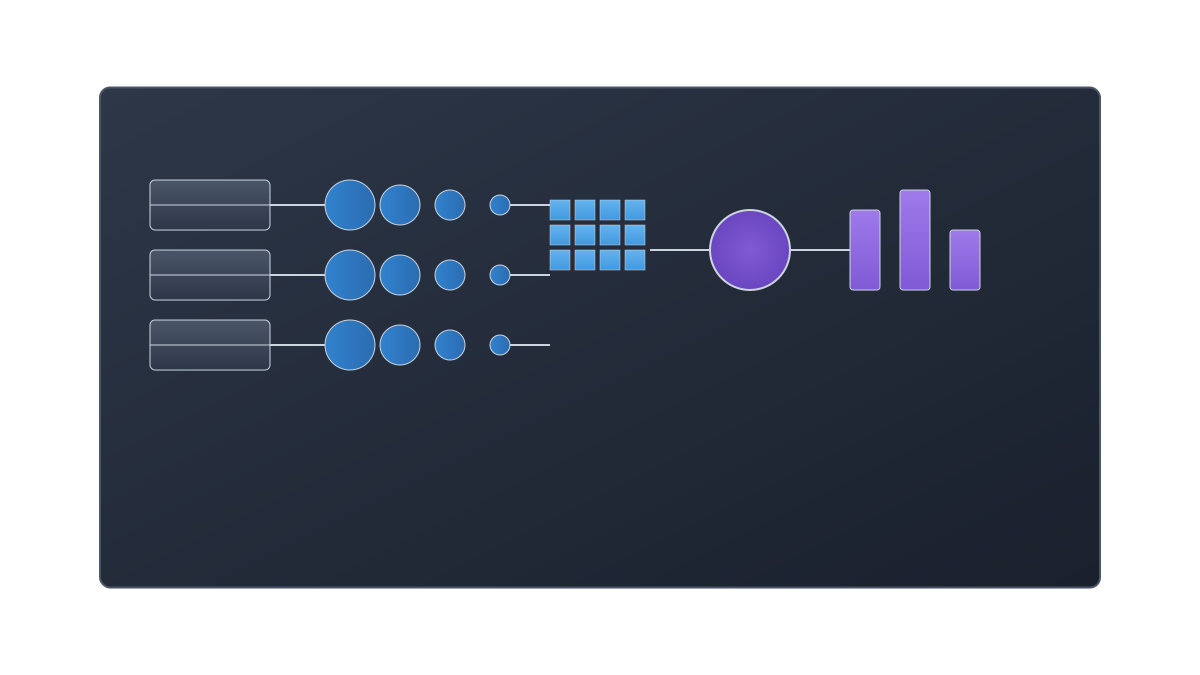
  1. Multi-dimensional Configuration Matrix: Automatically iterates through combinations of chunking, embedding, retrieval, etc.
  2. Automated Evaluation Workflow: Fully automated from preprocessing to evaluation.
  3. Multi-metric Evaluation: Retrieval accuracy, answer relevance, faithfulness, latency.
  4. Visualization Reports: Comparative reports and charts to intuitively show differences.

Core Idea: Let data speak instead of relying on empirical guesses.

4

Section 04

Technical Implementation Details

Document Processing Engine

Supports PDF/Word/Markdown formats, implements fixed-length, semantic, recursive, structure-aware chunking.

Embedding and Vector Storage

  • Embedding Models: OpenAI series, open-source Sentence-BERT, local HuggingFace models
  • Vector Databases: ChromaDB and ANN-compatible storage

Retrieval and Generation Pipeline

  • Retrieval Strategies: dense/sparse/hybrid retrieval, re-ranking
  • LLM Integration: Local (Ollama/vLLM) and cloud APIs (OpenAI/Anthropic)

Evaluation Framework

Built-in RAGAS metrics, supports manual annotation/synthetic/domain benchmark datasets.

5

Section 05

Application Scenarios and Tool Comparison

Application Scenarios

  • New project initiation: Quickly find baseline configurations
  • Existing system optimization: Identify bottlenecks
  • Technology selection: Objective data to support decisions
  • CI/CD integration: Automatically re-evaluate

Comparison with General RAG Frameworks

Feature RAG Forge General RAG Framework
Primary Goal Configuration evaluation and optimization Quick application building
Configuration Iteration Automatic testing Manual modification
Evaluation Metrics Multi-dimensional built-in Need to implement yourself
Visualization Comparative reports Basic logs
Applicable Stage Development and optimization Prototype deployment

Can be used complementarily with LangChain/LlamaIndex.

6

Section 06

Usage Examples and Best Practices

Usage Workflow

  1. Prepare test data (documents + Q&A pairs)
  2. Define configuration space
  3. Execute benchmark
  4. Analyze reports
  5. Migrate configurations to production

Best Practices

  • Start with a small configuration space and expand gradually
  • Test data should be representative
  • Balance effectiveness and performance metrics
  • Re-run benchmarks regularly (when models/data change)
7

Section 07

Limitations and Future Directions

Limitations

  • High computational resource requirements
  • Insufficient domain adaptability (mainly general metrics)
  • Dynamic data incremental benchmarking needs exploration

Future Directions

  • Introduce Bayesian optimization to reduce testing volume
  • Support multi-modal RAG evaluation
  • Build a community configuration knowledge base
8

Section 08

Conclusion

RAG Forge embodies the evolution of RAG technology from "usable" to "user-friendly", meets configuration optimization needs, helps developers shift from experience-driven to data-driven approaches, and is an important supplementary tool in the RAG ecosystem.

