Zing Forum

Reading

RAG Architecture-Based Intelligent Customer Service Bot: Application of Retrieval-Augmented Generation in Customer Support

This project implements an AI intelligent customer service bot based on the Retrieval-Augmented Generation (RAG) architecture. By combining information retrieval technology with large language models, the system can provide accurate, context-aware customer support responses based on domain-specific knowledge bases, addressing the issues of outdated knowledge and inaccurate responses in traditional customer service systems.

RAG智能客服检索增强生成聊天机器人大语言模型向量数据库知识库客户支持AI应用开源
Published 2026-04-25 19:12Recent activity 2026-04-25 19:23Estimated read 8 min
RAG Architecture-Based Intelligent Customer Service Bot: Application of Retrieval-Augmented Generation in Customer Support
1

Section 01

Introduction: Overview of the RAG Architecture-Based Intelligent Customer Service Bot Project

This article introduces an open-source intelligent customer service bot project based on the Retrieval-Augmented Generation (RAG) architecture, aiming to address issues like outdated knowledge and inaccurate responses in traditional customer service systems. By combining information retrieval with large language models, the project provides accurate, context-aware customer support, with advantages such as strong domain adaptability and traceability. It is applicable to various customer service scenarios and represents an important direction for enterprises to improve customer service efficiency.


2

Section 02

Background: Limitations of Traditional Customer Service Systems and RAG's Solutions

In the customer service field, traditional rule-based systems struggle to handle complex issues, while pure generative AI tends to produce "hallucinations". The RAG architecture-based intelligent customer service system, which combines retrieval and generation, has become an effective solution to this problem. The open-source project RAG-BASED-CUSTOMER-SUPPORT-BOT demonstrates its practical application value.

3

Section 03

Core Value of RAG Architecture and Project Technical Components

Core Value of RAG Architecture

RAG combines retrieval and generation, with advantages including:

  • Accuracy: Answers based on real documents
  • Timeliness: Updating the knowledge base reflects the latest information immediately
  • Traceability: Displays the original documents that the answer is based on
  • Domain Adaptability: Empowers general models through professional knowledge bases

Project Technical Components

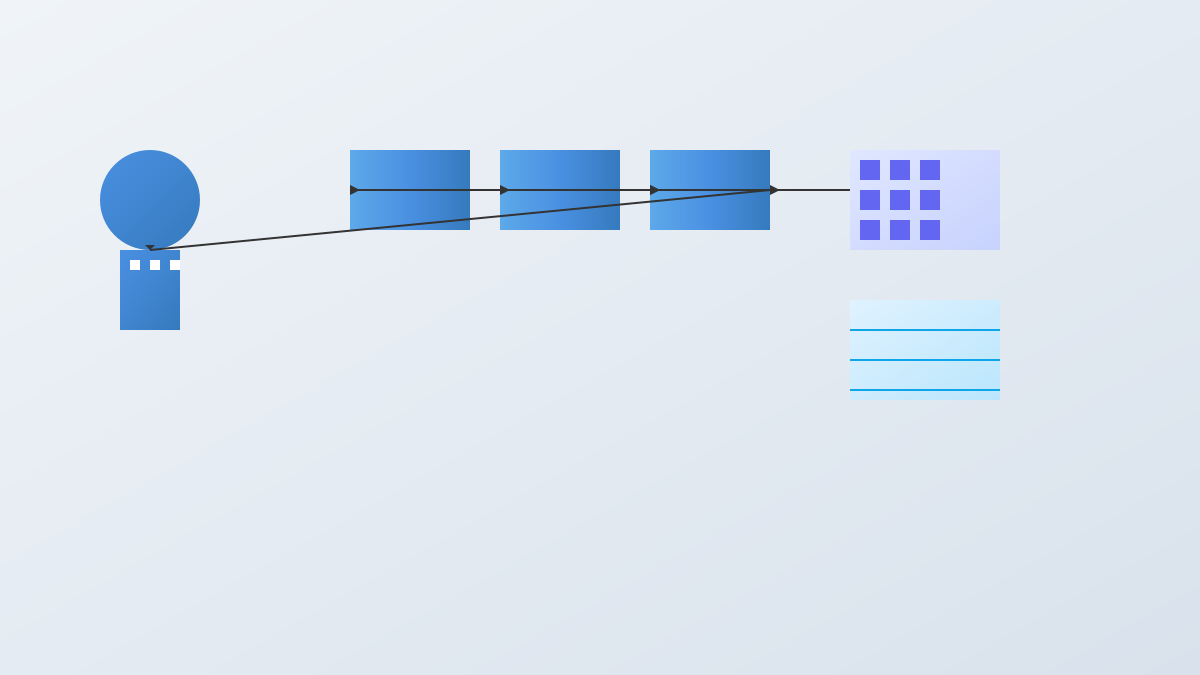
  • Document Processing and Vectorization: Preprocess enterprise documents (chunking, embedding) and store them in vector databases
  • Retrieval Engine: Recall relevant document fragments through vector similarity search
  • Generation Module: Generate responses by combining retrieval results and user queries
  • Dialogue Management: Maintain multi-turn conversation history to ensure coherence
4

Section 04

Application Scenarios and Advantages: Applicable Fields for RAG Customer Service Bots

RAG customer service bots are applicable to the following scenarios:

  • Product Technical Support: Answer technical questions based on product documents; updating the knowledge base enables grasping new product information
  • Enterprise Policy Consultation: Provide accurate information on HR policies, reimbursement processes, etc., to reduce HR workload
  • E-commerce Customer Service: Handle order inquiries, return/refund policies, etc., and provide personalized services combined with real-time data
  • Financial Services: Answer account questions and compliance requirements; traceability meets industry compliance standards
5

Section 05

Key Implementation Considerations: Points to Ensure RAG System Effectiveness

Knowledge Base Construction and Maintenance

  • Document Structuring: Convert unstructured documents into machine-readable formats
  • Chunking Strategy: Balance context integrity and noise control
  • Metadata Annotation: Add category, version, and other information to support filtering
  • Update Mechanism: Establish processes to ensure information timeliness

Retrieval Quality Optimization

  • Hybrid Retrieval: Combine vector similarity and keyword matching
  • Query Rewriting: Expand user queries to increase recall rate
  • Re-ranking: Refine the order of retrieval results
  • Multi-path Recall: Integrate results from different strategies

Generation Quality Control

  • Prompt Engineering: Guide the model to answer based on context
  • Citation Generation: Label information sources to enhance credibility
  • Refusal Strategy: Honestly inform users when unable to answer
  • Safety Filtering: Prevent harmful or sensitive content
6

Section 06

Open-Source Ecosystem and Toolchain: Lowering the Barrier to RAG System Construction

RAG technology relies on a rich set of open-source tools:

  • LangChain: Provides RAG process abstraction and component orchestration
  • LlamaIndex: Focuses on data connection and retrieval optimization
  • Haystack: End-to-end NLP search framework
  • Chroma/Weaviate/Milvus: Open-source vector databases These tools reduce the technical threshold for building RAG systems, facilitating rapid prototyping and production deployment.
7

Section 07

Challenges and Future Directions: Development Space for RAG Technology

The RAG architecture still faces the following challenges and development directions:

  • Multimodal RAG: Support embedding and retrieval of multi-modal content such as images and videos
  • Complex Reasoning: Solve complex problems through iterative retrieval or chain-of-thought
  • Personalization and Memory: Integrate user historical interactions to enhance experience
  • Evaluation and Monitoring: Improve evaluation and production monitoring mechanisms for retrieval and generation quality
8

Section 08

Conclusion: Value and Future Outlook of RAG Customer Service Bots

The RAG-BASED-CUSTOMER-SUPPORT-BOT project represents an important development direction for AI customer service. By combining the accuracy of retrieval and the flexibility of generation, it provides a reliable foundation for enterprise-level customer service systems. For enterprises, it can improve service efficiency and reduce costs; for developers, it is a practical direction for LLM applications. With technological progress, RAG customer service will become a standard configuration for enterprise AI applications, profoundly changing the way customer service is delivered.

