Zing Forum

Reading

Fully Localized Multimodal RAG Solution: Practical Implementation of Offline Document Intelligent Q&A System

A fully locally-run multimodal RAG tech stack that supports offline document Q&A for PDFs, DOCX files, and images, integrating OCR, image description, vector retrieval, and local large model generation.

RAG本地部署文档问答OCRFAISS多模态隐私保护
Published 2026-05-02 00:09Recent activity 2026-05-02 00:20Estimated read 7 min
Fully Localized Multimodal RAG Solution: Practical Implementation of Offline Document Intelligent Q&A System
1

Section 01

[Introduction] Fully Localized Multimodal RAG Solution: Practical Implementation of Offline Document Intelligent Q&A System

This project implements a fully locally-run multimodal RAG tech stack that supports offline document Q&A for PDFs, DOCX files, and images. It integrates OCR, image description, vector retrieval (FAISS), and local large model generation to address enterprise sensitive data privacy issues. No external APIs are required—all processing is done locally.


2

Section 02

Background: Why Do We Need a Fully Offline Document Q&A Solution?

Enterprise data security requirements are becoming increasingly strict. Industries such as finance, healthcare, and law have extremely high demands for data privacy, making it unacceptable to upload sensitive documents to the cloud for processing. The maturity of large language models and RAG technology has made intelligent document Q&A possible. This project aims to resolve this contradiction: building a multimodal document Q&A system in a fully offline environment to protect data privacy, avoid network latency, and eliminate API costs.

3

Section 03

Methodology: Comprehensive Analysis of System Architecture

The project implements a complete RAG tech stack with coordinated components:

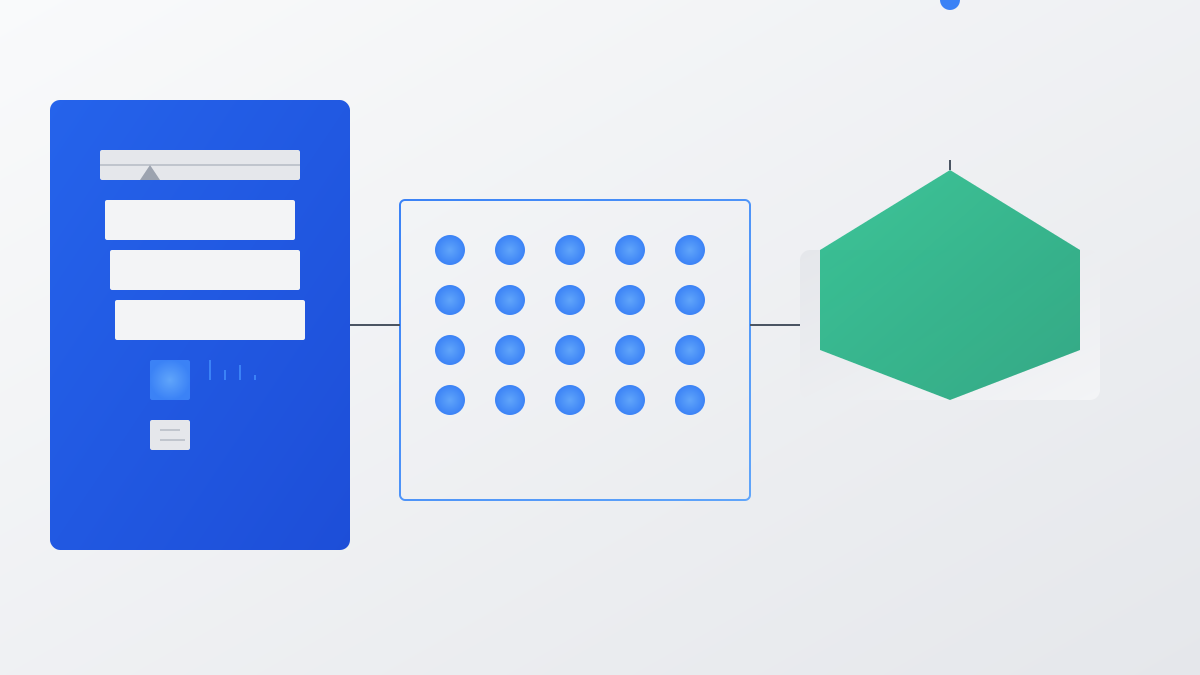
  1. Document Parsing Layer: Supports PDFs (OCR for extracting text from scanned documents), DOCX files (direct structural parsing), and images (image description models to understand visual content);
  2. Vectorization & Indexing: Text is split into sentence-level segments, converted to vectors via embedding models, and FAISS is used as the vector database;
  3. Generation Layer: Retrieved segments and user queries are input into a local causal language model to generate answers, with model parameters ranging from 7B to 70B selectable based on hardware.
4

Section 04

Methodology: Key Technical Implementation Details

  • OCR & Image Understanding: When processing scanned documents and images, OCR is used to extract text, and image description models are integrated to generate descriptions of visual content for retrieval, ensuring visual information such as charts is utilized;
  • Sentence-level Embedding Strategy: Sentence-level splitting is adopted for finer granularity to match user intent, and context window design solves the fragmentation problem;
  • FAISS Similarity Search: Leveraging FAISS's high-performance indexing, it completes million-level vector searches in milliseconds and supports incremental index updates, making it suitable for scenarios where the document library grows.
5

Section 05

Deployment Recommendations: Hardware Configuration Requirements

Basic Configuration (Individual/Small Team):CPU with 8+ cores, 16GB+ RAM, SSD storage, optional GPU (8GB+ VRAM); Enterprise Configuration (Large-scale Deployment):CPU with 16+ cores, 32GB+ RAM, GPU with 24GB+ VRAM (supports multi-card parallelism); Without a high-end GPU, it can run on CPU only, with reduced response speed, providing flexibility for users with different budgets.

6

Section 06

Application Scenarios & Value

Typical Application Scenarios:

  1. Enterprise Internal Knowledge Base: Unified indexing of technical documents, product manuals, etc., allowing employees to quickly obtain information via natural language queries;
  2. Legal Document Analysis: Law firms import judgments, contracts, etc., enabling lawyers to quickly locate clauses and precedents;
  3. Medical Literature Retrieval: Medical institutions build private knowledge bases to assist doctors in diagnosis and treatment decisions;
  4. Academic Research Assistant: Researchers import papers to quickly understand the current state of the field and related work.
7

Section 07

Comparison with Cloud-based Solutions

Advantages:Data is fully local, with the highest privacy and security; no API call costs; no network dependency, usable in intranets; no rate limits, scalable concurrency; Disadvantages:Requires self-provided hardware, high initial investment; local model capabilities are weaker than top cloud-based models; requires technical expertise for deployment and maintenance; For data-sensitive organizations, the privacy advantage is sufficient to offset the disadvantages.

8

Section 08

Summary & Outlook

This project provides a complete reference implementation for deploying intelligent document Q&A systems in offline environments, proving that fully localized multimodal RAG systems are feasible and reach production-ready levels. As local large model capabilities improve and hardware costs decrease, such solutions will become more competitive, and they are an important capability for enterprises that value data sovereignty in their digital transformation.

