Zing Forum

Reading

Multimodal RAG API: An Intelligent Retrieval-Augmented Generation System Unifying Text and Images

Introduces a multimodal RAG API project supporting text and image inputs, discussing its architectural design, vector embedding integration, and deployment strategies in practical applications.

多模态RAG向量嵌入图像检索LLMAPI设计知识管理
Published 2026-06-07 20:39Recent activity 2026-06-07 20:50Estimated read 7 min
Multimodal RAG API: An Intelligent Retrieval-Augmented Generation System Unifying Text and Images
1

Section 01

[Introduction] Multimodal RAG API: An Intelligent Retrieval-Augmented Generation System Unifying Text and Images

Multimodal-RAG-API is a scalable multimodal Retrieval-Augmented Generation (RAG) API project maintained by D-techno, with its source code hosted on GitHub. It combines vector embedding technology with large language models to support both text and image input forms, enabling cross-modal semantic retrieval and context-aware responses—marking an important evolution of RAG technology from a single text modality to multimodal fusion. This article will discuss its background, technical architecture, application scenarios, deployment considerations, and future outlook.


2

Section 02

Background: Why Do We Need Multimodal RAG?

Traditional RAG systems only process pure text data, but in real-world scenarios, information often exists in mixed text-image forms (such as document charts, product images, medical images, etc.). A single text modality cannot effectively utilize visual information, leading to one-sided retrieval. The core value of multimodal RAG lies in breaking modal barriers, allowing AI to comprehensively understand text and visual information like humans. For example, when a user asks about report trends, the system needs to read both text descriptions and chart data to give a complete answer.

3

Section 03

Technical Architecture: Implementation Methods of Multimodal RAG

Vector Embedding Layer

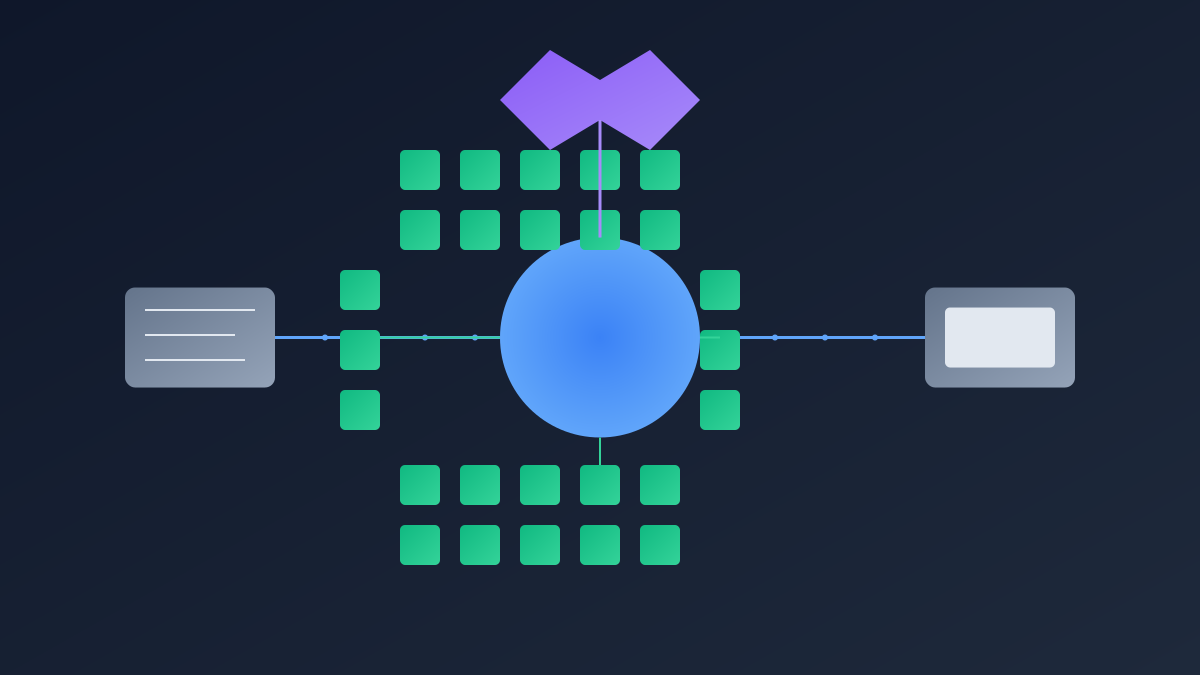
Adopt a unified strategy to map text and images to the same semantic space:

  • Text Encoding: Use pre-trained language models like BERT and Sentence-BERT to convert text into dense vectors
  • Image Encoding: Extract visual semantic features via multimodal models like CLIP and ALIGN
  • Vector Alignment: Share an embedding space to enable cross-modal semantic similarity calculation

Retrieval and Generation Pipeline

  1. Multimodal Index Construction: Automatically identify text blocks and image regions, supporting batch processing of mixed documents
  2. Cross-modal Retrieval: User queries trigger similarity searches of text and image vectors
  3. Context Fusion: Integrate multimodal context into a unified prompt input
  4. Response Generation: Large language models generate answers based on the fused context
4

Section 04

Application Scenarios: Practical Value of Multimodal RAG

Enterprise Knowledge Management

Assist employees in querying internally mixed text-image documents (product manuals, technical specifications, etc.) to quickly locate key information (text/charts)

E-commerce and Retail

Handle product Q&A, combining product description text and images to accurately answer questions about parameters, color effects, etc.

Medical Image Analysis

Assist doctors in retrieving similar cases, integrating text diagnoses and image features to improve diagnostic efficiency and accuracy

5

Section 05

Deployment and Scalability: Key Considerations for Implementation

The project design emphasizes scalability:

  • Horizontal Scaling: Vector databases and API services support cluster deployment to handle high concurrency
  • Model Hot Swap: Allow replacement of underlying embedding models and generation models
  • Incremental Update: Support real-time incremental indexing of document libraries without full reconstruction

Implementation Suggestions:

  1. Vector Database Selection: Choose Milvus, Pinecone, Weaviate, etc., based on data scale and query patterns
  2. Embedding Model Fine-tuning: General models need fine-tuning in specific domains to achieve optimal results
  3. Latency and Cost Balance: Design caching strategies to handle the high computational intensity of image encoding
6

Section 06

Summary and Outlook: Future Directions of Multimodal RAG

Multimodal-RAG-API represents the natural extension of RAG technology from text-only modality to text-image fusion. With the maturity of multimodal large models like GPT-4V, Claude3, and Gemini, such infrastructure will become more important. It is not only a directly deployable API service but also a reference implementation of the multimodal RAG architecture. In the future, with the integration of audio and video modalities, a true "full-modal RAG" system is expected to emerge.

Original Project Information:

