Zing Forum

Reading

Fully Local-Running RAG Assistant: A Private Knowledge Q&A System Without API Keys

A complete Retrieval-Augmented Generation (RAG) pipeline built on LangChain, ChromaDB, Sentence Transformers, and Ollama, enabling local large model knowledge Q&A with zero external dependencies.

RAG本地部署LangChainChromaDBOllama向量数据库大语言模型隐私保护知识问答
Published 2026-05-28 00:07Recent activity 2026-05-28 00:18Estimated read 7 min
Fully Local-Running RAG Assistant: A Private Knowledge Q&A System Without API Keys
1

Section 01

Introduction: Fully Local-Running Private RAG Knowledge Q&A System

The Local-RAG-Assistant introduced in this article is a fully local-running Retrieval-Augmented Generation (RAG) knowledge Q&A system built on LangChain, ChromaDB, Sentence Transformers, and Ollama, enabling private deployment with zero external dependencies. This system addresses data privacy, cost, and latency issues of cloud-based LLM services, allowing users to control all data in a local environment, suitable for enterprises, researchers, developers, and privacy-conscious individuals.


2

Section 02

Background: The Necessity of Localized RAG Systems

With the popularity of LLMs, cloud-based services have pain points such as sensitive data upload risks (unacceptable in industries like finance and healthcare), accumulated API call costs, and network latency limiting user experience. Localized RAG systems have emerged, allowing users to run the complete Q&A process locally without external APIs and fully control their data.

3

Section 03

Technical Architecture: Collaboration of Four Core Components

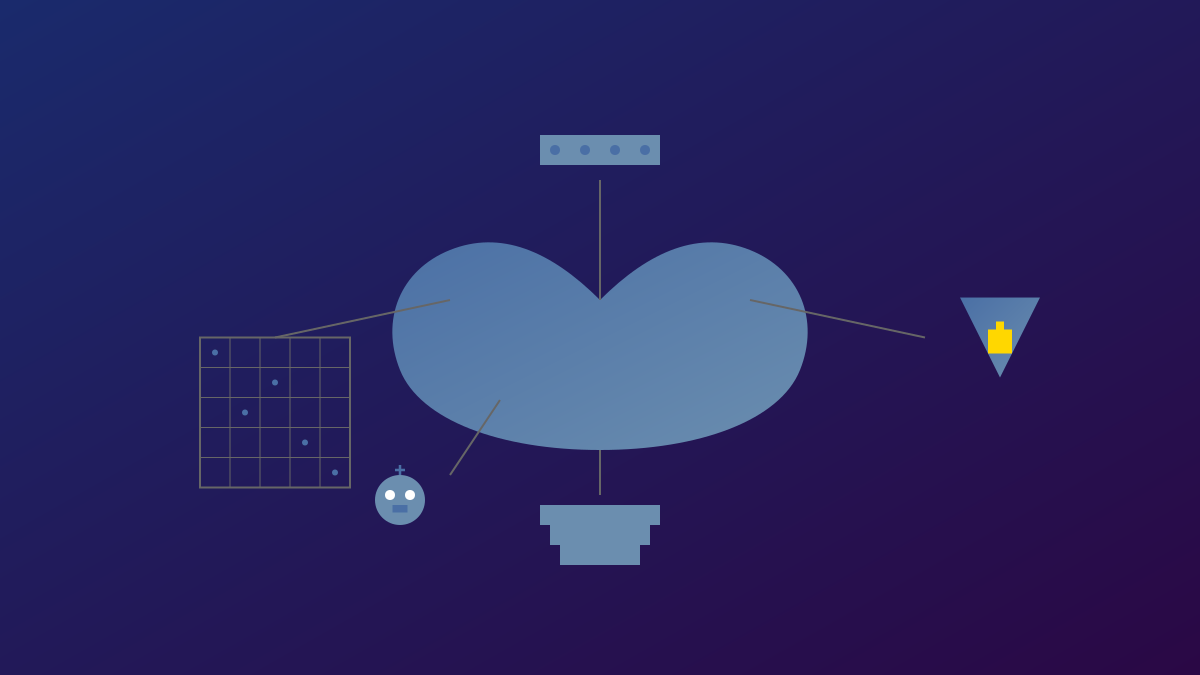
The technical architecture of Local-RAG-Assistant includes four core components:

  1. LangChain: As an orchestration framework, it coordinates document loading, text splitting, vector storage, and LLM interaction;
  2. ChromaDB: A lightweight embedded vector database that stores document vectors and supports similarity search;
  3. Sentence Transformers: Provides pre-trained embedding models to convert text into semantic vectors;
  4. Ollama: Simplifies local LLM operation, supports open-source models like Llama and Mistral, and offers command-line and API interfaces.
4

Section 04

Workflow: Complete Pipeline from Document to Intelligent Answer

The system workflow consists of six stages:

  1. Document Ingestion: Read PDF documents and extract text;
  2. Semantic Chunking: Split long text into semantically coherent short segments;
  3. Vector Embedding Generation: Convert text into vectors via Sentence Transformers;
  4. Vector Storage and Indexing: Store in ChromaDB to build a retrieval index;
  5. Query Processing and Retrieval: Convert user questions into vectors and search for similar document segments;
  6. Context-Enhanced Generation: Combine retrieved segments and the question to generate answers using the local LLM.
5

Section 05

Core Features: A Complete Set of RAG Functions

Core features include:

  • PDF document ingestion pipeline: Batch import PDFs and automatically extract text;
  • Semantic text chunking: Maintain paragraph integrity to improve retrieval quality;
  • Embedding vector generation: Support high-quality pre-trained models for multiple languages;
  • Persistent vector storage: ChromaDB local file storage ensures indexes are not lost;
  • Similarity retrieval: Cosine similarity search to locate relevant segments;
  • Local LLM execution: Generate answers without network connection;
  • LangChain integration: Standardized interfaces facilitate extension and customization.
6

Section 06

Application Scenarios: Practical Value Across Multiple Domains

Application scenarios include:

  • Enterprise users: Internal knowledge base Q&A with no risk of sensitive data leakage when querying confidential materials;
  • Researchers: Process academic papers in a private environment, suitable for analyzing unpublished results;
  • Developers: Example codebase for learning RAG architecture;
  • Individual users: Local AI assistant where conversation history never leaves the device.
7

Section 07

Deployment Recommendations and Outlook on Technical Limitations

Deployment recommendations:

  • Environment: Install Ollama and required models (e.g., Llama3, Mistral), and install Python dependencies (LangChain, ChromaDB, etc.);
  • Hardware: NVIDIA GPU is recommended to improve performance, with at least 8GB of memory, and storage depends on document scale;
  • Practice: Test with a small number of documents first, then scale up. Technical limitations: Local models are less capable than cloud-based ones, and low-end machines have slow response times; Future outlook: Progress in open-source models, optimization of quantization technology, and improvement of the local AI ecosystem.
8

Section 08

Conclusion: A Microcosm of AI Technology Democratization

Local-RAG-Assistant demonstrates a microcosm of AI technology democratization, allowing ordinary developers to build enterprise-level intelligent systems without relying on expensive cloud services or sacrificing privacy. For developers seeking to understand RAG principles or needing private deployment, it is an open-source project worth studying.

