Zing Forum

Reading

Deep Understanding of RAG: How Retrieval-Augmented Generation Revolutionizes LLM Applications

This article deeply analyzes the core principles, architectural design, and practical application scenarios of RAG (Retrieval-Augmented Generation) technology, explores how it solves the hallucination problem of large language models, and looks forward to the future development trends of RAG in AI application development.

RAG检索增强生成大语言模型LLM向量数据库知识库AI应用幻觉问题信息检索
Published 2026-04-18 04:14Recent activity 2026-04-18 04:18Estimated read 5 min
Deep Understanding of RAG: How Retrieval-Augmented Generation Revolutionizes LLM Applications
1

Section 01

[Introduction] RAG: The Retrieval-Augmented Generation Technology Revolutionizing LLM Applications

RAG (Retrieval-Augmented Generation) technology effectively solves the knowledge cutoff and hallucination problems of LLMs by integrating external knowledge bases with large language models (LLMs), while reducing deployment costs and improving answer transparency. This article will deeply analyze the principles, architecture, applications, and future trends of RAG to help readers fully understand this innovative technology.


2

Section 02

Limitations of LLMs: Knowledge Cutoff and Hallucination Problems

Large language models (such as GPT, Claude) have strong generation capabilities, but they have fundamental flaws: knowledge cutoff (inability to obtain real-time information or handle professional domain knowledge) and hallucination (fabricating incorrect content). These issues limit the reliable application of LLMs in real-world scenarios.

3

Section 03

Core Principles and Technical Architecture of RAG

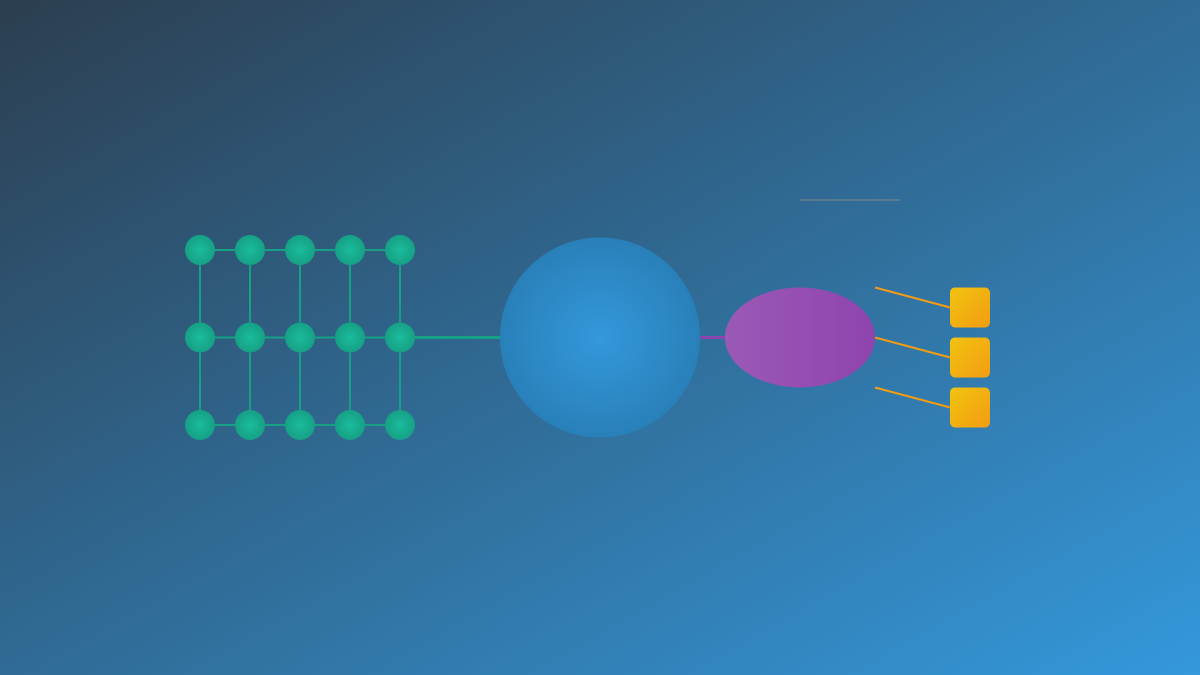
RAG is a framework that integrates retrieval systems with generative models. Its process consists of three steps: 1. Retrieval (finding relevant fragments from external knowledge bases); 2. Augmentation (integrating context and queries to construct prompts); 3. Generation (generating answers based on augmented prompts). Its architecture includes vector databases (storing semantic vectors), retrievers (searching for similar documents), re-rankers (filtering relevant fragments), and generators (LLMs generating answers), allowing the use of external knowledge without retraining the model.

4

Section 04

Practical Application Scenarios and Effects of RAG

RAG has been widely applied in scenarios such as enterprise knowledge management (integrating internal documents), customer service automation (accurately answering personalized questions), academic research (quickly retrieving literature), legal compliance (retrieving regulations and precedents), and medical assistance (integrating medical knowledge). It can eliminate hallucinations (providing traceable information), achieve real-time knowledge updates (only need to update the knowledge base), reduce deployment costs (no need to fine-tune the model), and improve answer transparency (displaying source documents).

5

Section 05

Optimization Strategies for RAG Systems

To optimize RAG performance, attention should be paid to strategies such as document splitting (semantic splitting, overlapping splitting, etc.), query optimization (expansion, rewriting, HyDE), multi-path retrieval fusion (sparse-dense hybrid, multi-vector representation), and context compression (filtering redundancy, summary compression) to improve retrieval accuracy and generation quality.

6

Section 06

Future Development Directions of RAG

RAG will develop in the following directions in the future: integration with Agent technology (actively planning multi-step retrieval), multi-modal RAG (processing images/videos, etc.), graph-augmented RAG (combining knowledge graphs), and end-to-end optimization (jointly optimizing retrieval and generation) to further improve system performance.

7

Section 07

Value and Outlook of RAG

RAG retains the flexibility of LLMs, solves pain points such as accuracy and timeliness, provides developers with a low-threshold path for AI applications, and activates knowledge assets for enterprises. With technological progress, RAG will become a standard feature of enterprise software and change the way information is obtained.

