Zing Forum

Reading

RAG: Retrieval-Augmented Generation Practice—How to Give Large Models "Memory"

This article deeply analyzes the core principles and implementation methods of RAG (Retrieval-Augmented Generation) technology, exploring how to inject external knowledge into large language models through vector databases and semantic search to solve the problems of model hallucinations and knowledge timeliness.

RAG检索增强生成向量数据库语义搜索大模型LLMEmbedding知识库人工智能
Published 2026-05-09 22:15Recent activity 2026-05-09 22:23Estimated read 7 min
RAG: Retrieval-Augmented Generation Practice—How to Give Large Models "Memory"
1

Section 01

【Introduction】RAG Technology: A Key Solution to Give Large Models an 'External Brain'

This article focuses on the practice of RAG (Retrieval-Augmented Generation) technology, analyzing its core principles and implementation methods. RAG injects external knowledge into large models through vector databases and semantic search, solving the problems of model knowledge cutoff (unable to access real-time/private knowledge) and hallucinations. It turns large models from 'closed-book exams' to 'open-book exams', improving the accuracy and credibility of answers, and is an important technology for enterprise-level AI implementation.


2

Section 02

Background: The 'Amnesia' and Hallucination Dilemmas of Large Models

Although large language models (LLMs) excel in natural language processing capabilities, they have fundamental limitations: knowledge cutoff (only remembers training data, no real-time/private knowledge) and hallucinations (easily 'talk nonsense' on questions outside training data). For example, asking ChatGPT about yesterday's new technology or internal enterprise documents will either result in no knowledge or wrong answers, restricting the implementation of enterprise-level applications.

3

Section 03

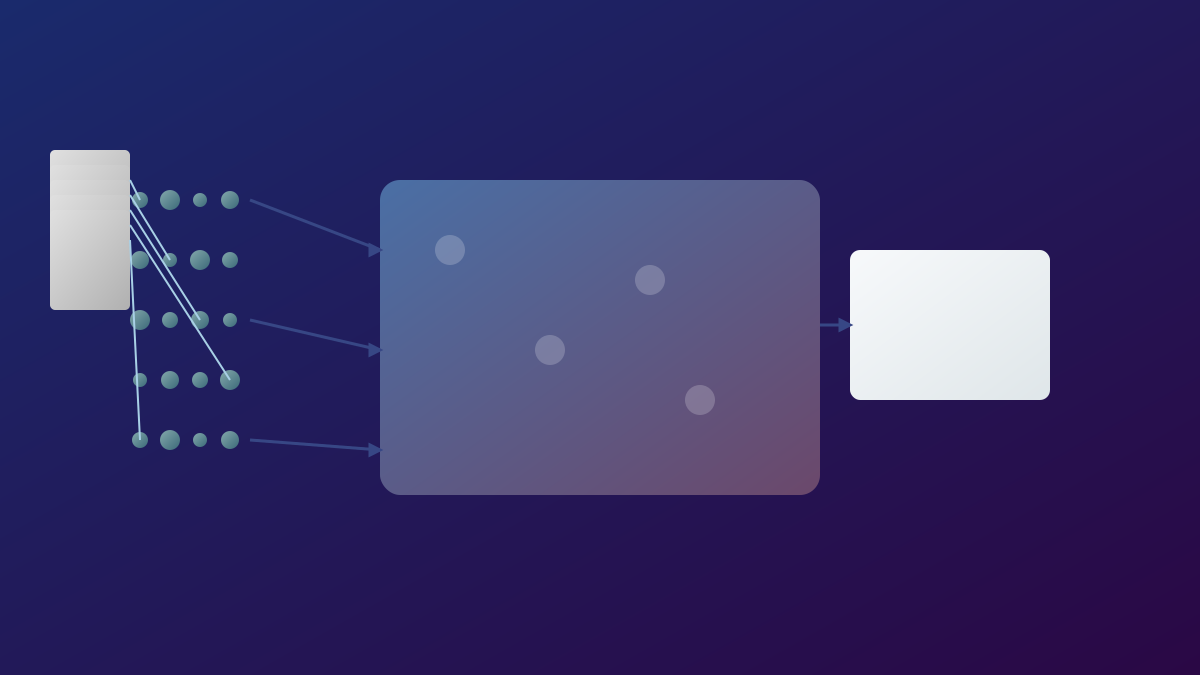
RAG Technology Architecture: Analysis of Three-Layer Structure

A complete RAG system includes three core components:

1. Index Layer

Convert external knowledge into retrievable vectors: Document segmentation (text chunks ensuring semantic integrity) → Embedding encoding (convert to high-dimensional vectors using Embedding models) → Vector storage (store in vector databases like Pinecone/Weaviate).

2. Retrieval Layer

When a user asks a question: Query to vector → Similarity search in vector database → Return Top-K relevant fragments (semantic understanding is better than keyword search).

3. Generation Layer

The large model generates answers by receiving the original question + retrieved context. Advantages: Traceable (clear sources), timeliness (no retraining needed when updating the knowledge base), domain adaptation (access to private data), and cost-controllable (avoids fine-tuning costs).

4

Section 04

Practical Points: Core Strategies for Building an Efficient RAG System

Text Segmentation Strategy

Segmentation granularity affects retrieval quality: Fixed character count, semantic boundaries (paragraphs/sentences), overlapping segmentation (ensures context coherence).

Embedding Model Selection

For Chinese scenarios, considerations include: Chinese semantic support, vector dimensions (768/1536 dimensions), speed and cost.

Retrieval Optimization

Combine hybrid search (keyword + vector), re-ranking (secondary screening), query rewriting (improve recall rate).

Prompt Engineering

Prompt templates need to clearly answer based on materials, handle cases of insufficient materials, and specify output formats (e.g., citing sources).

5

Section 05

Application Scenarios: Implementation Domains of RAG Technology

RAG has been applied in multiple domains:

  • Enterprise knowledge base Q&A: Employees query company documents/rules and regulations;
  • Customer service robots: Accurate responses based on product manuals;
  • Legal/medical assistants: Provide references based on professional literature (manual review required);
  • Code assistants: Retrieve code snippets to assist programming;
  • Research report analysis: Quickly extract key information from massive reports.
6

Section 06

Limitations and Prospects: Shortcomings and Future Directions of RAG Technology

RAG is not a panacea:

  • Retrieval failure: May still hallucinate when no relevant materials exist;
  • Context length limitation: Model input upper limit cannot accommodate too much material;
  • Multi-hop reasoning: Struggles with cross-document reasoning for complex problems.

Advanced directions: Agentic RAG (multi-step retrieval by agents), Graph RAG (combining knowledge graphs), etc.

7

Section 07

Conclusion: Paradigm Shift and Implementation Value of RAG

RAG represents a paradigm shift: from 'bigger and stronger models' to 'smarter use of models'. Large models don't have to know everything; they just need to know how to find knowledge to become useful tools. For enterprises and developers, mastering RAG is a must-have course for AI implementation.

