Zing Forum

Reading

Medical RAG Engine: Enterprise-Grade Clinical Document Intelligent Processing System

Explore an enterprise-grade on-premises RAG system for medical scenarios, supporting OCR document recognition, Retrieval-Augmented Generation (RAG), and streaming inference, providing a solution for hospital data privacy protection.

医疗AIRAG临床文档OCR本地部署数据隐私企业级病历管理
Published 2026-05-16 20:12Recent activity 2026-05-16 20:21Estimated read 7 min
Medical RAG Engine: Enterprise-Grade Clinical Document Intelligent Processing System
1

Section 01

Introduction to Medical RAG Engine: Enterprise-Grade Clinical Document Intelligent Processing System

This article introduces an enterprise-grade on-premises RAG system for medical scenarios, integrating core capabilities such as OCR document recognition, Retrieval-Augmented Generation (RAG), and streaming inference. It addresses medical data privacy compliance challenges, supports intelligent clinical document processing, and provides hospitals with a localized data security solution.


2

Section 02

Medical AI Needs and Compliance Dilemmas of Cloud Deployment

The medical industry has extensive demands for AI (e.g., medical record analysis, auxiliary diagnosis, drug development), but the sensitivity of medical data leads to strict compliance challenges for cloud deployment (such as HIPAA, GDPR). On-premises deployment has become a key direction to balance AI applications and data security.

3

Section 03

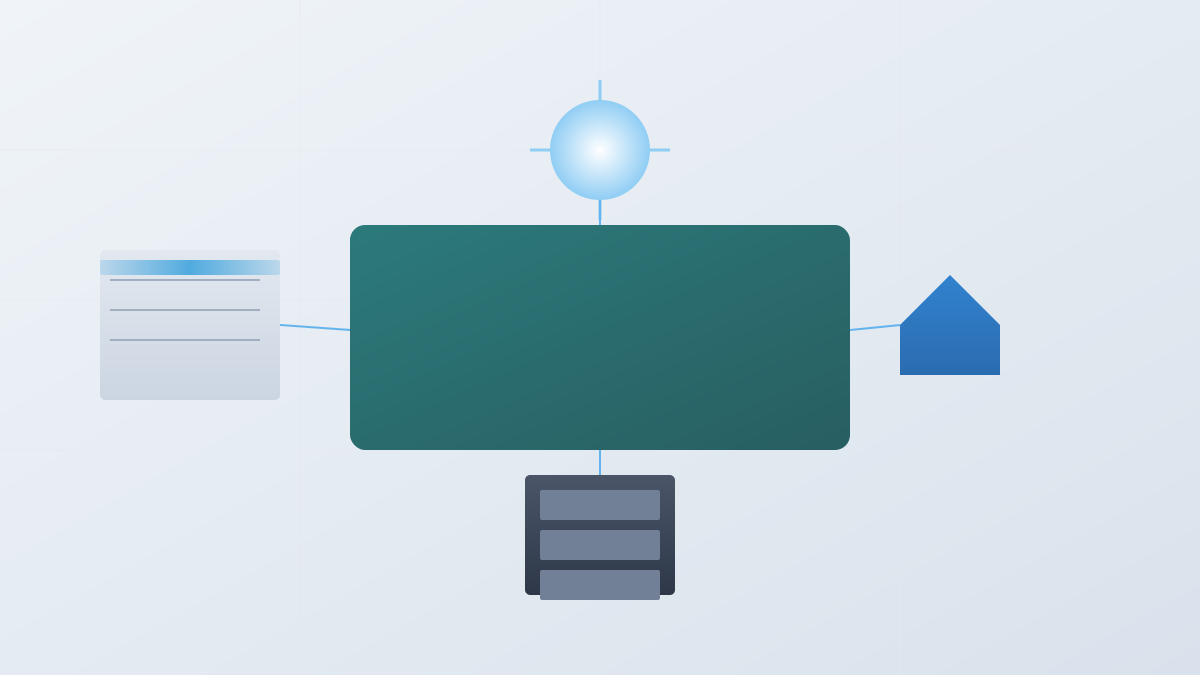
System Architecture and Core Technical Highlights

Modular Architecture

  • Document Ingestion Layer: Supports multi-format input, optimizes OCR recognition for medical documents
  • Knowledge Index Layer: Text segmentation, vectorization, and incremental updates
  • Retrieval Engine: Hybrid retrieval strategy (vector + keyword), supports accurate recall of medical terms
  • Generation Service: Streaming output from local large models, RAG technology enhances answer traceability
  • Orchestration Management: Model scheduling and concurrency control

Medical Scenario Adaptation

  • OCR Optimization: Fine-tuned for handwritten content, special symbols, and complex tables
  • Medical Term Processing: Built-in dictionaries and code mapping (ICD, SNOMED CT)
  • On-premises Deployment: All components run locally, data does not leave the domain
  • Streaming Inference: Improves waiting experience for long-document Q&A
4

Section 04

Core Application Scenario Examples

  1. Medical Record Summary Generation: Automatically extracts key information to generate structured patient summaries
  2. Similar Case Retrieval: Matches historical cases based on symptoms/examination results
  3. Drug Interaction Query: Answers contraindication questions by combining medication history and literature
  4. Clinical Guideline Q&A: Interactive query of internal hospital protocols
  5. Scientific Literature Retrieval: Quickly locates relevant medical research progress
5

Section 05

Data Security and Compliance Assurance Measures

  • Data Does Not Leave the Domain: All processing is done locally, eliminating leakage risks
  • Access Control: Role-based permission management to limit data access scope
  • Audit Logs: Complete records of query and access behaviors to meet compliance audits
  • Data Encryption: Dual encryption protection for static/transmitted data
6

Section 06

Deployment Modes and Scalability Solutions

Deployment Modes

  • Standalone Deployment: Suitable for small clinics/department-level applications
  • Cluster Deployment: Distributed architecture supports hospital-level large-scale processing
  • Hybrid Cloud: Sensitive data processed locally, non-sensitive tasks elastically scaled

Scalability

  • Microservice architecture, each component can be independently scaled horizontally
  • Vector database, inference service, and OCR engine can be dynamically expanded
7

Section 07

System Limitations and Challenges

  1. Medical Accuracy: AI outputs need to be reviewed by professional medical staff and cannot replace clinical judgment
  2. Data Quality Dependence: RAG effectiveness depends on the quality and update frequency of the knowledge base
  3. Resource Requirements: Local large model inference requires sufficient GPU hardware investment
  4. Integration Complexity: Customized development is required for integration with existing HIS/EMR systems
8

Section 08

Industry Significance and Future Outlook

This system represents an important direction for on-premises medical AI deployment, proving that large model technology can create value under privacy protection. In the future, it will integrate multimodal image understanding capabilities to achieve unified retrieval of text/images/laboratory reports; deeply integrate with electronic medical record systems to become an assistant for medical staff's daily work. It provides an open-source starting point for secure AI applications in medical institutions.

