Zing Forum

Reading

Qwen2-Mobile-LLM: A Lightweight Solution for On-Device Large Model Inference

An on-device LLM inference framework built with Flutter and llama.cpp, supporting the execution of quantized GGUF models on Android devices to deliver a fully offline intelligent conversation experience.

端侧推理大语言模型Flutterllama.cpp模型量化移动AI
Published 2026-04-13 03:10Recent activity 2026-04-13 03:24Estimated read 7 min
Qwen2-Mobile-LLM: A Lightweight Solution for On-Device Large Model Inference
1

Section 01

Introduction: Qwen2-Mobile-LLM—A Lightweight Solution for On-Device Large Model Inference

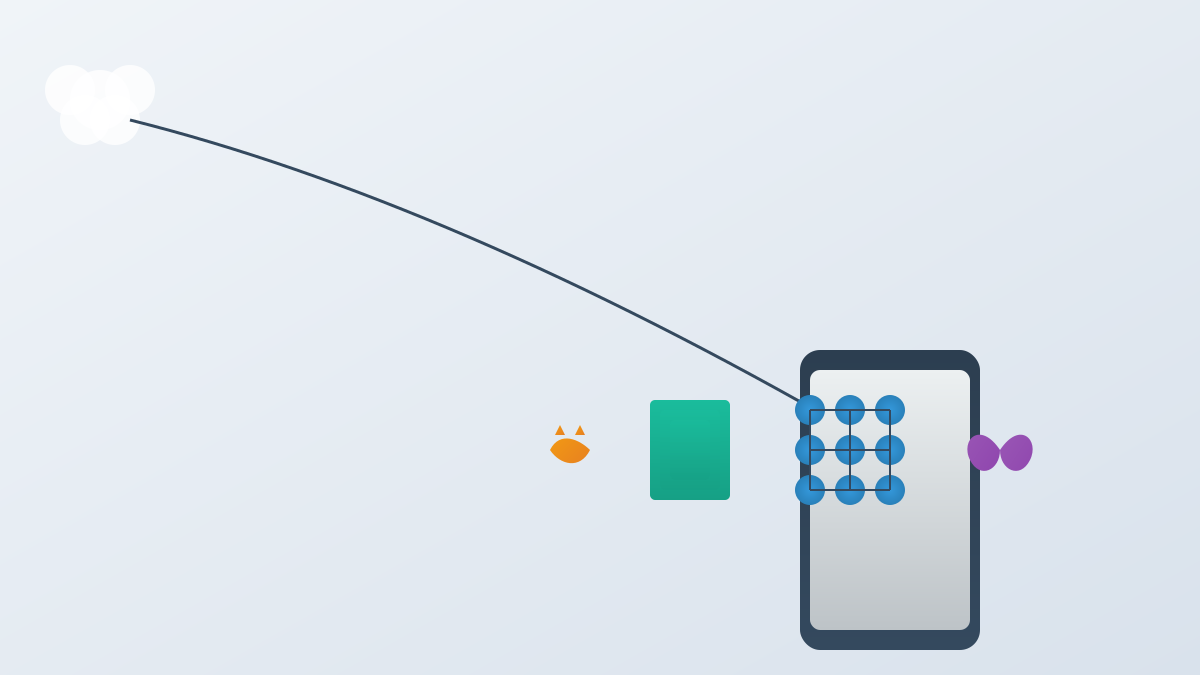
Qwen2-Mobile-LLM is an on-device LLM inference framework built with Flutter and llama.cpp. It supports running quantized GGUF models on Android devices to achieve a fully offline intelligent conversation experience. Addressing the resource constraints of on-device inference, this project provides users with AI services that offer better privacy protection and faster response times through cross-platform architecture and quantization optimization, making it an important practical case for on-device large language model applications.


2

Section 02

Background: The Rise and Challenges of On-Device AI

With the improvement of LLM capabilities, on-device inference has gained attention due to its advantages such as privacy protection, no network dependency, and low latency. However, it faces challenges like limited computing/memory/storage resources of mobile devices and battery life constraints. Cloud-based inference has issues like privacy leaks, network dependency, and high costs. On-device inference needs to break through these limitations through technological innovations such as model quantization, inference optimization, and cross-platform frameworks.

3

Section 03

Methodology: Cross-Domain Architecture Design with Flutter and llama.cpp

The project adopts a combination of Flutter (cross-platform UI) and llama.cpp (high-performance C++ inference engine): Flutter enables one codebase to support both Android and iOS; llama.cpp achieves efficient inference through optimized code and quantization schemes. The core goal is to deploy Qwen2 series models, convert them to GGUF format (the standard format for llama.cpp), and enable fully offline operation on Android devices.

4

Section 04

Technical Implementation: Key Paths for Quantization and Inference

Model Quantization

Compress the volume of FP32 models via GGUF format quantization (e.g., Q4_K_M/Q5_K_M); a 7B model can be compressed to 4-5GB. The imatrix quantization of llama.cpp uses importance matrix differentiation to balance compression ratio and quality.

Cross-Platform Binding

Call the C API of llama.cpp via Dart FFI to implement functions like model loading and inference execution, which requires handling memory management and data type conversion.

Mobile Optimization

Use memory mapping/chunked loading to reduce RAM usage, and optimize the NEON instruction set for ARM architecture to accelerate matrix operations.

5

Section 05

Application Scenarios: Practical Value of Offline AI

  • Privacy-sensitive scenarios: In fields like medical care, psychology, and legal consultation, data does not leave the device, eliminating leakage risks.
  • Network-constrained environments: Usable on planes, subways, or remote areas, meeting the need for information access anytime.
  • Real-time interaction needs: Eliminates network latency, improving experiences in scenarios like voice assistants and real-time translation.
  • Cost control: One-time deployment replaces frequent API calls, reducing costs in the long run.
6

Section 06

Technical Limitations and Future Outlook

Limitations: Supported model sizes are limited (7B and below), inference speed needs improvement, and long-context/multimodal capabilities are not fully implemented. Future Directions: More aggressive quantization (binarization), dedicated NPU acceleration, on-device model architecture optimization, and hybrid inference mode (local + cloud collaboration).

7

Section 07

Insights for Developers

This project proves the feasibility of running LLMs on devices and provides a reference for Chinese developers (leveraging Qwen2's advantages in Chinese). The choice of tech stack (Flutter + llama.cpp) reduces development costs while ensuring inference efficiency, offering a reusable path for similar projects.

8

Section 08

Conclusion: A New Chapter for On-Device AI

Qwen2-Mobile-LLM is an important milestone in on-device LLM applications, marking its transition from concept to practical use. With the improvement of model efficiency and hardware advancements, the capability boundary of on-device LLMs will expand, bringing users more private, fast, and reliable experiences, and creating possibilities for new product forms and business models for developers.

