Zing Forum

Reading

QSTN: A Robust Modular Framework for Questionnaire Inference Using Large Language Models

QSTN is a modular framework specifically designed for robust questionnaire inference using large language models, providing an automated solution for questionnaire data processing and analysis in social science research.

QSTN问卷推理大语言模型社会科学研究文本分析自动编码开放式问题稳健性模块化框架
Published 2026-05-07 20:10Recent activity 2026-05-07 20:23Estimated read 10 min
QSTN: A Robust Modular Framework for Questionnaire Inference Using Large Language Models
1

Section 01

[Introduction] QSTN: A Robust Modular Framework for Questionnaire Inference Using Large Language Models

QSTN (Questionnaire Inference with LLMs) is a modular framework dedicated to robust questionnaire inference using large language models, offering an automated solution for questionnaire data processing and analysis in social science research. Its core features include: Modular architecture (flexible combination and expansion), Robustness priority (addressing noise and ambiguity), Interpretability (outputting reasoning process explanations), Reproducibility (deterministic configurations ensuring consistent results). It aims to solve problems in traditional questionnaire processing such as data complexity, coding consistency, scale limitations, and multilingual challenges.


2

Section 02

Research Background and Challenges

Questionnaires are a core method for data collection in fields like social science, market research, and public health, but traditional processing faces multiple challenges:

Data Complexity: Open-ended responses are unstructured, containing typos, abbreviations, and other variations, making them hard to handle with simple rules; Coding Consistency: Manual coding has inter-coder consistency issues, affecting reliability; Scale Limitations: Manual processing of large-scale survey data is costly and time-consuming; Multilingual Challenges: Cross-country studies require separate coding teams for each language.

The emergence of large language models provides new possibilities to address these issues, and the QSTN framework is designed to systematically integrate LLM capabilities.

3

Section 03

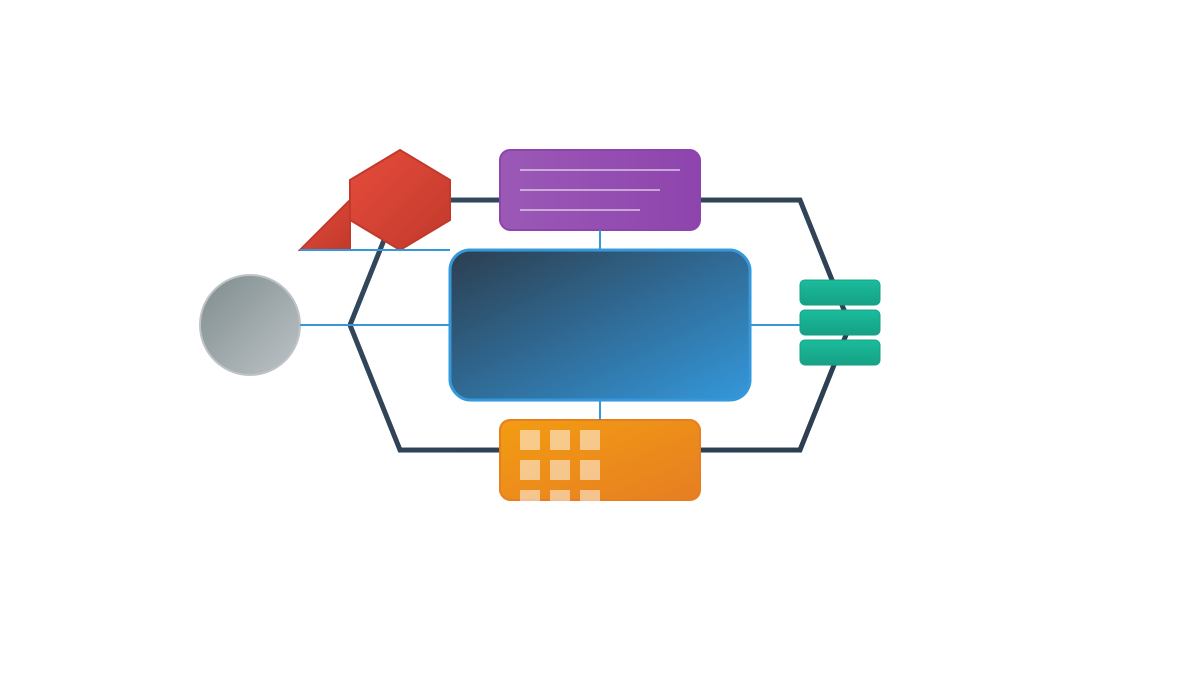
QSTN Framework Design and Core Modules

QSTN Framework Design Principles

  • Modular Architecture: Composed of independent components that can be flexibly combined, replaced, or expanded;
  • Robustness Priority: Built-in strategies to handle noise, variations, and ambiguity in questionnaire data;
  • Interpretability: Outputs reasoning process explanations for verification and auditing;
  • Reproducibility: Deterministic configurations and seed settings ensure the same input produces the same output.

Detailed Explanation of Core Modules

  1. Preprocessing Module: Text cleaning, language detection, optional spell correction, standardization;
  2. Prompt Engineering Module: Template system, few-shot learning, chain-of-thought, multi-turn dialogue;
  3. Inference Engine Module: Multi-model support, batch processing, error handling, cost optimization;
  4. Post-processing Module: Output parsing, format validation, confidence scoring, anomaly detection;
  5. Consistency Module: Self-consistency (select consistent answers from multiple samples), multi-model validation, manual verification interface.
4

Section 04

Typical Application Scenarios

Scenario 1: Open-ended Question Coding

Traditional practice involves manual theme induction and coding. QSTN solution: Define coding categories → Provide labeled examples → Auto-classify → Output results with confidence and explanations.

Scenario 2: Sentiment Analysis

Extract sentiment tendency (positive/negative/neutral), specific objects, key arguments, and generate sentiment intensity and confidence scores.

Scenario 3: Topic Modeling

Automatically identify topics → Cluster similar topics → Generate summaries → Quantify topic distribution.

Scenario 4: Multilingual Research

Automatically detect language → Unified processing with multilingual LLMs → Output standardized coding results → Generate comparative analysis of sub-samples in each language.

5

Section 05

Robustness Strategies

Prompt Robustification

  • Instruction Diversity: Use multiple phrasings to express the same instruction;
  • Negative Examples: Include common error examples to guide the model to avoid mistakes;
  • Explicit Constraints: Clearly define output formats and constraints.

Output Validation

  • Format Check: Verify compliance with expected formats like JSON;
  • Range Check: Ensure values are within reasonable ranges;
  • Consistency Check: Ensure logical consistency between input and output.

Uncertainty Quantification

  • Confidence Estimation: Based on model probability distribution;
  • Entropy Analysis: Mark high-entropy outputs as uncertain;
  • Divergence Detection: Mark cases where multiple samples are inconsistent.
6

Section 06

Usage Workflow and Tool Comparison

Usage Workflow

Quick Start: Install dependencies → Configure API key → Prepare data → Define task (config file) → Run inference → Review results (manual review of low-confidence samples). Advanced Configuration: Customize prompt templates, multi-model validation, integrate manual review, export results to tools like SPSS/R/Python.

Comparison with Existing Tools

Feature QSTN Traditional Text Analysis Other LLM Tools
Questionnaire-specific Optimization Yes No Limited
Robustness Strategies Rich Limited Basic
Interpretability Strong Medium Limited
Modularity High Low Medium
Academic Reproducibility High High Medium
7

Section 07

Limitations and Considerations

Model Dependency

Inference quality depends on the capabilities of the underlying LLM; choose the appropriate model based on the task.

Cost Considerations

Large-scale data inference may incur high API costs. Suggestions: Batch processing to reduce costs, reduce repeated sampling for high-confidence samples, use local open-source models.

Privacy Compliance

Questionnaire data may contain sensitive information; need to comply with regulations like GDPR: Data desensitization, local model deployment, sign data processing agreements.

Manual Supervision

Retain manual review for key decisions, especially in high-value/high-risk research.

8

Section 08

Summary and Outlook

QSTN provides a professional, robust, and scalable solution for automated questionnaire data inference. Through its modular architecture and optimization for questionnaire scenarios, it helps researchers efficiently process large-scale open-ended questionnaire data while maintaining the interpretability and reproducibility required for academic research.

With the advancement of LLM technology, QSTN will support more complex inference tasks in the future and become an important part of the social science research toolbox.

