Zing Forum

Reading

Qaithon: A Python Toolkit Combining Large Language Models with Quantum Computing

A high-level Python toolkit that allows developers to run PyTorch and HuggingFace models directly on real quantum and photonic hardware, supporting multiple quantum computing platforms such as IBM, Quandela, and AWS QuEra.

量子计算大语言模型PyTorchHuggingFace量子机器学习光子计算AI框架Python工具包
Published 2026-05-31 00:47Recent activity 2026-05-31 00:50Estimated read 7 min
Qaithon: A Python Toolkit Combining Large Language Models with Quantum Computing
1

Section 01

Qaithon Project Introduction: A Python Toolkit Combining Large Language Models with Quantum Computing

Qaithon is a high-level Python toolkit designed to combine large language models (such as HuggingFace models) with quantum computing, enabling developers to run models directly on real quantum/photonic hardware using PyTorch. Its core advantage is the "compile-and-replace" design—developers do not need a quantum background; they only need to add one line of compilation code to migrate existing PyTorch projects to quantum platforms. Currently supporting multiple platforms like IBM, Quandela, and AWS QuEra, it is in the pre-release phase (MIT license) and provides a smooth migration path for AI-quantum integration. The original author is fabian-bautista, and the project is open-sourced on GitHub (link: https://github.com/fabian-bautista/qaithon), with an update date of 2026-05-30.


2

Section 02

Project Background and Motivation

The intersection of quantum computing and AI is a research hotspot, but their combination faces challenges: traditional quantum machine learning frameworks require a deep background in quantum physics, and different hardware APIs have large differences, making cross-platform development difficult. Qaithon was born to address this pain point, allowing developers familiar with PyTorch/HuggingFace to deploy Transformer models to real quantum hardware without needing low-level quantum knowledge.

3

Section 03

Core Features and Design Philosophy

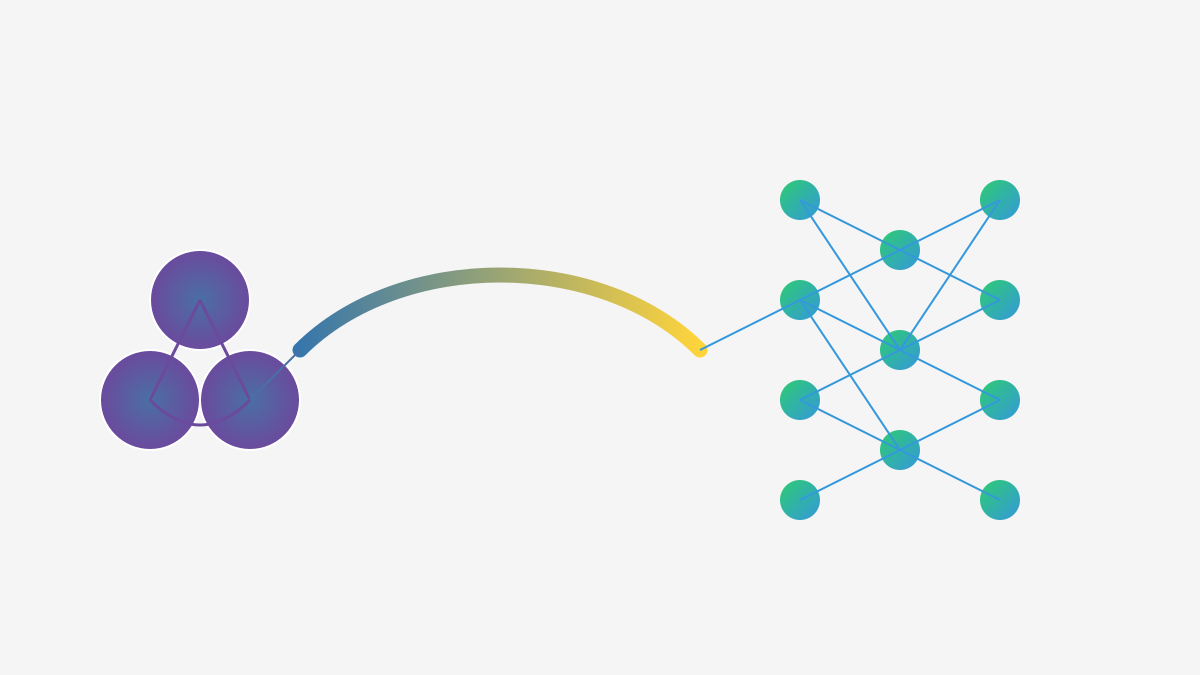
Qaithon's design philosophy is "compile-and-replace": developers write regular PyTorch code, and after calling qaithon.compile(model), the framework automatically traverses the network structure, replaces replaceable linear layers with quantum/photonic algorithm versions, and returns the same nn.Module object. Its biggest advantage is zero-learning-cost migration—no need to learn quantum languages/frameworks; just one line of code allows the model to run on quantum hardware.

4

Section 04

Supported Quantum Computing Platforms

Qaithon currently supports multiple mainstream quantum backends: IBM Quantum (superconducting qubits), Quandela (photonic computing), AWS QuEra (cloud quantum service), IonQ (ion trap), PennyLane (quantum ML framework), and DeepQuantum (simulation platform). Multi-backend support allows developers to switch platforms freely, compare performance characteristics, and no need to rewrite code.

5

Section 05

Technical Implementation Details

Qaithon intercepts PyTorch linear layer operations through a hook mechanism and redirects them to quantum algorithm implementations. Steps: 1. Analyze input matrix dimensions; 2. Select appropriate quantum algorithms (e.g., VQE, QAOA); 3. Convert classical matrix multiplication to quantum gate sequences; 4. Execute on the target hardware and return results. It has been verified on real QPUs; although its scale is smaller than modern LLMs, it provides an honest and reproducible starting point for AI-quantum integration.

6

Section 06

Application Scenarios and Value

Although large-scale quantum inference requires hardware development, Qaithon already provides value in the following scenarios: 1. Quantum algorithm prototype verification: quickly verify feasibility; 2. Hybrid classical-quantum model development: build hybrid architectures where some layers run on quantum hardware; 3. Quantum hardware benchmarking: unified API simplifies cross-platform performance comparison; 4. Education and learning: provides a zero-threshold quantum experiment environment for AI practitioners.

7

Section 07

Project Status and Outlook

Qaithon is in the pre-alpha stage with high test coverage, open-sourced under the MIT license, and encourages community contributions. As quantum hardware (number of qubits, coherence time) improves, Qaithon paves the way for large-scale quantum ML applications, allowing developers to lay the groundwork in advance and embrace the era of quantum advantage.

8

Section 08

Conclusion

Qaithon represents a pragmatic direction for AI-quantum integration—it does not seek to immediately replace classical computing, but instead provides a smooth migration path for developers to gradually explore the quantum paradigm. For researchers and engineers concerned with future computing architectures, this is a project worth paying attention to.

