Zing Forum

Reading

QA-Z: Building a Deterministic Quality Assurance System for AI Programming Agents

This article introduces the qa-z open-source project, a quality assurance framework specifically designed for AI programming agents. It provides deterministic QA gates, repair packets, and verification workflows to help improve the reliability and maintainability of AI-generated code.

AI coding agentquality assurancedeterministicgithubcode verificationCI/CD
Published 2026-05-07 16:15Recent activity 2026-05-07 16:19Estimated read 8 min
QA-Z: Building a Deterministic Quality Assurance System for AI Programming Agents
1

Section 01

Introduction: QA-Z — A Deterministic Quality Assurance System for AI Programming Agents

QA-Z: Building a Deterministic Quality Assurance System for AI Programming Agents

This article introduces the qa-z open-source project, a quality assurance framework specifically designed for AI programming agents. It provides deterministic QA gates, repair packets, and verification workflows to help improve the reliability and maintainability of AI-generated code. The project aims to address the quality control challenges of AI-generated code and provide a structured quality assurance mechanism for AI programming agents.

2

Section 02

Quality Dilemmas of AI Programming Agents

Quality Dilemmas of AI Programming Agents

With the breakthroughs of large language models in code generation, AI programming assistants and autonomous coding agents are transforming software development paradigms. However, quality control of AI-generated code has become a key challenge—models may produce code that is syntactically correct but logically flawed, or introduce hard-to-detect defects in complex projects. Traditional software testing methods struggle to adapt to the dynamic and uncertain nature of AI-generated code, creating an urgent need for specialized quality assurance mechanisms tailored to AI programming agents.

3

Section 03

Overview of the QA-Z Project

Overview of the QA-Z Project

qa-z is an open-source project developed by the qazedhq team, focusing on building a deterministic quality assurance system for AI programming agents. The 'Z' in the project name implies its pursuit of the highest (Zenith) quality standards, while the core design philosophy is to convert uncertainty into manageable quality risks through structured QA gates, automated repair packets, and verification workflows.

4

Section 04

Analysis of QA-Z Core Components

Analysis of QA-Z Core Components

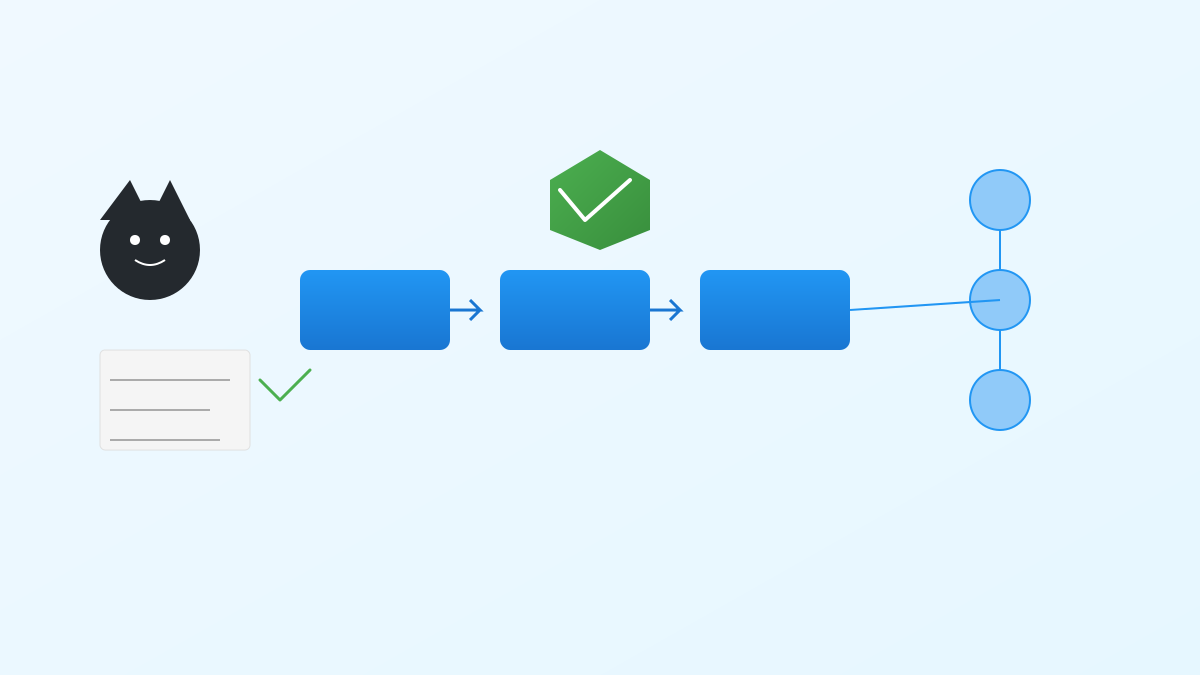
Deterministic QA Gates

QA gates are the entry criteria for code to enter the next development phase. Unlike traditional manual reviews, qa-z's QA gates are fully automated and produce reproducible results. The system defines a series of preset check rules, including code style consistency, static analysis warnings, unit test coverage thresholds, etc. Only code that passes all gate checks is allowed to be merged or deployed. This mechanism ensures that AI-generated code meets the basic quality baseline.

Repair Packets System

When QA gates detect issues, qa-z not only reports errors but also provides 'repair packets'—structured repair suggestions and automated patches. A repair packet includes problem description, root cause analysis, proposed modification plan, and confidence score. For AI programming agents, repair packets can be directly fed back to the model for iterative improvement, forming a closed-loop optimization process of 'generate-detect-repair'.

Verification Workflows

The project supports configurable verification workflows, allowing teams to customize quality check processes according to project characteristics. Workflows can combine multiple verification tools such as type checkers, security scanners, performance analyzers, etc., and support conditional branching and parallel execution. This flexibility enables qa-z to adapt to different scenarios from small scripts to large enterprise-level projects.

5

Section 05

Technical Architecture and Implementation of QA-Z

Technical Architecture and Implementation of QA-Z

qa-z adopts a modular architecture, where the core engine is responsible for workflow orchestration, and various verification tools are integrated as plugins. The project is implemented using modern programming languages, making full use of the Language Server Protocol (LSP) and static analysis toolchains. The design emphasizes extensibility—new verification rules and quality metrics can be added through declarative configurations without modifying the core code.

6

Section 06

Application Scenarios and Value of QA-Z

Application Scenarios and Value of QA-Z

For AI programming tool developers, qa-z provides a reference implementation for integrated quality assurance, helping products move from 'prototype usable' to 'production reliable'. For engineering teams using AI-assisted programming, this framework can be embedded into CI/CD pipelines to automatically block low-quality code submissions. For researchers, qa-z's deterministic verification mechanism provides a standardized benchmark for evaluating AI programming capabilities.

7

Section 07

Industry Significance and Future Directions of QA-Z

Industry Significance and Future Directions of QA-Z

The popularization of AI programming agents is reshaping software engineering practices, and quality assurance is a key link in this transformation. qa-z represents a pragmatic solution—it does not aim to completely eliminate the uncertainty of AI, but rather controls it within an acceptable range through structured mechanisms. As AI model capabilities continue to improve, similar deterministic quality frameworks will become standard components in AI-aided development toolchains, promoting the maturity of human-AI collaborative programming models.


