Zing Forum

Reading

PyTorch WideDeep: An Integrated Solution for Multimodal Deep Learning

pytorch-widedeep is a flexible PyTorch package that supports multimodal deep learning using the Wide&Deep model by combining tabular data, text, and images. It provides a complete workflow from data preprocessing to model training and interpretability analysis.

PyTorchWideDeep多模态学习推荐系统深度学习表格数据文本编码图像编码
Published 2026-04-30 22:04Recent activity 2026-04-30 22:27Estimated read 7 min
PyTorch WideDeep: An Integrated Solution for Multimodal Deep Learning
1

Section 01

[Introduction] PyTorch WideDeep: An Integrated Solution for Multimodal Deep Learning

PyTorch WideDeep is a flexible PyTorch-based package that supports multimodal deep learning using the Wide&Deep model by combining tabular data, text, and images. It provides a complete workflow from data preprocessing to model training and interpretability analysis. It extends the classic Wide&Deep architecture (which has both memorization and generalization capabilities) and is suitable for multi-domain scenarios such as recommendation systems, financial risk control, and medical diagnosis. Meanwhile, it maintains compatibility with the PyTorch ecosystem, facilitating a smooth transition from research prototypes to production deployment.


2

Section 02

[Background] The Intersection of Recommendation Systems and Multimodal Learning

In 2016, Google proposed the Wide&Deep framework, which combines memorization (cross features in the Wide part) and generalization (embedding vectors in the Deep part) capabilities and achieved significant results in application recommendations. With the development of deep learning, this idea has been extended to multimodal data such as text and images, but there are engineering challenges in combining encoders, preprocessing, and training strategies for different modalities. The pytorch-widedeep project emerged to address the need for a flexible framework for multimodal inputs.

3

Section 03

[Core Design] Flexibility, Native Multimodal Support, and Production Readiness

  1. Flexibility First: Modular components support free combination, adapting from simple baselines to complex multi-tower architectures;
  2. Native Multimodal Support: Text encoders (LSTM/Transformer, etc.) and image encoders (pre-trained CNN/ViT, etc.) are integrated from the design stage;
  3. Production Ready: Provides functions such as inference, interpretability analysis, model saving and loading, supporting the transition from prototype to production.
4

Section 04

[Architecture Details] Wide&Deep Components and Multimodal Fusion Strategies

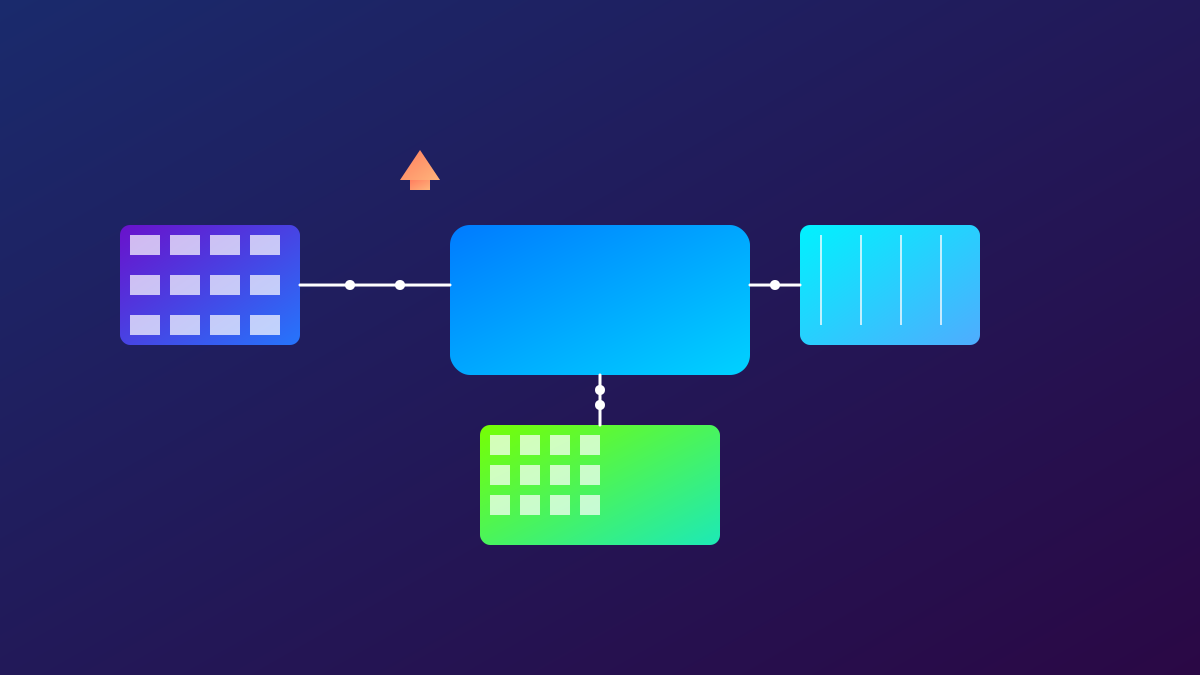
  • Wide Part: Explicit feature crossing to capture known strong correlation patterns (e.g., user explicit interests, business rules);
  • Deep Part: Encoding for tabular data (category embedding + numerical normalization), text (RNN/pre-trained LM), and images (pre-trained CNN/ViT);
  • Fusion Strategies: Early fusion (feature concatenation), late fusion (high-level semantic fusion), middle fusion (cross-modal attention).
5

Section 05

[Application Scenarios] Practical Use Cases Across Multiple Domains

  • Recommendation Systems: Combine user profiles (tabular), product descriptions (text), and images to improve recommendation effectiveness;
  • Financial Risk Control: Integrate credit records (tabular), customer service dialogues (text), and ID photos (images) to enhance risk identification;
  • Medical Diagnosis: Use lab indicators (tabular), medical records (text), and CT/X-ray images to assist diagnosis;
  • E-commerce Search Ranking: Combine user behavior (tabular), product titles (text), and main images to optimize relevance ranking.
6

Section 06

[Usage Example] Concise and Intuitive API Design and Workflow

Provides a modular API. The typical workflow includes:

  1. Data preprocessing (TabPreprocessor/TextPreprocessor/ImagePreprocessor);
  2. Model construction (WideDeep combines various modal components);
  3. Training (Trainer encapsulates training logic);
  4. Prediction (supports multimodal input). Code examples demonstrate a low-threshold development process for multimodal models.
7

Section 07

[Interpretability & Ecosystem] Interpretability Tools and PyTorch Ecosystem Integration

  • Interpretability Tools: Feature importance analysis, embedding visualization, attention weight analysis, meeting the needs of scenarios like finance and medical care;
  • Ecosystem Integration: Seamlessly connects with Hugging Face Transformers, TorchVision, PyTorch Lightning, and experiment tracking tools (W&B/TensorBoard).
8

Section 08

[Summary & Outlook] Project Value and Future Directions

PyTorch WideDeep provides a practical and flexible solution for multimodal deep learning, balancing explicit encoding of domain knowledge and data-driven implicit learning. Facing competition from multimodal large models, it still has advantages in interpretability, lightweightness, and customization, making it suitable for heterogeneous data processing scenarios. In the future, it will continue to follow the progress of deep learning and expand its functions.

