Zing Forum

Reading

Project-Status: A Project Status Management Service for Agent Workflows

A full-stack project status service designed specifically for AI agent workflows, offering three interaction methods (API, CLI, and Web) and supporting a human-AI collaborative project management paradigm.

AI智能体项目管理人机协作工作流自动化状态管理CLI工具API设计
Published 2026-05-22 07:13Recent activity 2026-05-22 07:20Estimated read 6 min
Project-Status: A Project Status Management Service for Agent Workflows
1

Section 01

Project-Status Guide: An Agent Project Status Management Service Connecting Human-AI Collaboration

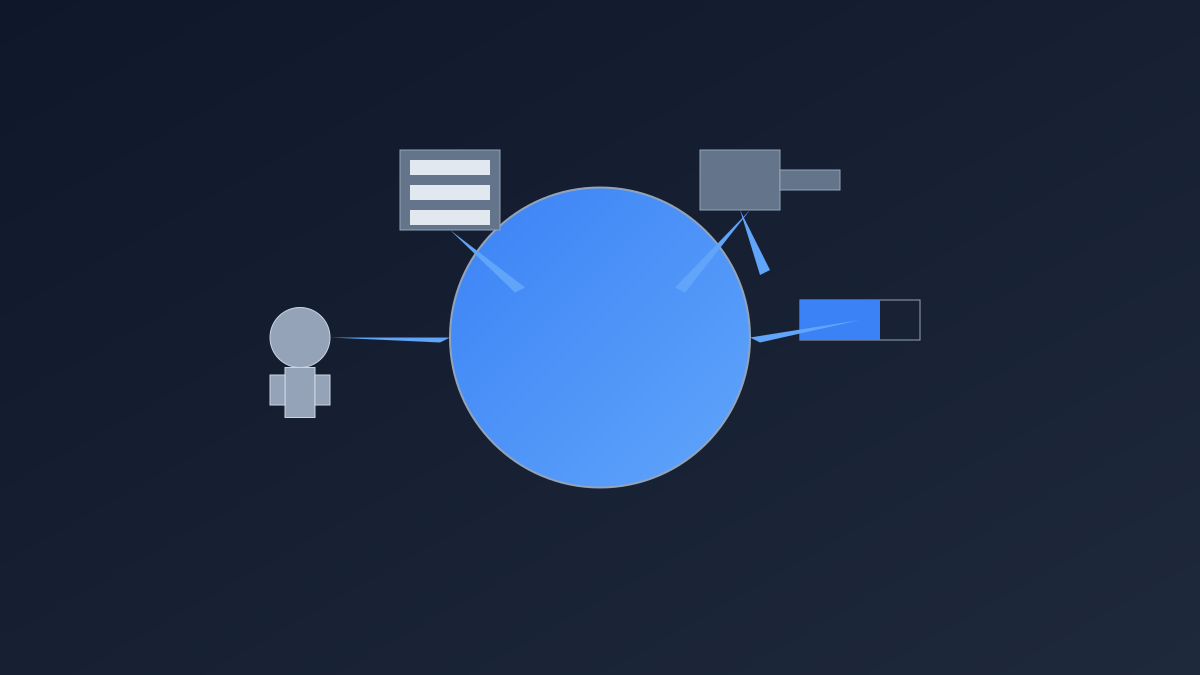
Project-Status is a full-stack project status service designed specifically for AI agent workflows. Its core goal is to solve the problem of efficient collaboration and project context sharing between human developers and AI agents. It offers three interaction methods (API, CLI, and Web), supports standardized project status management, and serves as a bridge connecting human-AI collaboration.


2

Section 02

Project Background and Design Intent

Traditional project management tools are designed with humans at the center, ignoring the growing role of AI agents in software development. When agents participate in tasks like code generation, testing, and documentation writing, they need a structured way to record status, track progress, and synchronize information. The design intent of Project-Status is precisely to fill this gap: as a bridge for human-AI collaboration, it allows agents to report progress in a standardized manner while enabling human developers to easily review and understand status information.

3

Section 03

Architecture Design and Core Methods

The project adopts a full-stack three-layer architecture:

  1. API Layer: Provides CRUD operation interfaces, serving as the system's data hub and supporting agents to manage project status automatically via HTTP requests;
  2. CLI Layer: Offers a command-line tool for developers to quickly view status and update progress, suitable for integration into CI/CD pipelines;
  3. Web Layer: Provides a visual dashboard where team members can intuitively view project status, historical trends, and key metrics.

In addition, the project features agent-friendly structured file organization, including AGENTS.md (agent operation guide), TODO.md (task board), MEMORY.md (persistent records), etc. The typical workflow is: Initialization → Agent Work → Status Update → Human Review → Submit Iteration.

4

Section 04

External Integration and Technical Details

Project-Status supports integration with external workflow orchestration systems like n8n and OpenClaw, providing equivalent storage configurations; it is also compatible with Hermes runtime log configurations, facilitating log mirroring to external storage. The code structure is clear: docs/ (requirements, architecture, etc.), src/ (source code), tests/ (test code), chats/ (local sessions), working/ (temporary drafts), build/ (build artifacts). Version control follows the Conventional Commits specification, requiring retention of AI contribution attribution information.

5

Section 05

Practical Value and Applicable Scenarios

Project-Status is particularly suitable for the following scenarios:

  1. AI-assisted development teams: Need a standardized status synchronization mechanism;
  2. Remote collaboration projects: Need asynchronous status update and review mechanisms;
  3. Automated workflows: Need to integrate status management into CI/CD or other automated processes;
  4. Multi-agent collaboration: Need a unified status service to avoid conflicts and redundant work.
6

Section 06

Summary and Outlook

Project-Status represents a new paradigm of agent-centric human-AI collaboration, which is not only a technical tool but also a transformation of work methods. As the role of AI agents in software development grows, such standardized status management services will become increasingly important. It provides a good starting point for teams exploring AI-assisted development models, and its modular design, agent-friendly interfaces, and clear workflow make it an ideal bridge connecting human wisdom and machine capabilities.

