Zing Forum

Reading

PROJECT_SAINATH: A Transformer Hardware Accelerator Built From Scratch

An RTL-level AI hardware accelerator project designed entirely from scratch using Verilog, aiming to implement core computations of large language models on FPGA without relying on any off-the-shelf IP cores.

FPGA硬件加速器TransformerVerilog脉动阵列AI芯片开源硬件大语言模型
Published 2026-04-28 18:10Recent activity 2026-04-28 18:19Estimated read 5 min
PROJECT_SAINATH: A Transformer Hardware Accelerator Built From Scratch
1

Section 01

PROJECT_SAINATH: Open-Source Transformer Accelerator Built From Scratch

PROJECT_SAINATH is an open-source project that aims to build a Transformer hardware accelerator on FPGA entirely from scratch using Verilog, without relying on any pre-made IP cores. It focuses on core computations of large language models, emphasizing transparency and educational value for understanding AI hardware principles.


2

Section 02

Project Background & Motivation

With the exponential growth in AI inference demand (driven by models like ChatGPT), traditional CPUs/GPUs face bottlenecks in energy efficiency and specific computation optimizations. FPGAs/ASICs are emerging as alternatives. PROJECT_SAINATH chooses to avoid ready-made IP cores and handwrite all RTL-level code—a rare approach in academia and industry—to gain full control over hardware behavior and deepen understanding of AI accelerators.

3

Section 03

Key Concepts & Core Challenges

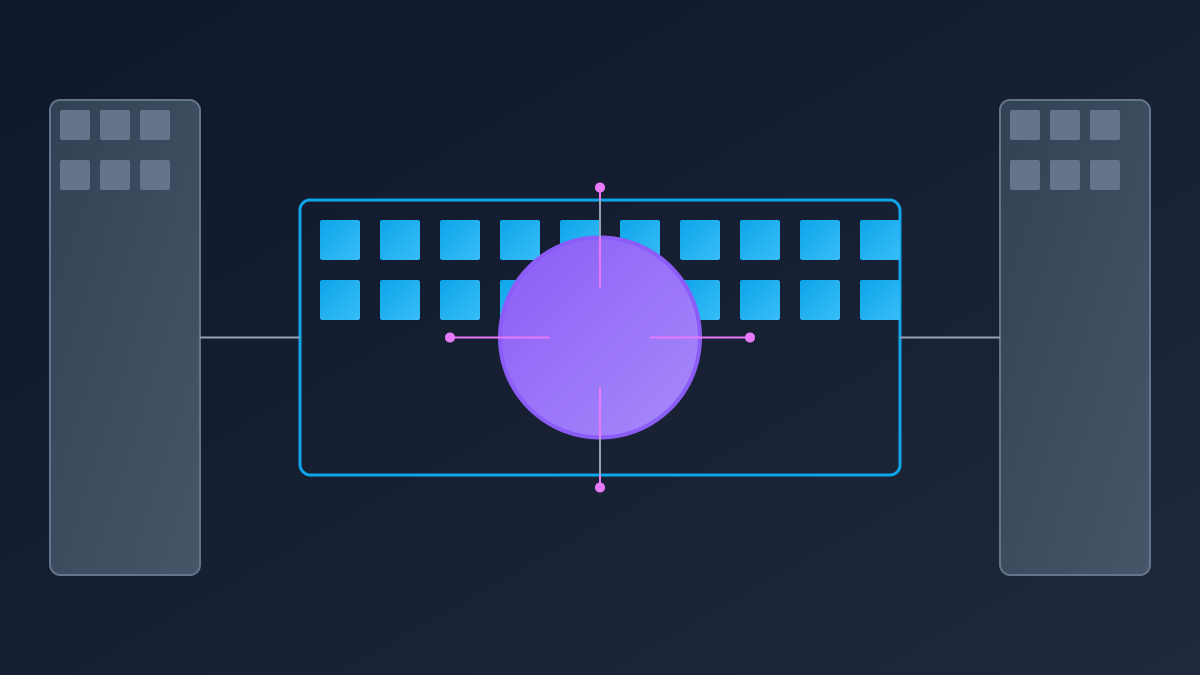
The project uses a systolic array (a parallel computing architecture inspired by heartbeats, ideal for matrix multiplications in the Transformer's attention mechanism, as seen in Google's TPU). Key challenges for implementing Transformer on FPGA include: 1) Compute density (needing sufficient MAC units for matrix operations within limited FPGA resources); 2) Memory bandwidth (DDR bottlenecks requiring optimized data flow and on-chip caching); 3) Numerical precision (balancing resource usage with FP16/BF16/INT8 quantization); 4) Flexibility (adapting to different model scales without a full redesign).

4

Section 04

Technical Route: No IP Core Philosophy

The project implements all modules from scratch: MAC arrays (optimized for parallelism), hierarchical management of on-chip memory (BRAM/URAM), coordinated data paths and control logic, and communication interfaces with the host CPU (like PCIe/AXI). This approach, though time-consuming, offers full hardware control and transparency, which is valuable for education and research.

5

Section 05

FPGA's Unique Advantages in AI Inference

FPGA stands out over GPU in specific scenarios: 1) Low-latency inference (deterministic delay for real-time applications, efficient single-request streaming versus GPU's batch processing); 2) Energy efficiency (better suited for edge devices with power constraints); 3) Customizable data flow (tailored to model computation graphs to reduce data movement); 4) Fast iteration (reconfigurable in hours versus ASIC's high tape-out cost).

6

Section 06

Open Source Impact & Future Plans

Open-source projects like PROJECT_SAINATH lower the barriers to AI hardware design (enabling software developers to learn hardware principles). With the rise of open-source EDA tools (Yosys, OpenROAD) and RISC-V, it contributes to the 'open chip' trend. Future plans: performance benchmarking against NVIDIA TensorRT/AMD Vitis AI; expanding model support to full Transformer layers; optimizing low-precision quantization (INT8/INT4); exploring multi-FPGA parallelism for larger models.

7

Section 07

Conclusion & Community Value

PROJECT_SAINATH embodies a 'back-to-basics' engineering spirit—building AI infrastructure from the ground up in an era of abstraction. Regardless of its final performance, its accumulated knowledge and open-source nature provide valuable learning resources for developers wanting to understand how AI chips work, and demonstrates the potential of small teams or individuals in AI hardware innovation.

