Zing Forum

Reading

PRISM: When Palm Print Recognition Meets RAG Architecture—A Novel Exploration of Explainable AI

The PRISM project combines ancient palmistry theories with modern RAG technology to build an explainable palm reading analysis system. This article explores its technical architecture, design ideas, and implications in the field of explainable AI.

RAG可解释AI多模态AI掌纹识别知识检索生成式AI计算机视觉
Published 2026-05-01 04:12Recent activity 2026-05-01 04:20Estimated read 8 min
PRISM: When Palm Print Recognition Meets RAG Architecture—A Novel Exploration of Explainable AI
1

Section 01

PRISM Project Core Introduction: Cross-Disciplinary Exploration of Palm Print Recognition and RAG Architecture

The PRISM project combines ancient palmistry theories with modern RAG (Retrieval-Augmented Generation) technology to build an explainable palm reading analysis system. This series of floors will discuss its technical architecture, design ideas, application scenarios, and implications in the field of explainable AI, while also exploring the project's limitations and improvement directions.


2

Section 02

Cross-Disciplinary Background of PRISM: Collision Between Ancient Palmistry and Modern AI

In the landscape of AI applications, palmistry seems to be insulated from cutting-edge technology. However, the PRISM project (Palm Reasoning & Interpretation System with Models) on GitHub breaks this stereotype by combining the ancient tradition of palm reading with modern large language models and RAG architecture, becoming a novel and technically inspiring application example.

3

Section 03

PRISM Project Positioning: Structured Intelligent Exploration Beyond Entertainment

PRISM emphasizes 'structured intelligence', 'explainable AI', and 'logic and insight'. Its goal is not mere entertainment but to transform highly subjective traditional knowledge into a verifiable and traceable intelligent analysis process. From a technical perspective, it is a typical multimodal AI application: inputting palm images and outputting structured interpretation reports, involving computer vision, knowledge retrieval, and natural language generation, among other links.

4

Section 04

Analysis of PRISM's Technical Architecture: Explainable Design with RAG as Core

RAG as the Core Reasoning Engine

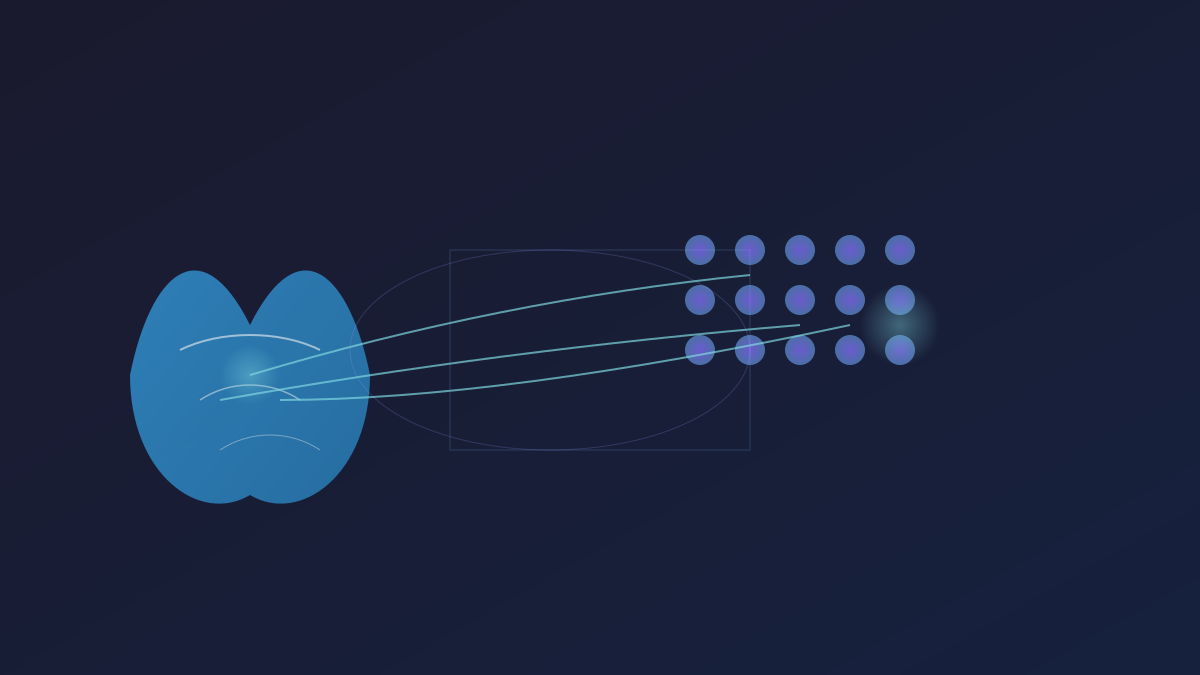
PRISM selects the RAG architecture as the reasoning foundation, storing the symbolic system and interpretation rules of traditional palmistry in a structured manner as a vector database. When analyzing specific palm print features, the system retrieves relevant explanations from the knowledge base and then organizes them into a coherent report via the language model.

Explainability Design

PRISM uses the RAG architecture to label the knowledge source (e.g., chapters of palmistry classics) for each analysis, ensuring transparency and helping users distinguish between system analysis and random generation.

Multimodal Processing Challenges

The core challenge is converting palm images into structured information, involving computer vision tasks such as palm print detection, feature extraction, and region segmentation. It is necessary to accurately identify key features like the life line and wisdom line to match the rules in the knowledge base.

5

Section 05

Technical Implications of PRISM: Expansion of RAG Boundaries and Practice of Explainable AI

Expansion of RAG Boundaries

PRISM demonstrates the potential of RAG: it can not only carry objective facts but also include subjective knowledge such as cultural symbols and traditional wisdom (as long as they can be structured and retrieved), extending from fact retrieval to explanation generation.

Practice Path of Explainable AI

PRISM achieves explainability at the system architecture level—separating knowledge storage from generation logic, naturally providing decision traceability. This lightweight method is suitable for rapid deployment and resource-constrained scenarios, enabling explainability without needing to delve into the model's internal workings.

6

Section 06

Extension of PRISM Application Scenarios: Possibilities for Cultural Preservation and Educational Tools

Digital Preservation of Cultural Knowledge

The PRISM framework can be migrated to digital projects of traditional knowledge such as TCM diagnosis, tea ceremony appreciation, and traditional crafts, preserving the essence while providing modern interactions.

Explanatory Tools in Education

An art history teaching system can be built to analyze paintings uploaded by students, generate interpretation reports from dimensions like style and technique, and provide academic sources.

Boundary Between Entertainment and Serious Applications

PRISM raises a thought: when AI deals with non-scientific fields, how to balance entertainment and seriousness? Palmistry's scientific validity is questionable, but the project emphasizes logic and insight, reflecting the tension between technical neutrality and social impact.

7

Section 07

Limitations and Improvement Directions of PRISM

Challenges in Knowledge Base Authority

Palmistry lacks unified standards, and different schools have significant differences; screening and balancing sources is a difficult problem.

Bottleneck in Visual Understanding Accuracy

The accuracy of palm print recognition affects subsequent analysis; current CV technology still has limitations in fine-grained textures and real scenarios (lighting changes, hand postures).

Cultural Sensitivity Considerations

Palmistry is associated with specific cultures; international deployment needs to consider cultural adaptability to avoid offensive outputs.

8

Section 08

Value of PRISM: A Case of Cross-Disciplinary Thinking and AI Cultural Penetration

PRISM may not be a core technology that changes the world, but it provides a unique perspective: the collision between traditional knowledge and advanced AI architecture. In today's era of homogenized technologies like RAG and multimodal AI, it reminds us that innovative inspiration can come from unexpected corners. For developers, it is a case of cross-disciplinary thinking and architectural innovation; for observers, it is a slice of AI's penetration into human cultural life.

