Zing Forum

Reading

Primeiro-LLM: A Multi-Agent AI Infrastructure for Planetary-Scale Operations

An ambitious multi-agent AI system project with capabilities in autonomous reasoning, distributed computing, civilization modeling, and planetary-scale operations, exploring the boundaries of AGI regulation and recursive cognition.

多智能体系统AGI分布式计算文明建模递归认知RAG行星级运营
Published 2026-05-20 06:32Recent activity 2026-05-20 06:53Estimated read 9 min
Primeiro-LLM: A Multi-Agent AI Infrastructure for Planetary-Scale Operations
1

Section 01

Primeiro-LLM Project Introduction: A Multi-Agent AI Infrastructure for Planetary-Scale Operations

Primeiro-LLM is an ambitious multi-agent AI system project aimed at building a complete AI infrastructure for planetary-scale operations. This project integrates cutting-edge technologies such as autonomous reasoning, distributed computing, civilization modeling, and recursive cognition, exploring the boundaries of AGI regulation and recursive cognition, and represents a bold exploration direction in multi-agent system research.


2

Section 02

Background: From Single Model Limitations to the New Frontier of Multi-Agent Systems

While large language model technology has made breakthroughs, single models have inherent limitations. Multi-agent systems have become a new frontier in AI research, achieving complex capabilities beyond single models through collaboration among multiple specialized agents. The Primeiro-LLM project is an exploration of this trend, positioned as a complete AI infrastructure for planetary-scale operations.

3

Section 03

Core Architecture: Multi-Layered Agent System Design

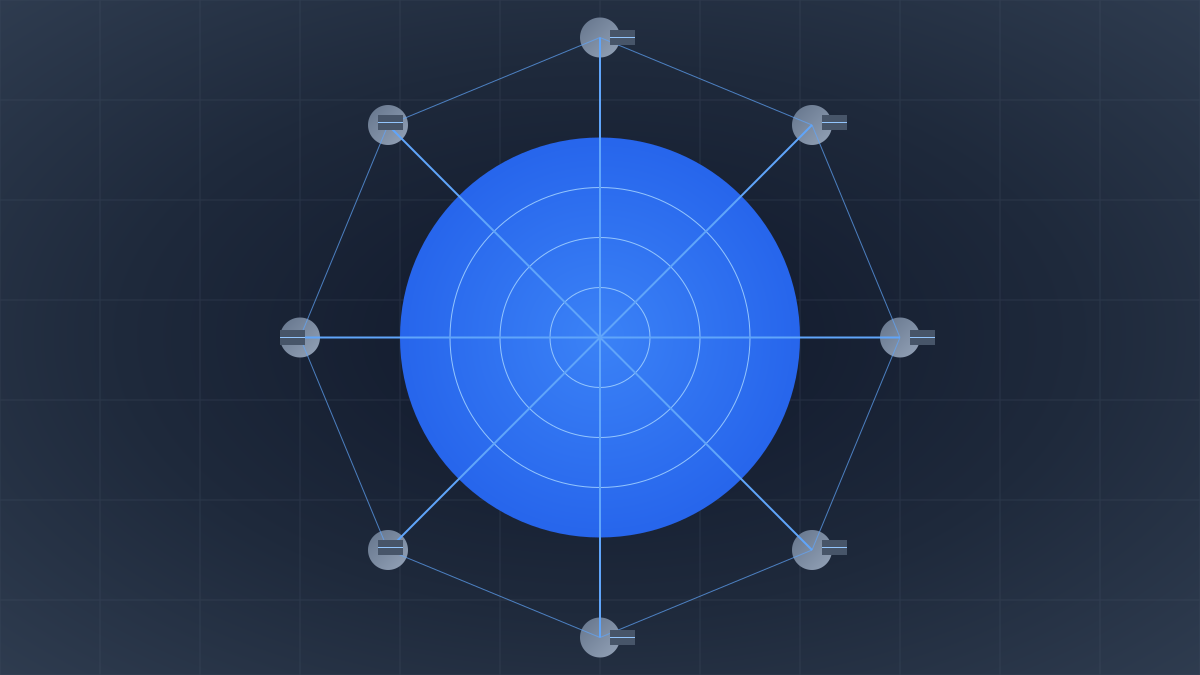
Primeiro-LLM adopts a layered agent architecture:

AGI Regulatory Layer: The highest layer of the system, responsible for coordinating and supervising lower-level agents, performing resource allocation, task scheduling, conflict resolution, and overall goal management—implying a pursuit of general artificial intelligence.

Specialized Agent Layer: Divided by functional domains (e.g., economic simulation, social dynamics), responsible for tasks in different functional areas.

Knowledge Synthesis & RAG Layer: The system’s memory and knowledge hub, with strong knowledge management capabilities, integrating multi-source information and providing contextual responses via retrieval-augmented generation.

Recursive Cognition Layer: Agents possess self-reflection and self-improvement capabilities, able to analyze their own thinking processes, identify cognitive biases, and optimize reasoning strategies—an embodiment of metacognitive ability.

4

Section 04

Analysis of Key Technical Components

Distributed Computing Architecture: Uses microservices or similar architectures to distribute computing tasks across multiple nodes for horizontal scaling, supporting large-scale concurrency and high availability for planetary-scale operations.

Civilization Modeling: Conducts computational simulations of complex systems (society, economy, culture) for macro scenarios like urban planning and policy simulation, capturing emergent phenomena at the group level.

Autonomous Reasoning Engine: Agents can perform complex logical reasoning, hypothesis testing, scheme evaluation, and decision-making—potentially combining symbolic reasoning with neural networks and causal reasoning capabilities.

Recursive Cognition Mechanism: Enables agents to "think about their own thinking" for self-correction and learning optimization, possibly involving multi-level attention mechanisms, meta-learning frameworks, or reasoning chain monitoring.

5

Section 05

Potential Application Scenarios: From Urban Operations to Global Challenge Response

Primeiro-LLM’s architecture enables diverse application scenarios:

  • Smart City Operations: Traffic optimization, energy distribution, emergency response, public service scheduling.
  • Global Climate Modeling & Response: Integrate multi-source data, simulate policy scenarios, and coordinate international responses.
  • Complex Economic System Analysis: Macroeconomic forecasting, financial market analysis, supply chain optimization.
  • Large-Scale Scientific Research Collaboration: Coordinate global research forces, integrate interdisciplinary knowledge to accelerate scientific discoveries.
  • Disaster Response & Emergency Management: Rapidly coordinate resources, assess impacts, and formulate response strategies.
6

Section 06

Technical Challenges & Risk Considerations

Primeiro-LLM faces several challenges:

  • System Complexity Management: Coordinating multi-layered architectures, handling inter-layer communication delays/failures, and debugging/optimizing complex systems.
  • Interpretability & Controllability: Ensuring the AGI regulatory layer controls lower-level agent behavior and maintains decision transparency.
  • Safety & Alignment: Aligning system goals with human values to prevent abuse or unexpected behavior—requiring solutions across technical, ethical, and governance dimensions.
  • Computational Resource Requirements: Engineering challenges to achieve efficient operation under massive computational demands.
7

Section 07

Comparative Analysis with Existing Technologies

Differences between Primeiro-LLM and existing technologies:

  • vs. AutoGPT/BabyAGI: More ambitious architectural design and clear infrastructure positioning.
  • vs. Microsoft Copilot Ecosystem/Google AI Agent Framework: Emphasizes multi-agent autonomous collaboration rather than single assistant function expansion.
  • vs. Academic Multi-Agent RL Research: Focuses more on engineering implementation and practical deployment than theoretical exploration.
8

Section 08

Conclusion: Project Significance & Ethical Safety Reminders

Primeiro-LLM represents a bold exploration in AI infrastructure, integrating cutting-edge concepts like multi-agent systems and autonomous reasoning to address planetary-scale complex problems. Regardless of whether its vision is realized, the directions it explores (scalable multi-agent architectures, recursive cognition) are key frontiers in AI development and deserve researchers’ attention.同时, planetary-scale operation capabilities imply huge impacts—requiring重视 technical ethics and safety alignment with responsibility and prudence.

