Zing Forum

Reading

Prefill-Decode Segregation: A New Paradigm for LLM Inference Acceleration

This article deeply analyzes how the Prefill-Decode segregation architecture optimizes the inference performance of large language models (LLMs). By separating the compute-intensive prefill phase and memory-intensive decode phase onto different GPUs, it maximizes resource utilization and reduces latency.

LLM推理优化Prefill-Decode分离大语言模型推理加速KV Cache内存带宽计算优化vLLMTransformer
Published 2026-06-10 23:13Recent activity 2026-06-10 23:22Estimated read 5 min
Prefill-Decode Segregation: A New Paradigm for LLM Inference Acceleration
1

Section 01

【Introduction】Prefill-Decode Segregation: A New Paradigm for LLM Inference Acceleration

Original author: shubh2579. Source: GitHub project Prefill-Decode-Segregation-Experiment (link: https://github.com/shubh2579/Prefill-Decode-Segregation-Experiment). Publication date: 2026-06-10. Core idea: The Prefill-Decode segregation architecture solves the resource mismatch problem in traditional LLM inference architectures by separating the compute-intensive prefill phase and memory-intensive decode phase onto different GPUs. It maximizes resource utilization and reduces latency, making it a new paradigm for LLM inference optimization.


2

Section 02

Background: Bottlenecks of Traditional LLM Inference Architectures

LLM inference consists of two phases: prefill (processing input prompts) and decode (autoregressive output generation). Traditional architectures execute both phases on the same GPU, ignoring their characteristic differences: prefill is compute-intensive (large number of matrix operations, complexity proportional to the square of sequence length), while decode is memory-intensive (frequent access to KV Cache, obvious bandwidth bottlenecks). This design leads to resource mismatch, which easily causes head-of-line blocking under high concurrency and affects performance.

3

Section 03

Method: Core Concept of the Segregation Architecture

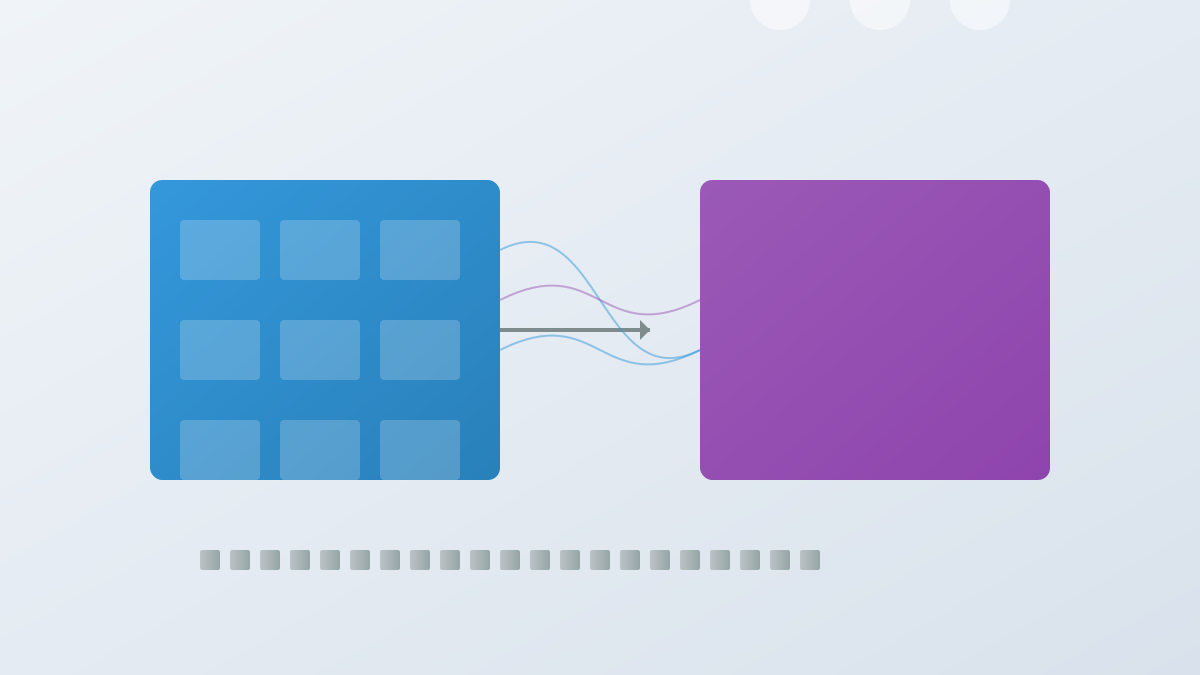
The core of the Prefill-Decode segregation architecture is to allocate the two phases to specially optimized hardware: the prefill phase is executed by Prefill Workers equipped with high-performance computing GPUs, focusing on quickly processing inputs to generate KV Cache; the decode phase is executed by Decode Workers equipped with high-memory-bandwidth GPUs, focusing on low-latency token generation. At the same time, issues such as KV Cache transmission, request scheduling, and fault handling need to be addressed.

4

Section 04

Evidence: Performance Benefits of the Segregation Architecture

Measured data shows that the segregation architecture can reduce token generation latency by 30% to 50% in high concurrency scenarios; prefill nodes improve throughput through batch processing, while decode nodes serve more concurrent streams; enterprises can independently scale prefill or decode nodes according to load to optimize resource utilization.

5

Section 05

Challenges: Key Technical Issues in Implementation

The segregation architecture faces three major challenges: 1. Efficient KV Cache transmission (requires high-speed interconnection technology and software optimization); 2. Complexity of request scheduling (global load prediction and routing); 3. Consistency in fault handling (cross-node request state management and retries).

6

Section 06

Industry Practices and Future Outlook

Mainstream inference engines such as vLLM and TensorRT-LLM have explored or supported phase segregation; cloud service providers offer optimized instances for specific phases. In the future, LLM inference will develop towards more refined directions, combining technologies such as heterogeneous computing and edge inference to further push the performance boundaries.

7

Section 07

Conclusion: Value of Architectural Innovation

The Prefill-Decode segregation architecture represents an important direction for LLM inference optimization to evolve from extensive to refined. While pursuing large models, the separation of concerns at the architectural level can significantly improve performance and provide important references for LLM application design.

