Zing Forum

Reading

Pragma Providers: Unified Resource Management Layer for Cloud-Native AI Infrastructure

This article introduces the pragma-providers project, a resource provisioning layer designed for pragma-os. It explores the infrastructure management paradigm of AI-native operating systems by managing cloud infrastructure, AI agents, knowledge bases, pipelines, and workflows through unified abstraction.

pragma-providerspragma-os资源管理AI基础设施云原生声明式配置AI代理知识库
Published 2026-04-03 21:43Recent activity 2026-04-03 21:51Estimated read 6 min
Pragma Providers: Unified Resource Management Layer for Cloud-Native AI Infrastructure
1

Section 01

Pragma Providers: Unified Resource Management Layer for Cloud-Native AI Infrastructure (Introduction)

This article introduces the pragma-providers project, a core component of the pragma-os ecosystem. It aims to address the paradigm shift in resource management in the AI-native era by managing cloud infrastructure, AI agents, knowledge bases, pipelines, and workflows through unified abstraction. It simplifies the management complexity of heterogeneous AI resources and helps developers efficiently build and operate AI applications.


2

Section 02

Infrastructure Management Challenges in the AI-Native Era

As AI penetrates from the application layer to the infrastructure layer, traditional resource management models (based on virtual machines, containers, etc.) face pressure to restructure. AI workloads require heterogeneous resources such as GPU acceleration, vector databases, and message queues, with management complexity far exceeding that of traditional application stacks. The pragma-providers project is precisely an infrastructure component designed to address this paradigm shift.

3

Section 03

Core Design Philosophy and Layered Architecture

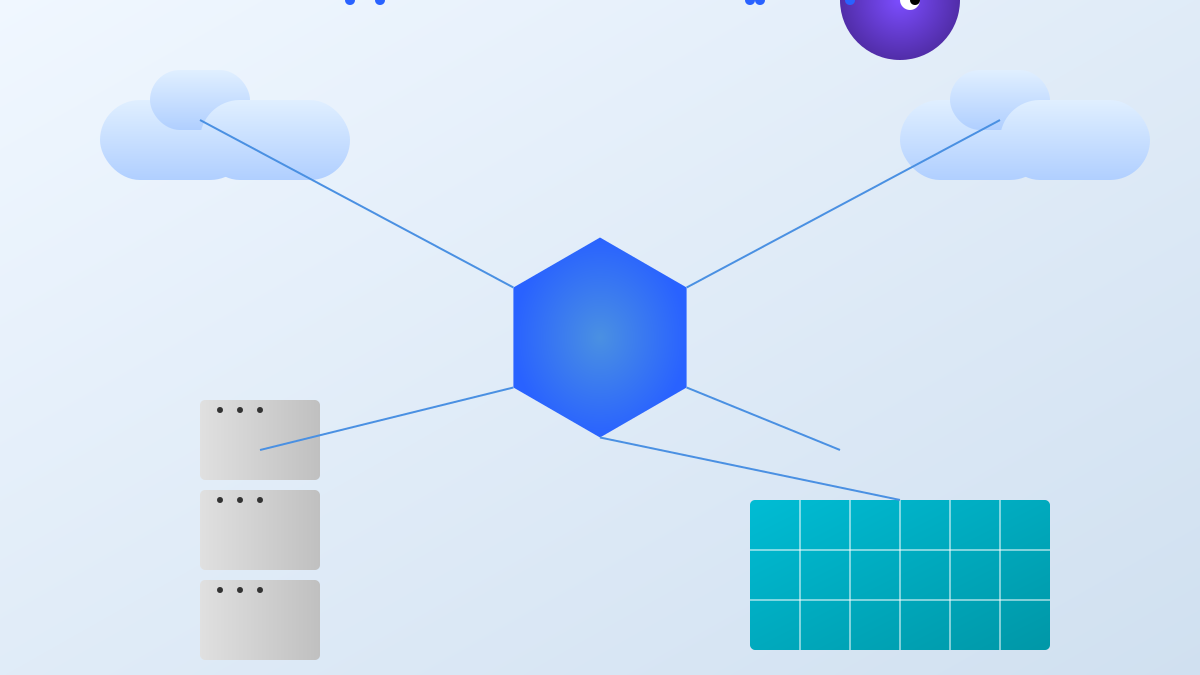
The core philosophy of pragma-providers is "Everything as a Resource", abstracting physical servers, AI models, etc., into declarative and configurable resource objects using a declarative configuration paradigm (YAML/JSON to describe desired states). The architecture adopts a layered design: the resource abstraction layer defines unified models and APIs; the provider layer encapsulates specific implementations; the control plane coordinates state consistency; and the plugin architecture supports extensions.

4

Section 04

Key Resource Types Covering the Entire AI Lifecycle

pragma-providers supports multiple resource types:

  1. Cloud infrastructure resources (computing, storage, network, including vector databases);
  2. AI agent resources (managing agent lifecycle and collaboration);
  3. Knowledge base resources (associating multiple storage backends and providing a unified semantic access interface);
  4. Pipeline resources (orchestrating AI workflows, supporting dependency management and parallel execution).
5

Section 05

Application Scenarios and Ecosystem Integration

Application scenarios cover the entire AI lifecycle: prototype development (quickly spinning up environments), training (pipelines coordinating distributed tasks), service deployment (integration of agents and inference services), and operation (monitoring and cost optimization). It is deeply integrated with the pragma-os ecosystem: providing command-line management via pragma-cli, realizing resource binding with pragma-runtime, and supporting resource template sharing with pragma-hub.

6

Section 06

Cloud-Native Technical Implementation and Multi-Environment Support

The technology stack is built on Kubernetes (using CRD to extend APIs and Operator to manage lifecycles), supporting major cloud service providers (AWS/Azure/GCP) and private data centers. The multi-cloud abstraction layer shields underlying differences. It natively supports multi-environment management: environment abstraction separates configurations and parameters, supporting migration between environments and cost tracking.

7

Section 07

Current Challenges and Future Evolution Directions

The challenges faced include resource modeling balance (generality vs. specificity), distributed state consistency, and performance optimization. Future directions: edge computing support, Serverless integration, and AI-assisted operation and maintenance (proactive optimization and fault prediction).

8

Section 08

An Important Attempt to Build AI-Native Infrastructure

pragma-providers represents an important attempt in the evolution of infrastructure toward the AI-native paradigm. It simplifies heterogeneous resource management through unified abstraction and declarative configuration, lowering the threshold for AI application development. Its open-source nature and plugin architecture provide a foundation for community participation and will grow alongside the AI ecosystem.

