Zing Forum

Reading

Planner-App: A Multi-Agent Workflow Orchestration Framework Based on Claude Code

Planner-App is an open-source multi-agent workflow framework designed specifically for Claude Code, supporting the decomposition, planning, and execution of complex tasks.

多智能体Claude Code工作流AI协作任务分解
Published 2026-04-26 16:45Recent activity 2026-04-26 16:49Estimated read 6 min
Planner-App: A Multi-Agent Workflow Orchestration Framework Based on Claude Code
1

Section 01

Planner-App: A Multi-Agent Workflow Orchestration Framework Based on Claude Code (Introduction)

Planner-App is an open-source multi-agent Claude Code workflow framework created by developer Jygo95, aiming to support the decomposition, planning, and execution of complex tasks. The core design of this framework embodies principles such as task decomposition specialization, coordination and communication mechanisms, and workflow orchestration. It is suitable for various multi-agent collaboration scenarios and is of great significance to Claude Code users and developers.


2

Section 02

Background: The Rise of Multi-Agent Workflows

With the improvement of large language model capabilities, a single agent can hardly meet the needs of complex software development tasks. Multi-agent collaboration has become a new paradigm for solving complex problems—by decomposing tasks into multiple specialized agents, each responsible for specific subtasks, the overall efficiency and output quality can be significantly improved.

3

Section 03

Core Design Philosophy

Planner-App's design follows key principles of modern multi-agent systems:

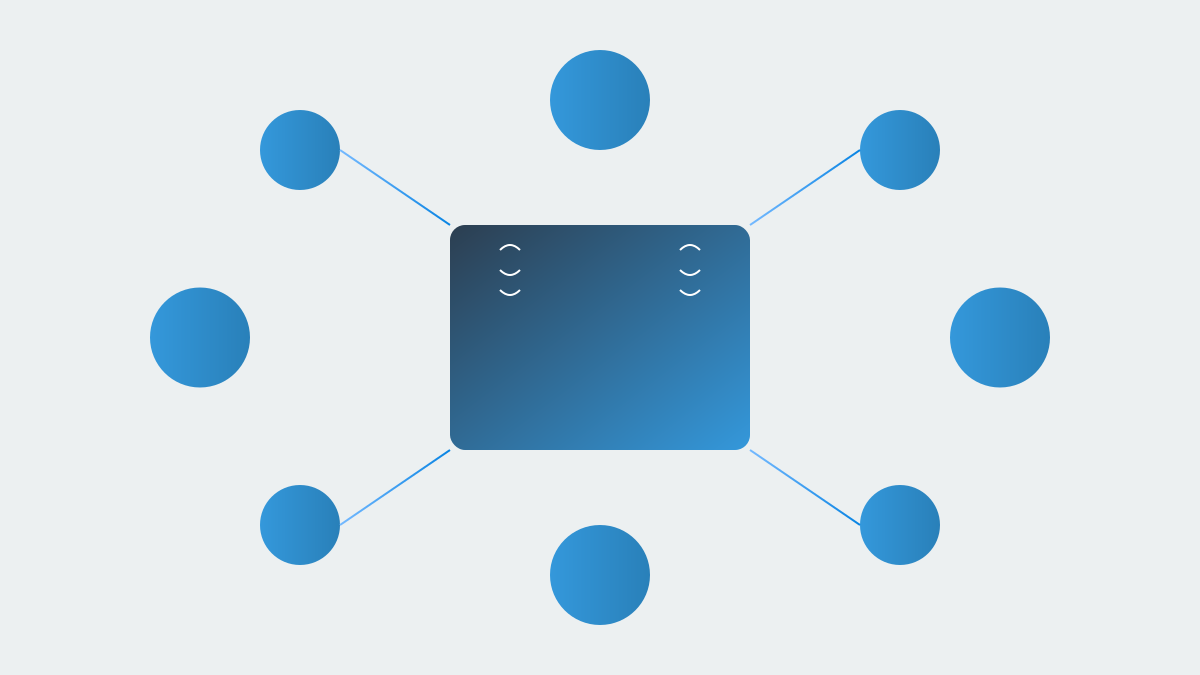
  • Task Decomposition and Specialization: Supports automatic decomposition of complex tasks into subtasks, assigning them to the most suitable agents to leverage their domain expertise;
  • Coordination and Communication Mechanism: Provides a structured communication protocol to ensure effective information exchange, state synchronization, and conflict resolution between agents;
  • Workflow Orchestration: Allows users to define task execution order, dependencies, and branch logic to accurately model complex business processes.
4

Section 04

Technical Implementation Features

Planner-App's technical features include:

  • Claude Code Integration: Deeply adapted to Anthropic's Claude Code environment, making full use of its code understanding and generation capabilities;
  • Modular Architecture: Adopts a modular design for easy expansion and customization;
  • State Management: Maintains the complete state of task execution, supporting resumption from breakpoints and error recovery.
5

Section 05

Application Scenarios

Planner-App is suitable for various multi-agent collaboration scenarios:

  • Complex software architecture design (decomposed to specialized agents for front-end, back-end, database, etc.);
  • Code review and refactoring (multiple agents review from different perspectives and propose improvement suggestions);
  • Project planning and estimation (collaborative task decomposition, man-hour estimation, and risk assessment);
  • Document generation (collaborative generation of technical documents, API documents, and user manuals).
6

Section 06

Significance for Developers

For Claude Code developers, Planner-App builds a collaborative ecosystem and represents a new work model, which is particularly suitable for:

  • Teams that need to handle cross-domain complex problems;
  • Individual developers who want to improve the efficiency of AI-assisted development;
  • Researchers exploring the boundaries of multi-agent systems.
7

Section 07

Future Outlook and Conclusion

Future Outlook: Multi-agent workflow is an important development direction for AI applications. With the evolution of models and the improvement of toolchains, frameworks like Planner-App will become more mature, supporting more complex collaboration modes, intelligent task allocation, and powerful error handling capabilities.

Conclusion: Although Planner-App is lightweight, the multi-agent collaboration concept it represents is of far-reaching significance. Effectively organizing and coordinating multiple agents will become a key issue in improving the efficiency of AI-assisted development.

