Zing Forum

Reading

Planckatron: An Innovative Solution for Accelerating Project Development via Parallel AI Workflows

Planckatron addresses conflict issues in multi-AI collaboration by introducing a parallel AI worker mechanism, providing an accelerated development workflow framework for various project types such as front-end, back-end, and full-stack.

AI辅助开发并行工作流Claude Code智能体协作软件开发效率工具
Published 2026-04-11 01:13Recent activity 2026-04-11 01:17Estimated read 5 min
Planckatron: An Innovative Solution for Accelerating Project Development via Parallel AI Workflows
1

Section 01

[Introduction] Planckatron: An Innovative Solution to Break Development Efficiency Bottlenecks via Parallel AI Collaboration

Planckatron is a parallel AI workflow framework developed by GitHub user AgriciDaniel. It resolves conflict issues in multi-AI collaboration by introducing a parallel AI worker mechanism, supporting various project types including front-end, back-end, and full-stack. With a zero-configuration setup (activate by placing the .planckatron folder in the project directory), it offers a low-barrier entry to help developers accelerate project development.


2

Section 02

Background: Efficiency Bottlenecks and Collaboration Challenges in AI-Assisted Development

With the popularity of AI programming tools like GitHub Copilot and Claude Code, AI-assisted development has entered the production phase. However, when multiple AI agents participate in a project simultaneously, coordination and conflict issues become key obstacles to improving efficiency. How to enable multiple AIs to collaborate efficiently without interference is a core pain point facing the industry today.

3

Section 03

Core Mechanisms: Zero-Configuration Access and Parallel AI Conflict Avoidance

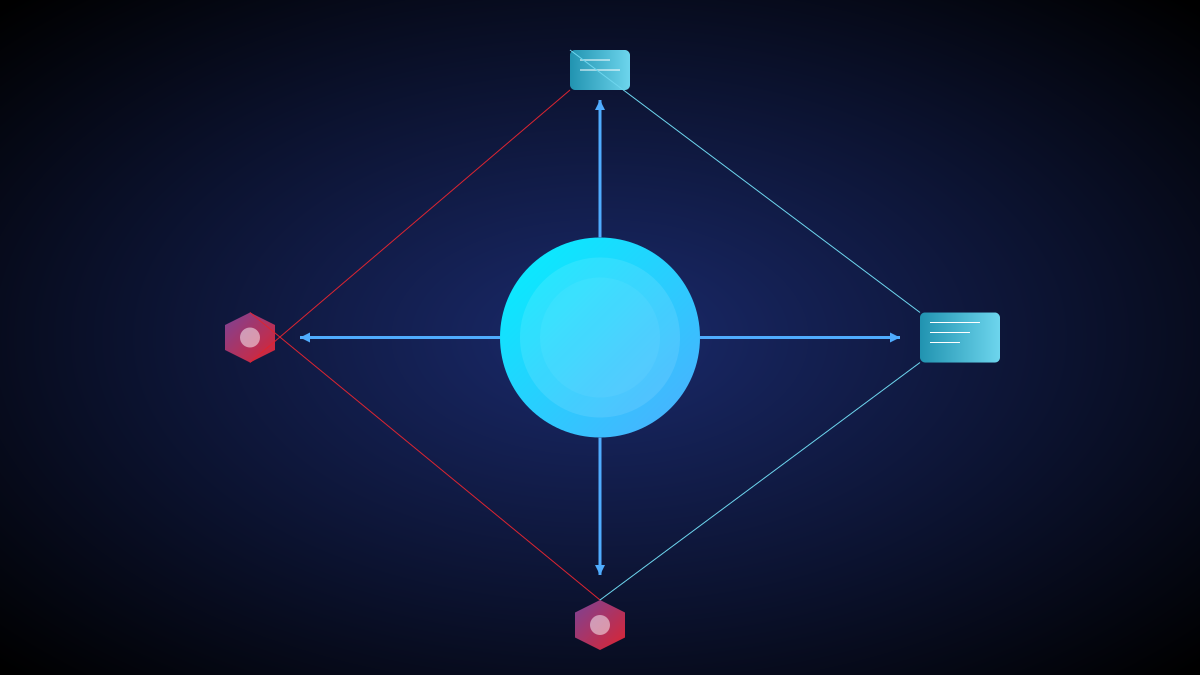
Planckatron features a simple design: it can be activated by placing the .planckatron folder in the project directory. Its core innovation lies in the parallel AI workflow scheduling mechanism, which uses task isolation and state management (such as file locking, change queues, dependency graph analysis, etc.) to ensure AI workers operate in independent contexts while maintaining overall consistency, achieving the goal of "parallel AI workers never conflicting".

4

Section 04

Scenario Support and Integration with Claude Code

Planckatron covers various development scenarios including front-end (component design, style adjustment, etc.), back-end (data models, business logic, etc.), full-stack (synchronous front-end and back-end development), and automation scripts. The "claude-code" in the project name implies a close association with Anthropic Claude Code; it may be an orchestration layer built on top of Claude Code, providing seamless expansion for developers already using Claude Code.

5

Section 05

Application Value: Significantly Improving Development Efficiency and Business Value

Planckatron promises to compress development cycles through parallelization (e.g., three parallel tasks can save two-thirds of the time), reduce the cost of manual conflict resolution, and has direct business value for startup teams pursuing rapid iteration or projects with tight delivery deadlines.

6

Section 06

Potential Limitations and Practical Usage Recommendations

Planckatron has potential limitations: small projects may experience reduced efficiency due to coordination overhead; the quality of AI-generated code still requires manual review; teams need to adjust their collaboration models to adapt to the tool. It is recommended to start with non-core modules for trial use and gradually establish best practices.

7

Section 07

Industry Trend: AI-Assisted Development Evolving Towards Multi-Agent Collaboration

Planckatron represents the trend of AI-assisted development tools evolving from single assistants to multi-AI collaboration systems, which aligns with the growing complexity of modern software. Future development environments may come standard with multi-AI role-based collaboration, and Planckatron provides an early reference for this vision.

