Zing Forum

Reading

PipeMax: A New Scheme for High-Throughput Offline Large Model Inference on Consumer-Grade GPU Servers

By combining pipeline parallelism with KV cache offloading, PipeMax achieves 2.51x higher throughput than vLLM on an 8-GPU node, providing a practical solution for cost-sensitive offline inference scenarios.

LLM推理优化GPU显存管理流水线并行KV缓存卸载高吞吐推理消费级GPU
Published 2026-05-04 11:37Recent activity 2026-05-05 12:47Estimated read 6 min
PipeMax: A New Scheme for High-Throughput Offline Large Model Inference on Consumer-Grade GPU Servers
1

Section 01

PipeMax: A New Scheme for High-Throughput Offline Large Model Inference on Consumer-Grade GPU Servers (Introduction)

By deeply integrating pipeline parallelism and KV cache offloading, PipeMax achieves 2.51x higher throughput than vLLM on an 8-card consumer-grade GPU node, providing a practical solution for cost-sensitive offline inference scenarios. It breaks the limitations of isolated traditional optimization methods and unleashes hardware potential.


2

Section 02

Background: Cost Dilemma of Offline Inference and Bottlenecks of Consumer-Grade GPUs

Offline inference needs to handle more requests within a fixed budget. Consumer-grade GPU servers are cost-effective but face memory capacity limitations (model parameters + KV cache exhaust memory) and interconnection bandwidth constraints (lower than data center grade). Traditional systems treat pipeline parallelism and memory offloading as independent optimizations, failing to exploit their synergistic potential.

3

Section 03

Core Design of PipeMax: Deep Integration of Pipeline Parallelism and KV Cache Offloading

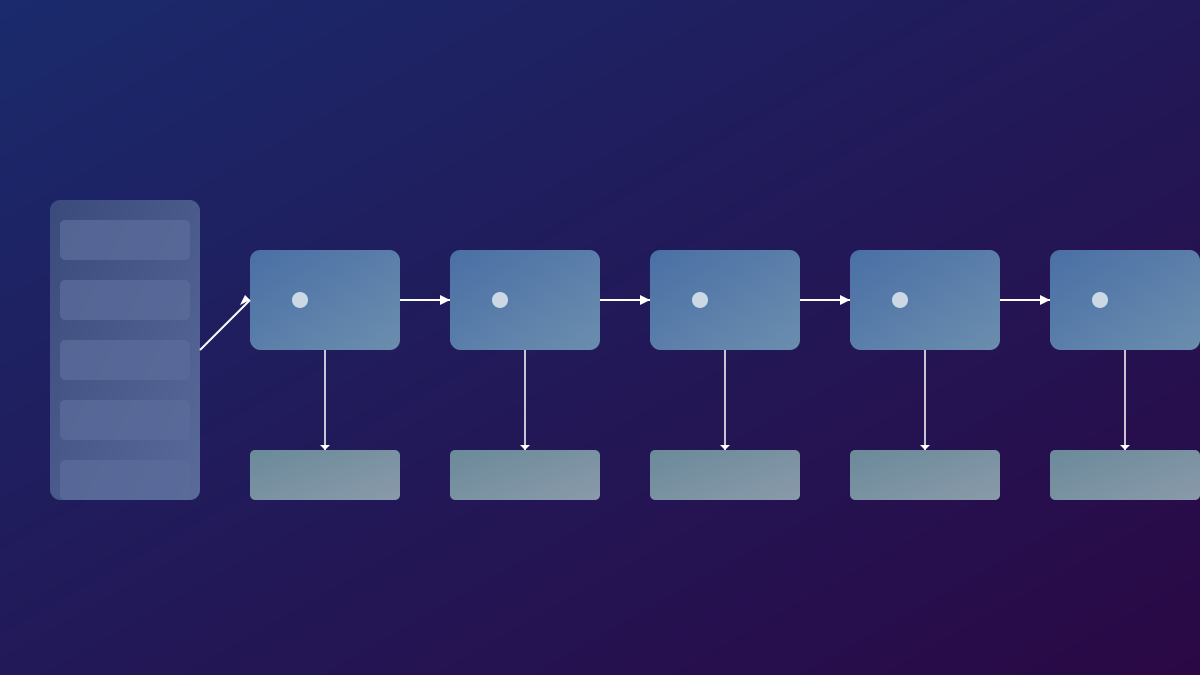
The breakthrough of PipeMax lies in integrating the two: during pipeline execution, each GPU processes only one micro-batch, and KV caches of inactive batches can be moved out of VRAM. Advantages include: low pipeline communication overhead (only transferring intermediate activation values), offloading expands effective memory, and fine-grained scheduling coordinates computation and data movement to avoid GPU idling.

4

Section 04

Key Technical Implementation Mechanisms: Hierarchical Offloading and Compute-Transfer Overlapping

Memory management uses dynamic hierarchical offloading: active KV caches are stored in VRAM, recently used ones in CPU memory, and older ones on SSD (similar to virtual memory but optimized for LLM access). Scheduling introduces a compute-transfer overlapping algorithm: while the GPU processes the current batch, it pre-fetches the KV cache of the next batch and asynchronously offloads the cache of completed batches, hiding transfer delays.

5

Section 05

Experimental Evidence: Significant Throughput Improvement

Experiments show that PipeMax achieves 2.51x higher throughput than vLLM on an 8-GPU node, and maintains a 1.38-1.42x advantage over the current state-of-the-art dedicated high-throughput systems. This means handling more tasks with the same budget, or using fewer GPU resources for the same throughput.

6

Section 06

Practical Significance and Application Prospects

For small and medium-sized enterprises/research institutions with limited budgets, high-throughput inference can be achieved without expensive data center GPUs, lowering the AI entry barrier; it represents the trend of combining system-level and model-level optimizations; and inspires collaborative optimization for scenarios with high memory demands such as multi-modal inference and long text processing.

7

Section 07

Limitations and Future Research Directions

Limitations: It is targeted at offline batch processing scenarios; adjustments are needed for online low-latency scenarios; it has only been verified on 8-GPU nodes, and scalability in large-scale clusters remains to be studied. Future directions: Extend to heterogeneous hardware (CPU+GPU), more intelligent cache prefetching, and combine model quantization/sparsification to improve efficiency.

8

Section 08

Conclusion: Cross-Layer Collaborative Design Unleashes Hardware Potential

PipeMax provides a new paradigm for LLM offline inference, breaking the barriers between pipeline parallelism and memory offloading, and achieving near-professional performance on consumer-grade hardware. It not only has practical value but also indicates that cross-layer collaborative design is more effective than local optimization in resource-constrained environments.