Zing Forum

Reading

Production-Grade Multimodal Vision-Language Model Pipeline: Image/Video Understanding and Document Q&A

A production-grade multimodal vision-language pipeline integrating Gemini 1.5 Pro and PaliGemma, supporting functions like image/video understanding, chart analysis, document Q&A, visual grounding, and cross-modal search.

多模态模型视觉语言模型Gemini 1.5 ProPaliGemma文档问答视频理解生产级PipelineVLM
Published 2026-06-10 08:25Recent activity 2026-06-10 08:53Estimated read 7 min
Production-Grade Multimodal Vision-Language Model Pipeline: Image/Video Understanding and Document Q&A
1

Section 01

[Introduction] Production-Grade Multimodal Vision-Language Model Pipeline: A Full-Featured Solution Integrating Gemini and PaliGemma

This article introduces an open-source production-grade multimodal vision-language pipeline project that integrates Google Gemini 1.5 Pro and PaliGemma models, supporting functions such as image/video understanding, chart analysis, document Q&A, visual grounding, and cross-modal search. Maintained by jhondados, the source code is available on GitHub (https://github.com/jhondados/multimodal-vision-language-model). It features production-grade capabilities like asynchronous processing, batch processing, and error recovery, and can be applied to scenarios such as intelligent document processing and e-commerce search.


2

Section 02

Development Background of Multimodal AI

Traditional computer vision (CV) and natural language processing (NLP) have developed independently, but real-world information is often multimodal (e.g., financial reports contain text and charts, videos include visuals and commentary). Multimodal Vision-Language Models (VLMs) break down these barriers—early ones used a two-stage architecture (visual encoder + language model), while current ones have evolved into end-to-end models (e.g., GPT-4V, Gemini). However, transforming VLM capabilities into production systems faces challenges: differences in model capability boundaries, varying format requirements, trade-offs between latency and cost, and error handling design.

3

Section 03

Project Architecture and Model Selection

The project adopts a dual-model complementary architecture:

  • Gemini 1.5 Pro: Google's multimodal large model, supporting ultra-long context of 2 million tokens. It excels in high-resolution image/long video processing and complex reasoning, handling deep understanding tasks.
  • PaliGemma: Google's open-source VLM based on the PaLI-3 architecture and SigLIP visual encoder. It is small in size, fast in inference, and suitable for low-latency/cost-sensitive scenarios (e.g., object detection, OCR). Design philosophy: Select models based on task characteristics to balance capability, cost, and latency.
4

Section 04

Core Function Modules

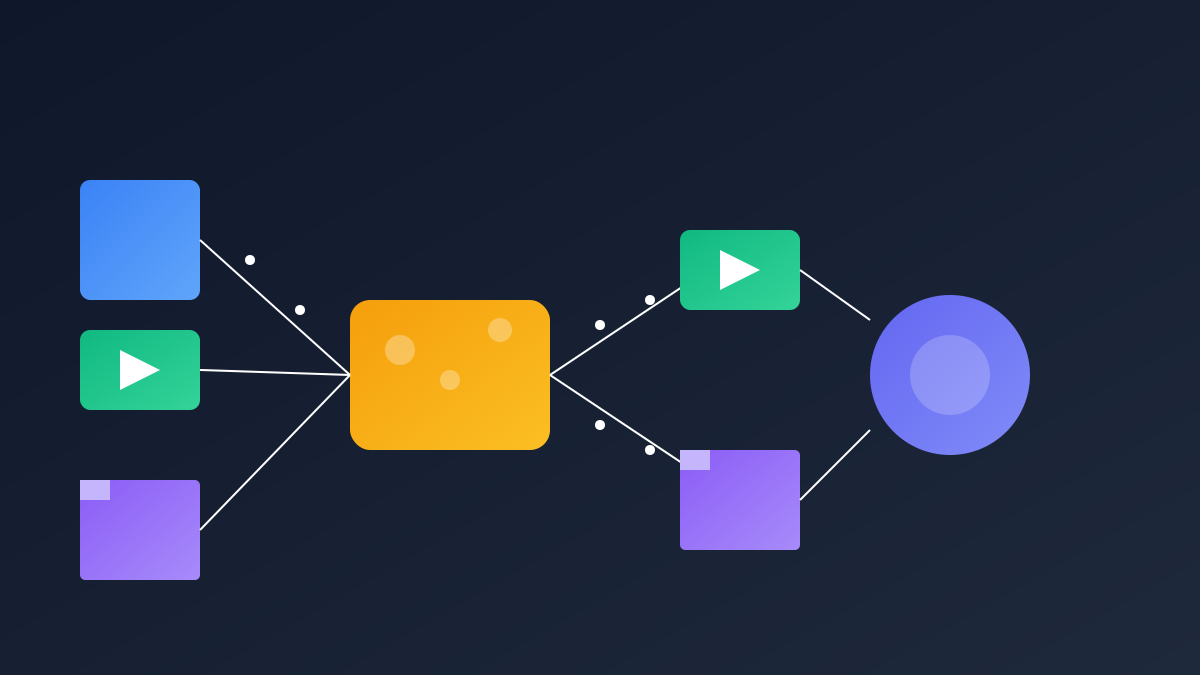
  1. Image/Video Understanding: Analyze static images (description, object recognition, scene relationships) and videos (temporal content, keyframe extraction, action/event understanding);
  2. Chart-to-Insight: Automatically analyze bar charts/line charts/pie charts, extract data points, and generate natural language insights;
  3. Document Visual Q&A (Document VQA): Understand the layout of scanned documents/PDFs/tables and answer semantic questions;
  4. Visual Grounding: Associate text descriptions with image regions (e.g., return coordinates of a sofa);
  5. Cross-Modal Search: Support cross-modal retrieval of text-to-visual or visual-to-text.
5

Section 05

Production-Grade Engineering Features

  • Asynchronous Processing: Return an ID after receiving a task; clients can poll or use callbacks to get results;
  • Batch Processing Support: Automatically group and schedule large numbers of tasks to optimize resource utilization;
  • Error Handling and Retry: Automatic retry and degradation strategies (switch to backup when the main model is unavailable);
  • Caching Mechanism: Cache results of repeated queries to reduce model call costs;
  • Observability: Integrate monitoring logs to track metrics like request processing time, cost, and success rate.
6

Section 06

Key Application Scenarios

  • Intelligent Document Processing: Analyze contracts/invoices/reports, extract information, and generate summaries;
  • Content Moderation: Identify non-compliant content in images/videos and generate moderation reports;
  • E-commerce Search and Recommendation: Search for products by image, or images by description;
  • Educational Assistance: Analyze teaching videos to generate subtitles, chapter summaries, and knowledge points;
  • Business Intelligence: Automatically analyze charts and generate data insight reports.
7

Section 07

Summary and Outlook

This project demonstrates how to transform cutting-edge VLM capabilities into practical production systems, balancing capability and efficiency through a dual-model architecture. As multimodal models evolve, such pipelines will become an important bridge connecting model capabilities and real-world applications, providing valuable reference implementations for developers and enterprises.

