Zing Forum

Reading

Peer AI: A Fully Automated AI Development Workflow from Requirement Emails to Deliverable Applications

A portable, agent-agnostic AI-assisted software development workflow framework that enables end-to-end automated development from stakeholder emails to tested, well-documented applications.

AI开发工作流自动化代理无关代码生成测试自动化软件工程
Published 2026-06-16 02:16Recent activity 2026-06-16 02:30Estimated read 7 min
Peer AI: A Fully Automated AI Development Workflow from Requirement Emails to Deliverable Applications
1

Section 01

Peer AI: Fully Automated AI Development Workflow—End-to-End Solution from Requirement Emails to Deliverable Applications

Peer AI is a portable, agent-agnostic AI-assisted software development workflow framework designed to enable end-to-end automated development from stakeholder emails to tested, well-documented applications. Its core advantages include agent agnosticism (supports multiple AI models), full coverage of the software development lifecycle, and portable declarative configuration, addressing the pain points of existing AI development tools.


2

Section 02

Project Background: Four Pain Points of AI-Assisted Development

With the improvement of LLM capabilities, AI-assisted development has become popular, but existing tools have the following issues:

  1. Tool Lock-in: Bound to specific models/platforms, high migration costs;
  2. Fragmented Processes: Tools for each link are scattered, lacking a unified workflow;
  3. Context Loss: AI struggles to maintain complete project context, leading to inconsistent code;
  4. Uncontrollable Quality: Lack of automated testing and verification mechanisms. Peer AI is designed to address these pain points.
3

Section 03

Core Design Philosophy: Agent-Agnostic, End-to-End, Portable

Three key design highlights of Peer AI:

  • Agent-Agnostic: Supports multiple models such as OpenAI GPT, Anthropic Claude, Google Gemini, and local Ollama, allowing flexible switching to optimize costs and adapt to needs;
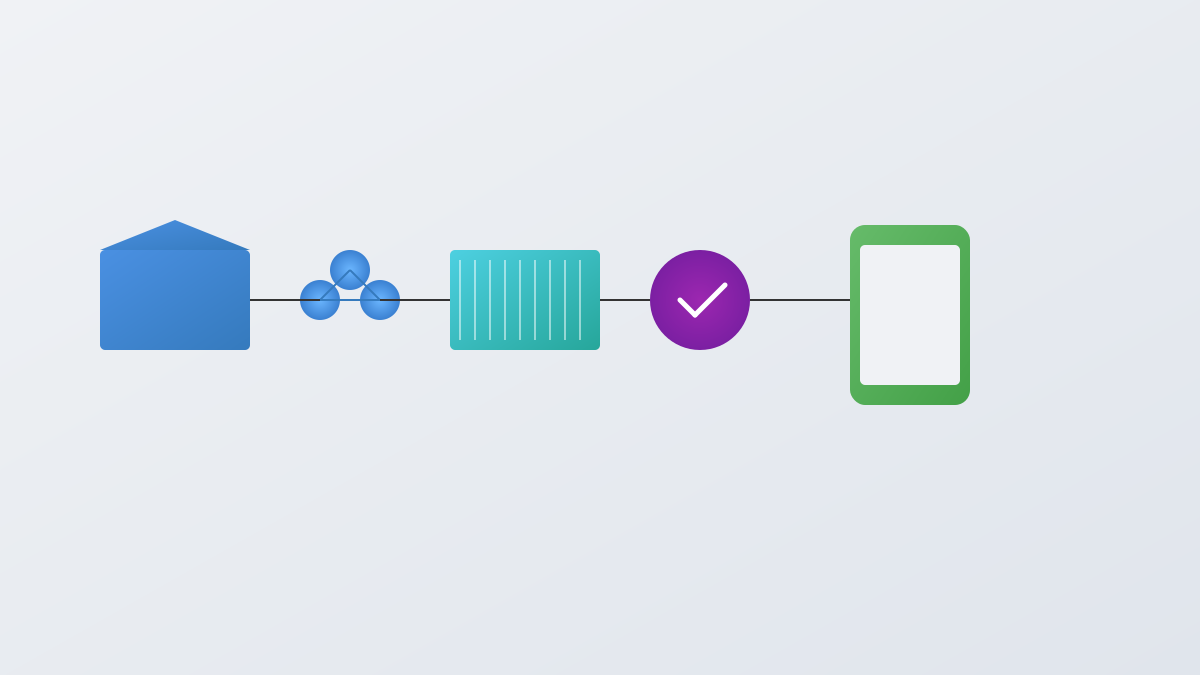
  • End-to-End Workflow: Covers the entire process from requirement input → analysis → technical design → code generation → review → testing → documentation → delivery;
  • Portability: Defines model parameters, processing rules, quality gates, etc., via declarative configuration, enabling easy migration across projects/environments.
4

Section 04

Detailed Workflow: Six Stages from Requirement to Delivery

Peer AI's workflow consists of six stages:

  1. Requirement Parsing: Extract requirements from emails/documents, clarify ambiguities, and generate structured specifications;
  2. Technical Design: Determine architecture, technology selection, data models, and security solutions;
  3. Code Generation: Generate modular code, maintain context consistency, and follow best practices;
  4. Code Review: Static analysis, security scanning, complexity checks, and automatic feedback for corrections;
  5. Test Generation & Execution: Generate unit/integration/end-to-end tests, execute automatically, and analyze results;
  6. Documentation Generation: Generate README, API documentation, architecture documentation, and deployment documentation.
5

Section 05

Key Technical Implementation: Prompt Engineering and Quality Assurance

Key technical implementations include:

  • Prompt Engineering: Stage-specific templates that support variable injection of project context;
  • Context Management: Maintain project memory, incremental updates, and intelligent compression to preserve consistency;
  • Quality Gates: Set thresholds for each stage (e.g., code lint pass, test pass rate >90%);
  • Error Recovery: Analyze failure causes, rollback and retry, with manual intervention if necessary.
6

Section 06

Application Scenarios: From Rapid Prototyping to Outsourcing Management

Peer AI is suitable for various scenarios:

  1. Rapid Prototyping: Generate runnable prototypes within hours for user validation;
  2. Legacy System Refactoring: Assist in generating new code, migrating data, and writing tests;
  3. Standardized Development: Ensure teams follow unified coding standards and architectural patterns;
  4. Outsourcing Project Management: Generate code and documentation to facilitate client acceptance.
7

Section 07

Limitations and Improvement Directions: Balancing Efficiency and Quality

Current Limitations:

  • Complex business logic requires manual adjustments;
  • Auto-generated code performance may not be optimal;
  • Restricted in innovative design scenarios. Improvement Directions:
  • Integrate domain knowledge bases to enhance business logic accuracy;
  • Add an automated performance optimization stage;
  • Introduce human-machine collaboration models at key decision points.
8

Section 08

Conclusion: Future Directions of AI-Assisted Development

Peer AI demonstrates the future trends of AI-assisted development: end-to-end automation, agent agnosticism, and controllable quality. While it cannot fully replace humans, it can significantly improve efficiency and reduce repetitive work. As AI capabilities improve, such tools will become more mature, and development teams should try them early to maintain competitiveness.

