Zing Forum

Reading

PC Energy Telemetry System: Real-Time Monitoring of Hardware Power Consumption for Gaming and AI Inference

This article introduces a desktop PC energy monitoring system based on Python, Prometheus, and Grafana, which can real-time track the power consumption performance of GPU, CPU, memory, and storage in large-scale gaming and LLM inference scenarios.

PC监控能耗遥测PrometheusGrafanaGPU功耗LLM推理硬件监控Python
Published 2026-04-08 19:14Recent activity 2026-04-08 19:19Estimated read 8 min
PC Energy Telemetry System: Real-Time Monitoring of Hardware Power Consumption for Gaming and AI Inference
1

Section 01

PC Energy Telemetry System: Real-Time Monitoring of Hardware Power Consumption for Gaming and AI Inference (Main Floor Guide)

This article introduces an open-source desktop PC energy telemetry system based on Python, Prometheus, and Grafana, which can real-time track the power consumption performance of GPU, CPU, memory, and storage in large-scale gaming and LLM inference scenarios. The system aims to help gamers and AI practitioners optimize performance, control costs, ensure hardware lifespan, and bring data center-level monitoring capabilities to personal desktops.


2

Section 02

The Necessity of PC Energy Monitoring (Background)

Against the current technical backdrop, PC energy monitoring has become a刚需 (must-have):

  1. Energy Challenges of Localized AI: Local inference of large language models requires high hardware power consumption; without monitoring, it is difficult to evaluate costs and optimize efficiency;
  2. Balance Between Gaming Performance and Energy Efficiency: Gamers need to find a balance between image quality, frame rate, and power consumption; real-time monitoring helps them understand the energy consumption differences under different settings;
  3. Hardware Health and Lifespan Management: By monitoring power consumption curves and their correlation with temperature, anomalies can be detected in time and heat dissipation strategies adjusted;
  4. Electricity Cost Calculation: Users running AI workloads for long periods can use accurate data for cost estimation and optimization.
3

Section 03

System Architecture Design (Methodology)

The system adopts a cloud-native monitoring technology combination:

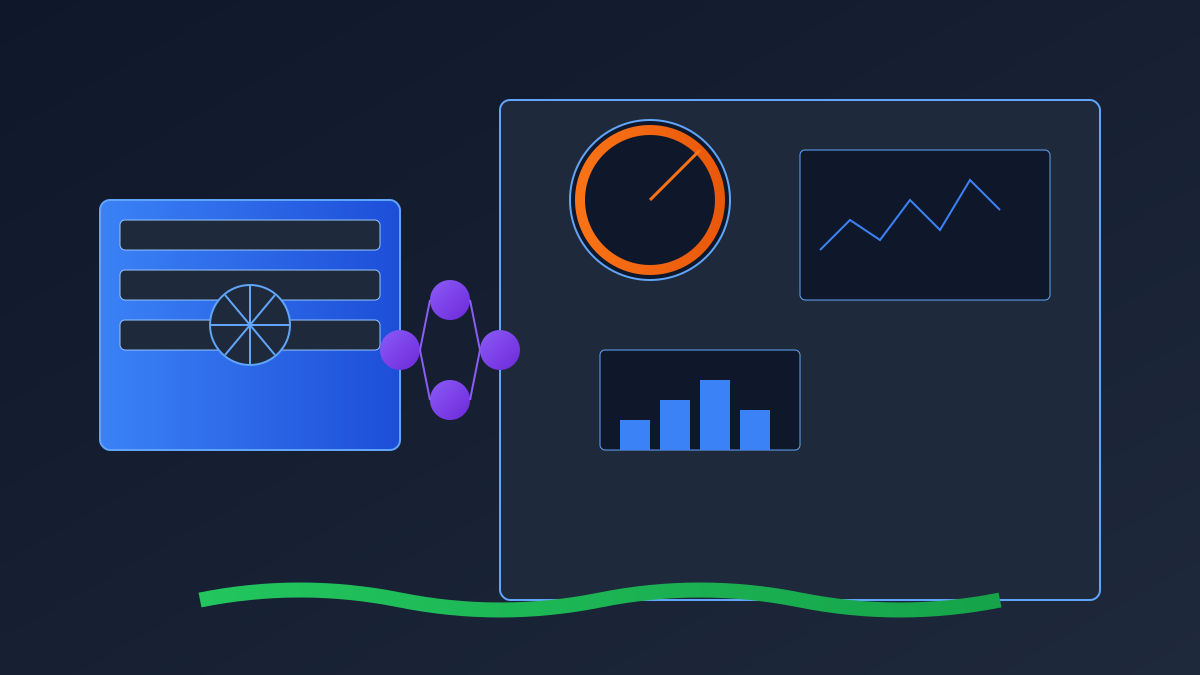
1. Data Collection Layer (Python): Collects power consumption and related metrics of GPU (NVML/ROCm), CPU (MSR/RAPL), memory, and storage through libraries like nvidia-ml-py, pyadl, and psutil; 2. Data Storage Layer (Prometheus): Designed specifically for time-series data, supports efficient storage, PromQL queries, and alert mechanisms; lightweight and suitable for personal PCs; 3. Visualization Layer (Grafana): Provides real-time power consumption curves, heatmaps, statistical panels, etc., supporting comparative analysis across multiple time ranges.

4

Section 04

Core Functions and Application Scenarios (Evidence)

Core functions cover three major scenarios:

Scenario 1: LLM Inference Optimization: Monitors power consumption differences across different quantization levels, batch sizes, and inference frameworks, identifying memory bottlenecks; Scenario 2: Gaming Energy Efficiency Analysis: Compares the impact of image quality presets, ray tracing on/off, and resolution scaling on energy consumption, identifying CPU/GPU bottlenecks; Scenario 3: System Tuning Verification: Evaluates the power consumption benefit ratio of overclocking/undervolting, heat dissipation modifications, and power supply strategies.

5

Section 05

Key Technical Implementation Points (Method Details)

Key technical implementation points:

1. Multi-source Data Fusion: Unifies and abstracts different hardware interfaces (NVIDIA NVML, AMD ROCm, Intel RAPL, etc.); 2. Sampling Frequency and Precision: GPU (1-5 seconds), CPU (1 second), storage (10-30 seconds), balancing precision and system overhead; 3. Data Persistence: Short-term local retention (7-30 days); long-term can be configured with remote clusters or export key data; 4. Cross-platform Compatibility: Windows relies on WMI/NVML; Linux natively supports /sys/proc; macOS relies on powermetrics.

6

Section 06

Deployment and Usage Guide (Recommendations)

Deployment and usage:

Quick Start:

  1. Install dependencies: pip install prometheus-client nvidia-ml-py pyadl psutil
  2. Start the collection service: python telemetry_server.py
  3. Configure Prometheus scraping targets
  4. Import Grafana dashboard template

Advanced Configuration:

  • Alert rules (e.g., GPU temperature >85°C)
  • Custom dashboards (electricity cost calculator)
  • Automated integration (auto-adjust fan curves, power supply strategies)
7

Section 07

System Limitations and Future Outlook (Conclusion and Directions)

Current limitations and future outlook:

Limitations:

  • Power consumption interfaces are limited on some laptop platforms
  • Peripheral power consumption is difficult to measure accurately
  • Power consumption attribution for multi-GPU systems requires additional processing

Future Directions:

  • Integrate carbon emission calculation
  • Introduce machine learning to predict power consumption peaks
  • Link with task schedulers to implement power-aware orchestration
8

Section 08

Conclusion (Summary)

The PC energy telemetry system brings data center-level monitoring capabilities to personal desktops, providing hardware insights for AI developers and gamers. In the trend of AI localization, controlling hardware power consumption is a necessity for cost management and sustainable computing. This open-source solution lowers the threshold for monitoring, helping users make data-driven hardware optimization decisions.

