Zing Forum

Reading

ParaView: Using Visualization and AI to Help Students Overcome Parallel Programming Debugging Challenges

ParaView helps students intuitively understand parallel program behavior through execution recording and visualization, combined with LLM-assisted analysis of concurrency errors. Experiments show a significant improvement in students' debugging success rates, providing an innovative tool for parallel programming education.

并行编程ParaView可视化调试并发错误计算机科学教育LLM辅助学习死锁竞态条件
Published 2026-06-13 00:30Recent activity 2026-06-15 10:21Estimated read 6 min
ParaView: Using Visualization and AI to Help Students Overcome Parallel Programming Debugging Challenges
1

Section 01

Introduction: ParaView—Visualization and AI Empower Parallel Programming Debugging Teaching

Parallel programming is a core but complex part of computer science education. The non-determinism of concurrency errors (such as deadlocks and race conditions) makes it difficult for students to master. ParaView helps students intuitively understand parallel program behavior through execution record visualization and LLM-assisted analysis. Experiments show a significant improvement in students' debugging success rates, providing an innovative tool for parallel programming education.

Source Information:

2

Section 02

Core Pain Points in Parallel Programming Education

The difficulties in parallel programming learning include:

  1. Execution Non-Determinism: The same program may produce different results when run multiple times, making traditional debugging loops ineffective;
  2. Hidden Errors: Deadlocks and race conditions require specific timing to trigger, which are hard to capture;
  3. Difficult Mental Model Construction: Need to track the state of multiple threads simultaneously, leading to high cognitive load.

Traditional teaching relies on theory and code examples but lacks intuitive understanding of program runtime behavior, limiting learning effectiveness.

3

Section 03

Core Function Design of ParaView

ParaView has two core functions:

  1. Transparent Execution Recording: Automatically records key events such as thread creation, synchronization operations, and memory access without modifying source code, with low performance overhead;
  2. Visualization Presentation:
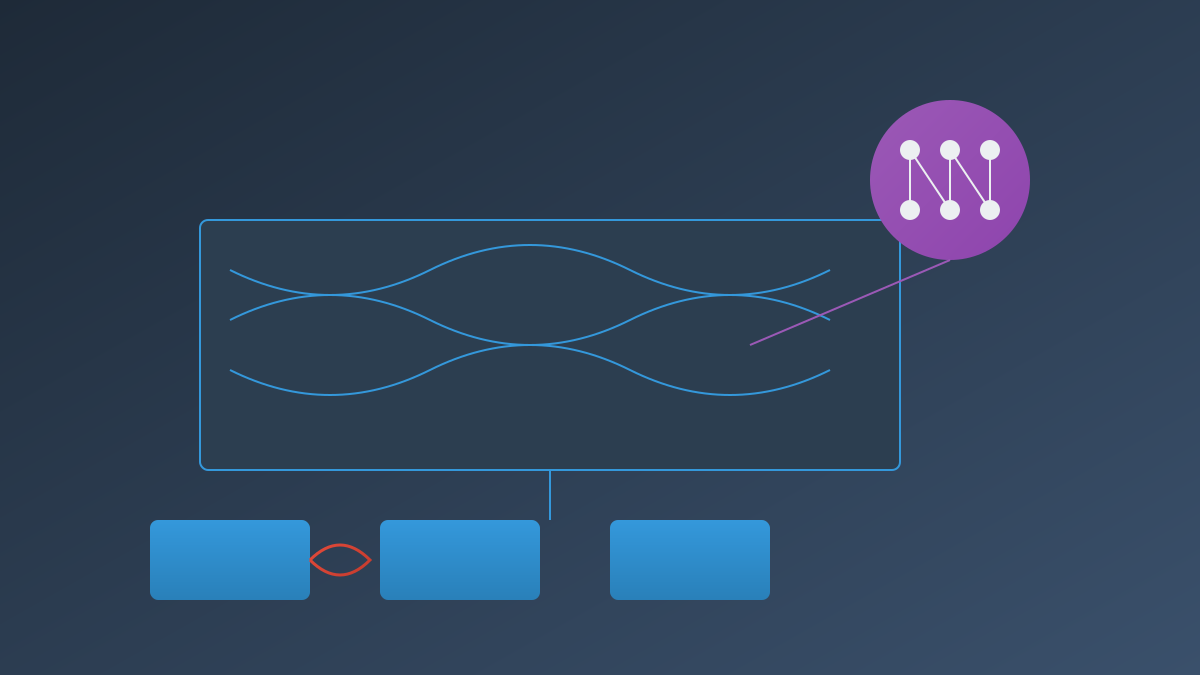
    • Timeline View: Check thread execution sequence and synchronization points;
    • Dependency Graph: Visualize data dependencies and synchronization relationships between threads;
    • Memory Access Patterns: Observe shared memory access sequences to detect race conditions;
    • Deadlock Detection: Automatically identify and highlight deadlock positions and involved threads.

Visualization converts abstract concurrency concepts into intuitive visual elements, lowering the threshold for understanding.

4

Section 04

Experimental Evaluation: ParaView's Teaching Effect is Significant

17 students participated in the evaluation, and the results show:

  1. Improved Debugging Success Rate: Visualization helps quickly locate problems and reduce time spent on blind attempts;
  2. Enhanced Task Performance: Students' parallel algorithm design and coding abilities improved;
  3. Positive Student Feedback: Most students think the visualization is intuitive, and the record-replay function supports the debugging process.
5

Section 05

Pros and Cons of LLM-Assisted Concurrency Error Analysis

LLM's performance in assisted analysis:

  • Advantages: Effectively identify concurrency error patterns (such as unprotected shared variables, lock order errors) and explain execution traces;
  • Limitations: Repair suggestions are inconsistent—high accuracy for simple synchronization modes (mutexes, semaphores), but lower accuracy for complex modes (condition variables, barrier synchronization).

LLM can be used as an auxiliary tool but cannot replace human judgment and verification.

6

Section 06

Teaching Insights and Future Development Directions

Teaching Insights:

  • Visualization is a key tool for understanding concurrency and helps build correct mental models;
  • LLM should be positioned as an "intelligent teaching assistant" to amplify teachers' effectiveness, and students need to verify repair plans.

Future Directions:

  1. Expand language support (Java, Python);
  2. Integrate LLM interaction functions;
  3. Conduct large-scale course evaluations;
  4. Build a library of common concurrency error cases.

Summary: ParaView reduces the learning threshold of parallel programming through technical means, provides an innovative tool for education, and helps cultivate talents in multi-core distributed computing.



