Zing Forum

Reading

Parallel Agents: Design and Practice of Parallel AI Agent Architecture for Software Workflows

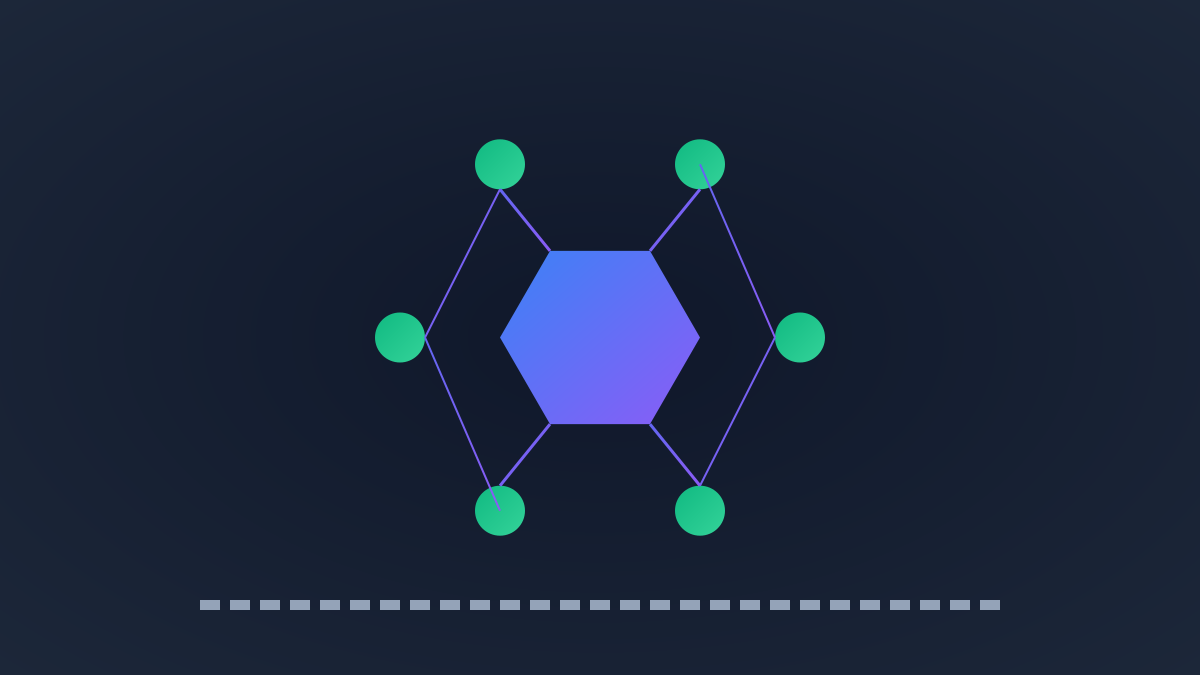
The Parallel Agents project explores a new paradigm of parallel collaboration among multiple AI agents. By decomposing complex software workflows into parallelizable subtasks and having multiple specialized agents collaborate to complete them, it significantly improves the efficiency and intelligence level of AI-assisted software development.

AI代理并行计算软件开发多代理系统工作流自动化代码生成AI工程
Published 2026-05-22 20:15Recent activity 2026-05-22 20:22Estimated read 7 min
Parallel Agents: Design and Practice of Parallel AI Agent Architecture for Software Workflows
1

Section 01

【Introduction】Parallel Agents: Parallel AI Agent Architecture Revolutionizes Software Workflows

The Parallel Agents project explores a new paradigm of parallel collaboration among multiple AI agents. By decomposing complex software workflows into parallelizable subtasks and having specialized agents collaborate to complete them, it significantly improves the efficiency and intelligence level of AI-assisted software development. This article will analyze it from aspects such as background, architecture, and practical strategies.


2

Section 02

Background: Inherent Limitations of Traditional Single-Agent AI Development Tools

Traditional AI programming assistants adopt a "one question, one answer" serial mode, which has four major limitations:

  1. Context Window Bottleneck: When processing large codebases, it is prone to information overload and struggles to handle multi-dimensional tasks simultaneously;
  2. Diluted Professional Capability: General-purpose models lack depth in specific tasks (e.g., security audits);
  3. Inefficient Serial Execution: Complex tasks require iteration and cannot leverage parallel computing capabilities;
  4. Cumulative Error Propagation: Early errors affect subsequent steps, leading to exponentially increasing correction costs.
3

Section 03

Core Architecture: Design Philosophy of Parallel Agents

The core architecture of Parallel Agents includes:

  • Task Decomposition and Dependency Analysis: Split requirements into subtasks and analyze dependencies (dynamically generated by templates or planning agents);
  • Agent Pool and Role Allocation: Maintain a pool of specialized agents (code generation, review, testing, etc.) and assign roles based on task nature;
  • Parallel Execution Engine: Schedule parallel execution of independent tasks and manage the order of dependent tasks;
  • Result Aggregation and Conflict Resolution: Integrate parallel results and arbitrate conflicts in code modifications;
  • Iterative Optimization Loop: Feedback results trigger agent corrections (e.g., review issues → code generation improvements).
4

Section 04

Parallelization Strategy: Parallel Practices in Software Development Phases

Parallelization strategies cover multiple scenarios:

  1. Multi-file Parallel Generation: Simultaneously generate modules such as front-end components and back-end APIs (under the premise of clear interface contracts);
  2. Code and Test Collaboration: Generate code and test cases simultaneously for mutual verification;
  3. Multi-dimensional Review: Parallel review in dimensions like style, security, and performance;
  4. Multi-target Documentation: Parallel generation of user manuals, API documents, etc.;
  5. Cross-language/Platform Synchronization: Parallel generation and verification of multi-version implementations.
5

Section 05

Technical Challenges and Toolchain Integration

Technical Challenges:

  • State Consistency Management: Prevent race conditions for shared resources;
  • Communication Overhead Optimization: Balance synchronization timeliness and overhead;
  • Error Isolation and Recovery: Failure of a single agent does not affect the entire system;
  • Resource Scheduling Optimization: Intelligently allocate computing resources;
  • Result Quality Assurance: Select/combine optimal solutions (via evaluation agents or human feedback).

Toolchain Integration:

  • Version Control: Agents submit modifications to Git by granularity;
  • CI/CD: Automatically trigger build and testing;
  • IDE Integration: Developers interact in a familiar environment;
  • Issue Tracking: Synchronize task statuses.
6

Section 06

Application Scenarios: Value Manifestation of Parallel Agent Architecture

Applicable scenarios:

  1. Rapid Prototyping: Parallel generation of multiple technical solutions for comparison and verification;
  2. Legacy Code Modernization: Parallel execution of tasks like module extraction and type annotation;
  3. Full-stack Initialization: Parallel generation of front-end, back-end, database, etc.;
  4. Codebase Maintenance: Parallel execution of continuous review, dependency updates, etc.
7

Section 07

Future Directions and Conclusion

Future Directions:

  • Adaptive Agent Organization: Dynamically adjust the number and structure of agents;
  • Agent Learning and Evolution: Learn customized capabilities from history;
  • Deepened Human-Agent Collaboration: Better understand developers' intentions;
  • Cross-project Knowledge Sharing: Reuse experiences and best practices.

Conclusion: The parallel agent architecture draws on distributed and parallel computing ideas, providing a new direction for AI-assisted development and is worthy of in-depth research and practice.

