Zing Forum

Reading

Parallax AI: Multi-Model Intelligent Orchestration Platform, Dynamic Routing for a Unified AI Experience

This article introduces Parallax AI, an open-source multi-model AI orchestration platform that integrates professional AI systems such as reasoning, programming, research, UI/UX, and voice interaction into a unified experience through adaptive routing, response fusion, and real-time dialogue capabilities.

多模型编排AI路由大语言模型响应融合智能对话模型选择AI平台自适应系统多模态交互
Published 2026-05-26 18:51Recent activity 2026-05-26 19:34Estimated read 7 min
Parallax AI: Multi-Model Intelligent Orchestration Platform, Dynamic Routing for a Unified AI Experience
1

Section 01

Introduction: Parallax AI – Multi-Model Intelligent Orchestration Platform for a Unified AI Experience

Core Introduction to Parallax AI

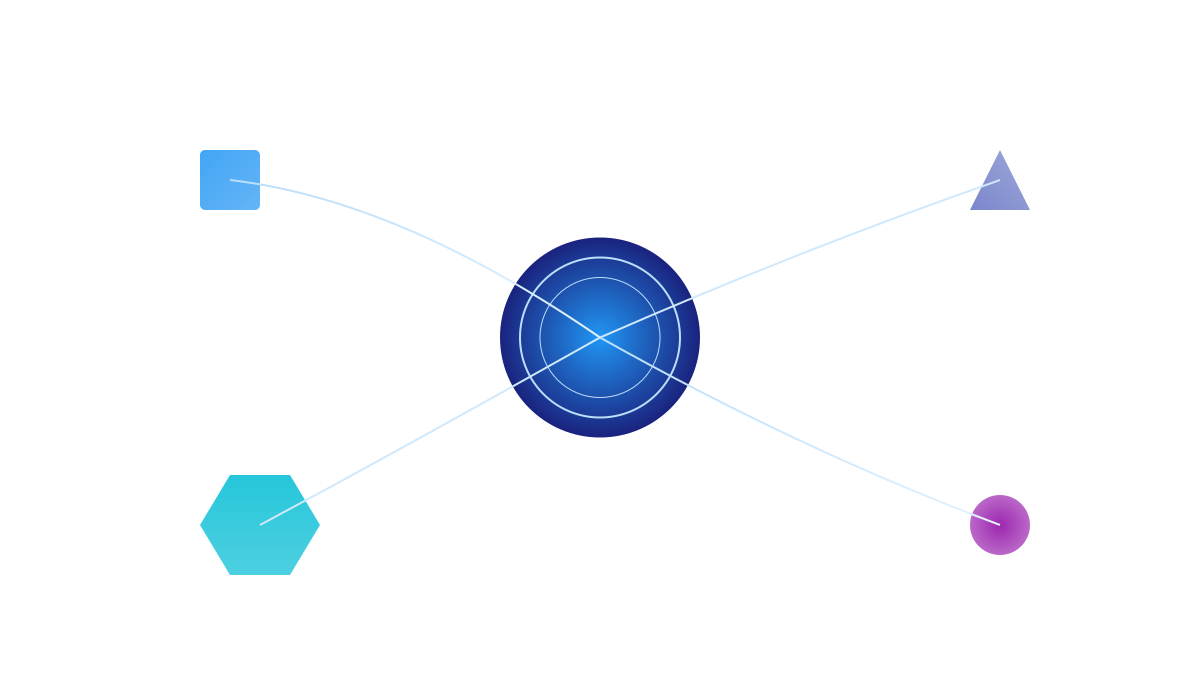
Parallax AI is an open-source multi-model AI orchestration platform developed by AnurugDey2005 on GitHub. It aims to address the limitations of single models by integrating professional AI systems (such as reasoning, programming, research, UI/UX design, and voice interaction) into a unified user experience through adaptive routing, response fusion, and real-time dialogue capabilities. Users do not need to manually switch models or manage multiple API keys; the system automatically identifies query intent and selects the optimal model combination to complete tasks.

Basic Project Information

2

Section 02

Background: Limitations of Single Models and the Need for the Multi-Model Era

Limitations of Single Models and the Rise of Multi-Model Strategies

Although large language models (LLMs) are powerful, no single model excels at all tasks:

  • GPT-4 is good at general dialogue but may not handle programming tasks as well as specialized code models;
  • Claude excels at long text analysis but lags behind specialized models in mathematical reasoning;
  • Open-source models are low-cost but have limited performance on complex tasks.

This situation has given rise to the 'multi-model strategy', but operations like manual model switching and API key management pose barriers for users and developers. Parallax AI was created to address this pain point.

3

Section 03

Core Architecture: Dynamic Routing and Multi-System Integration

Core Functional Modules

  1. Adaptive Query Routing: Through intent recognition and task classification, queries are dynamically routed to the most suitable model (e.g., programming tasks to code models, mathematical reasoning to logical models), while considering real-time factors (model load, response latency, cost).
  2. Multi-Professional AI System Integration: Supports reasoning engines (logic/mathematics), code assistants (code generation/understanding), research tools (literature/data analysis), UI/UX design assistants, voice interaction modules, etc.
  3. Response Fusion and Coordination: Invokes multiple models for complex tasks, integrates outputs, resolves conflicts, and provides comprehensive solutions.
  4. Real-Time Dialogue Management: Maintains dialogue context across models to ensure coherence in multi-turn interactions.
4

Section 04

Technical Highlights: Performance and Cost Optimization

Advantages of Technical Implementation

  • Model-Agnostic Abstraction Layer: Interacts with underlying models through a unified interface; adding/replacing models does not require modifying upper-layer logic, offering high flexibility.
  • Latency Optimization Strategies: Reduces response time through predictive preloading (preparing models based on dialogue trends), parallel queries (requesting multiple candidate models simultaneously), and intelligent caching (responses to common queries).
  • Cost-Aware Scheduling: Built-in cost tracking and budget management; prioritizes cost-effective models and automatically downgrades when budgets are limited.
5

Section 05

Application Scenarios: Covering Multiple Roles and Multi-Modal Interactions

Applicable Scenarios

  • Developer Assistant: One-stop assistance for code generation, architecture design, document writing, bug analysis, etc.
  • Research Partner: Coherent research support for literature retrieval, data analysis, writing assistance, etc.
  • Product Manager Tool: Efficiency improvement for user research, competitor analysis, prototype design, requirement document writing, etc.
  • Multi-Modal Interaction Entry: Voice interaction supports AI access in scenarios like smart homes and in-vehicle systems.
6

Section 06

Significance and Outlook: Future Trends of Multi-Model Collaboration

Project Value and Future

Parallax AI represents an important trend in the AI application layer—shifting from single-model competition to multi-model collaboration:

  • User Value: Gain more comprehensive capabilities than a single model.
  • Developer Value: Flexibly integrate the latest models without being limited to specific vendors.
  • Future Outlook: As the AI model ecosystem enriches, such multi-model orchestration platforms may become the standard architecture for AI applications, driving more intelligent and human-centric AI interaction experiences.



