Zing Forum

Reading

Parallax Architecture: Why Thinking and Execution Must Be Completely Separated in AI Agents

This article introduces the Parallax security paradigm, which addresses fundamental security vulnerabilities in AI agents through four core principles: cognition-execution separation, adversarial validation, information flow control, and reversible execution. Experiments show that this architecture can block 98.9% to 100% of attacks with zero false positives.

AI安全智能体架构权限分离提示词注入对抗验证信息流控制OpenParallaxAI智能体安全认知执行分离可逆执行
Published 2026-04-15 01:20Recent activity 2026-04-15 11:19Estimated read 7 min
Parallax Architecture: Why Thinking and Execution Must Be Completely Separated in AI Agents
1

Section 01

Core Guide to Parallax Architecture: Cognition-Execution Separation Is Key to AI Agent Security

This article introduces the Parallax security paradigm, which aims to address fundamental security vulnerabilities in AI agents. Its core lies in implementing architecture-level security enforcement through four core principles: cognition-execution separation, adversarial validation, information flow control, and reversible execution. Experiments show that this architecture can block 98.9% to 100% of attacks with zero false positives in compromise assessment, providing a new direction for AI agent security.


2

Section 02

AI Agent Security Crisis and Fatal Flaws of Prompt Guardrails

Autonomous AI agents are becoming core infrastructure for enterprises, but traditional prompt guardrails have three major flaws: 1. Sharing a computing base with threats, making them vulnerable to prompt injection; 2. Degradation in long contexts; 3. Failure in multi-agent propagation. In early 2026, a vulnerability in the OpenClaw framework exposed over 21,000 instances, and a Fortune 500 company leaked customer data due to malicious invoice prompt injection, highlighting the severity of the problem.

3

Section 03

Core Principles of Parallax Architecture: Architecture Enforcement Learned from System Security

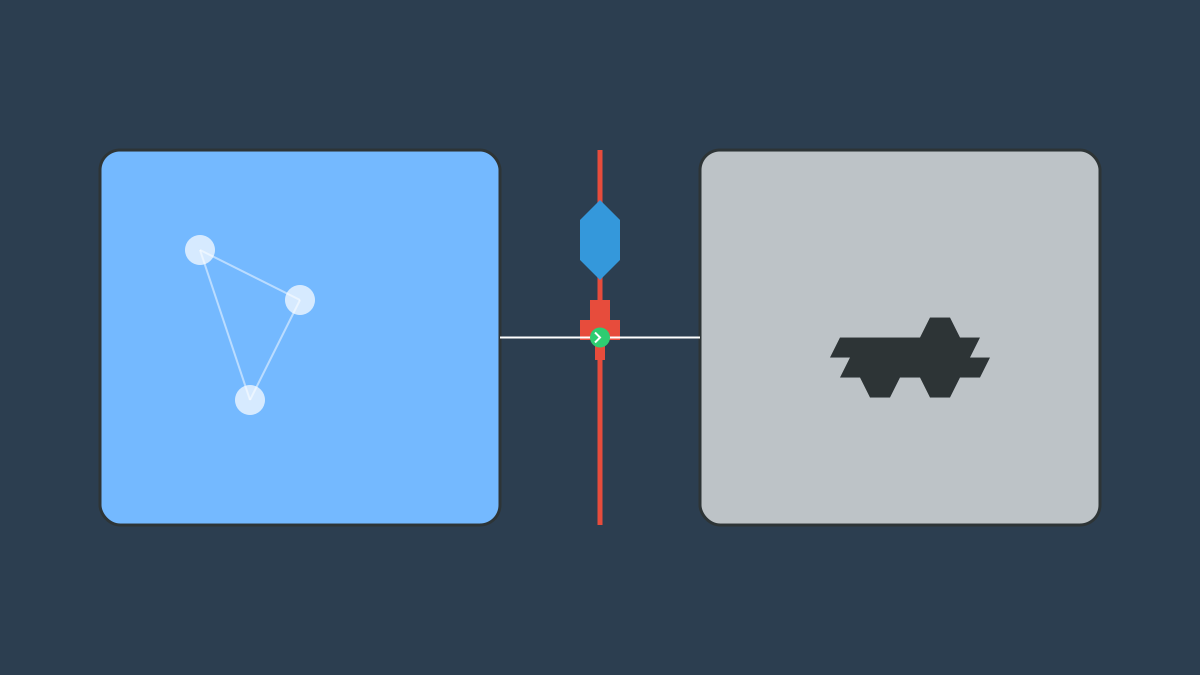
Parallax believes that agent security should rely on architecture enforcement rather than language-level mechanisms. Its core insights come from system security practices: such as OS privilege separation, mandatory access control, and hardware security modules. The key point is: the reasoning system (cognition layer) cannot directly execute actions, the execution system (execution layer) cannot reason, and an independent immutable validator is inserted in between.

4

Section 04

Detailed Explanation of Parallax's Four Core Principles

Parallax's four core principles include:

  1. Cognition-Execution Separation: The cognition layer is responsible for decision-making, the execution layer for actions, with process-level isolation;
  2. Adversarial Validation and Progressive Determinism: Four layers of validation (syntax, semantics, policy, behavior), low-risk actions pass quickly, high-risk actions undergo strict validation;
  3. Information Flow Control: Data is tagged with sensitivity labels to prevent confidential data from flowing to public channels;
  4. Reversible Execution: Chronicle records pre-execution states, supporting rollback and recovery.
5

Section 05

Key Components of the OpenParallax Open-Source Implementation

OpenParallax (developed in Go) includes:

  • Shield: A four-layer validation system that intercepts calls from the cognition layer to the execution layer;
  • Chronicle: Pre-damage state capture, supporting reversible execution;
  • Sandbox: Process-isolated execution environment;
  • Tagging System: Data sensitivity labeling mechanism to implement information flow control.
6

Section 06

Compromise Assessment: Experimental Evidence for Parallax

The Parallax team used compromise assessment (direct tool call injection testing) on 280 adversarial cases (including 9 types of attacks such as prompt injection and multi-agent compromise):

  • The default configuration blocks 98.9% of attacks with zero false positives;
  • The highest security configuration blocks 100% of attacks. Prompt guardrails are ineffective when the reasoning system is compromised, while Parallax's architectural boundaries remain effective.
7

Section 07

Implications and Recommendations of Parallax for Enterprise AI Security

Implications of Parallax for enterprises: Security requires architecture enforcement. Recommendations:

  1. Audit existing systems to check if cognition and execution layer permissions are mixed;
  2. Introduce an independent validation layer;
  3. Implement information flow control (sensitive data labeling);
  4. Prepare rollback mechanisms for destructive operations.
8

Section 08

Limitations and Future Directions of Parallax

Limitations of Parallax: Architecture enforcement introduces performance overhead, and the security of the validator itself is crucial. Future research directions:

  • Develop dedicated evaluation models for validators;
  • Apply to embodied intelligent systems (e.g., robots);
  • Deploy validation in critical infrastructure;
  • Hardware-level security enhancements (e.g., dedicated chips).

