Zing Forum

Reading

Overseer: A Visual Simulator for Multi-Agent Software Development Lifecycle Based on Ollama

A fully locally deployed AI-driven SDLC simulation system that coordinates multiple roles such as requirements analysis, development, and testing via the Supervisor agent, combined with a RAG memory system and an interactive node visualization interface to help users understand and experiment with multi-agent collaboration processes.

Overseer多智能体系统SDLC模拟器OllamaRAG记忆React Flow软件开发生命周期本地AI部署智能体协作可视化工作流
Published 2026-05-05 13:14Recent activity 2026-05-05 13:24Estimated read 7 min
Overseer: A Visual Simulator for Multi-Agent Software Development Lifecycle Based on Ollama
1

Section 01

Overseer Project Guide: Core Introduction to the Local Multi-Agent SDLC Visual Simulator

Overseer is a fully locally deployed AI-driven Software Development Lifecycle (SDLC) simulation system. It coordinates roles like requirements analysis, development, and testing through the Supervisor agent, and combines a RAG memory system with the React Flow interactive visualization interface to help users understand and experiment with multi-agent collaboration processes, addressing the pain point of understanding the black-box nature of multi-agent system interactions.


2

Section 02

Project Background: Challenges in Understanding and Debugging Multi-Agent Systems

With the development of large language models, multi-agent collaboration has become a frontier in AI applications. However, agent interactions are often black-box, making it difficult for developers to observe and debug. Overseer aims to provide a local environment for users to experiment with and observe multi-agent workflows safely and privately.

3

Section 03

Core Architecture and Methodology: Three-Tier System and Agent Design

Three-Tier Architecture

  • Frontend layer: Built with React 18+Vite, React Flow for node canvas, Zustand for state management, Socket.IO for real-time communication
  • Backend layer: Node.js+Express for logic processing, Socket.IO for frontend-backend coordination
  • RAG layer: Python+FastAPI for services, ChromaDB for vector memory storage

Agent Roles

  • Supervisor: System brain, coordinates requirements, development, and testing agents
  • Requirements Analysis Agent: Converts requirements to user stories and confirms them
  • Development Agent: Designs, implements, and reviews code
  • Testing Agent: Writes test cases, tests boundaries, and generates reports

RAG Memory System

Supports cross-session retrieval, persistent storage of historical summaries, and pre-fills domain knowledge with a seed knowledge base.

4

Section 04

Visual Interaction Experience: Real-Time Workflow and Chat Interface

Node Canvas

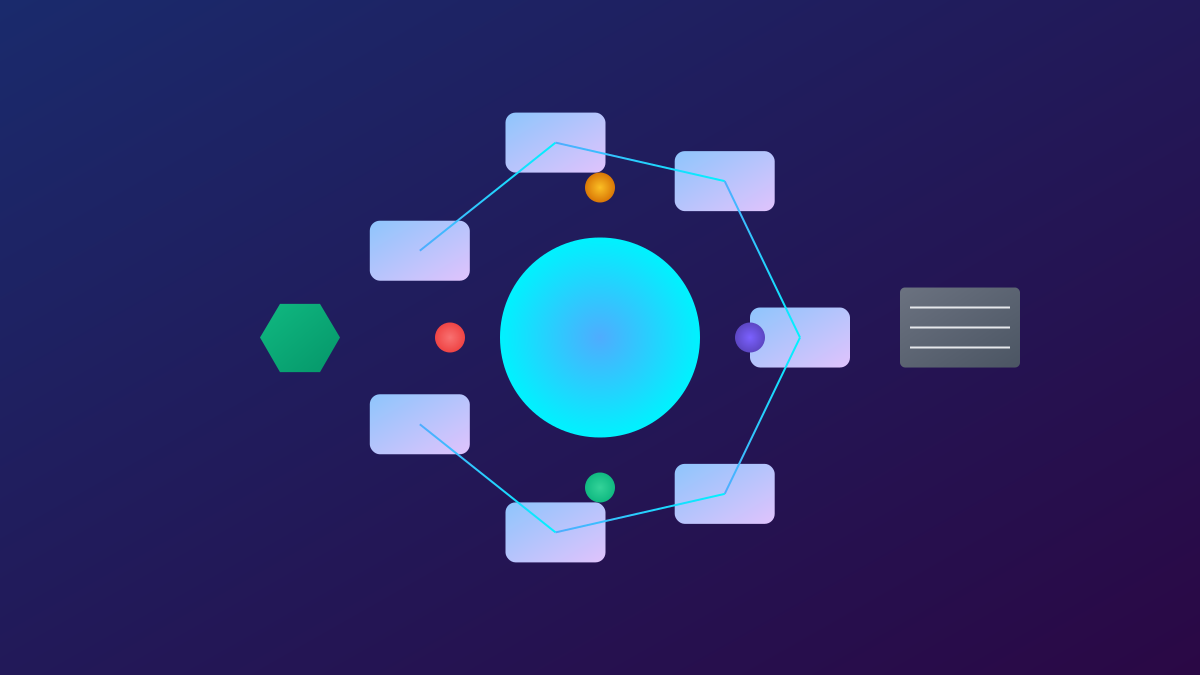
Uses React Flow to display real-time processes: user input nodes, RAG retrieval nodes, Supervisor decision nodes, agent execution nodes, and connecting edges—helping observe collaboration processes and identify bottlenecks.

Real-Time Chat Panel

Displays conversation history, allows users to intervene and clarify at any time, and maintains session context.

5

Section 05

Local Deployment and Privacy Protection: Data Security and Autonomous Control

Fully local operation: Ollama local model inference, ChromaDB local memory storage, no external service dependencies. Privacy advantages include data not leaving the local environment, no account requirements, no API quota limits, and open-source code for auditability.

6

Section 06

Use Cases and Value: Application Potential Across Multiple Domains

  • Education and training: Visualizes multi-agent collaboration concepts to assist teaching
  • Prototype validation: Quickly tests agent configurations and task decomposition strategies
  • Privacy-sensitive scenarios: Enterprise internal automated workflow experiments
  • AI research: Transparently observes agent interactions and expands codebases

Overseer is positioned as a learning/demonstration tool, not a production-grade system.

7

Section 07

Limitations and Improvement Directions: Current Restrictions and Future Optimizations

Limitations

  • Model capability: The default phi3 model is lightweight but has limited performance for complex tasks
  • Single-user design: Lacks multi-user collaboration and permission management
  • Non-production ready: No error recovery, concurrency handling, or similar features
  • Limited agent types: Missing DevOps, security review, and other roles

Improvement Directions

  • Expand agent ecosystem: Add DevOps, security, performance optimization, and other roles
  • Enhance memory: Support long-term project memory and external knowledge base integration
  • Production-grade features: Persistent storage, user authentication, audit logs
  • Model flexibility: Mix local/cloud models and support multi-modal input
8

Section 08

Summary and Comparison with Similar Projects: Overseer's Unique Value

Overseer lowers the barrier to understanding multi-agent systems through visualization, ensures privacy via local deployment, and features a modular design for easy expansion. Compared to AutoGPT, CrewAI, and MetaGPT, its advantages lie in excellent real-time visualization, fully local deployment, high usability, and educational value—focused on helping users understand the working principles of multi-agent systems rather than being a fully automated solution.