Zing Forum

Reading

Orbit: Architectural Exploration of a Multimodal Decentralized Agent Platform

Introducing the Orbit project—an open-source multimodal decentralized agent platform. This article explores its design philosophy of "each model is a satellite" and its technical implementation based on Tauri, Rust, and React.

Orbit去中心化智能体Agent多模态TauriRust边缘AI本地模型分布式系统
Published 2026-06-15 21:24Recent activity 2026-06-15 21:53Estimated read 6 min
Orbit: Architectural Exploration of a Multimodal Decentralized Agent Platform
1

Section 01

Orbit Project Introduction: Exploration of a Decentralized Multimodal Agent Platform

Introducing Orbit—an open-source multimodal decentralized agent platform with the core philosophy of "each model is a satellite". It uses the Tauri, Rust, and React tech stack, aiming to solve issues like data privacy and vendor lock-in in centralized agent platforms. It distributes model inference and agent operations across user-controllable nodes, returning data sovereignty to users.


2

Section 02

Background: Pain Points of Centralized Agent Platforms and the Need for Decentralization

With the evolution of large language models, AI Agents are moving toward practical applications. However, mainstream solutions rely on centralized cloud services, which have risks like data privacy leaks, vendor lock-in, and single points of failure. The concept of decentralized agent platforms emerged as a result, and Orbit is an exploratory attempt in this direction.

3

Section 03

Design Philosophy: The "Satellite" Metaphor and Multimodal Capabilities

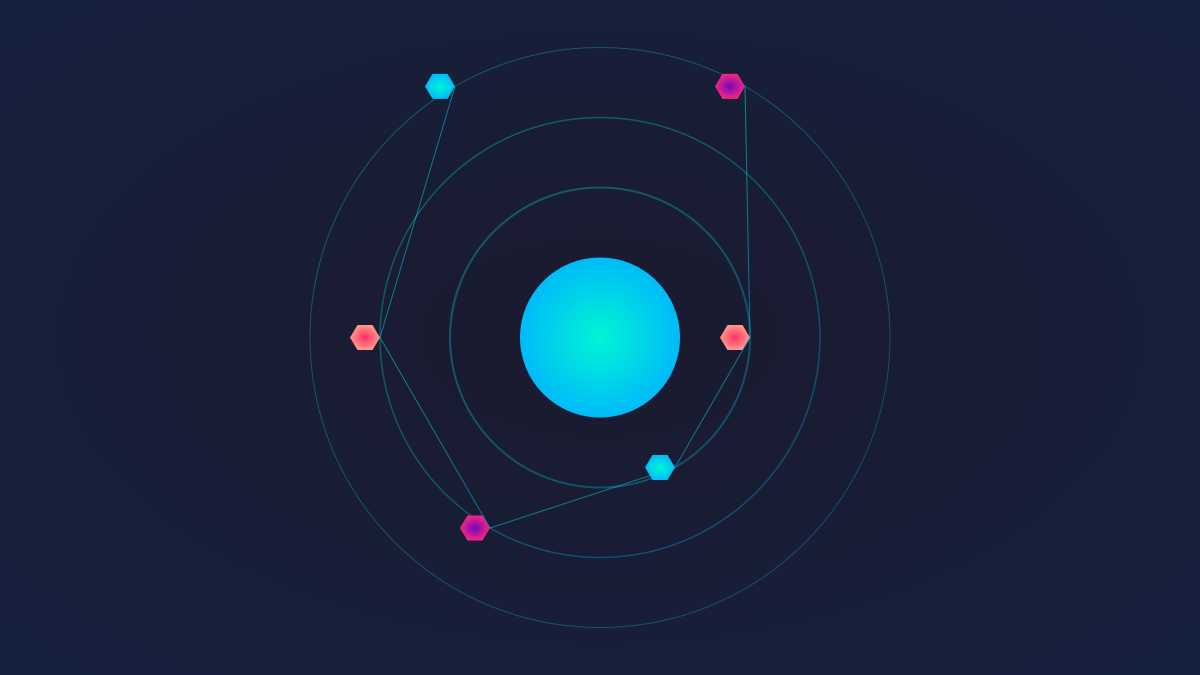
Orbit's core philosophy is "each model is a satellite": distributed operation (models run on local/edge nodes), collaborative work (different models/agents collaborate via protocols), and elastic redundancy (no single point of failure). Multimodal support means agents can process diverse information like images and audio, and sensitive data is processed locally to protect privacy.

4

Section 04

Technical Implementation: Choice of Tauri+Rust+React

Orbit uses the Tauri framework (lightweight backend + Web frontend container), Rust (performance and security), and React+shadcn/ui (modern UI). Compared to Electron, Tauri has a smaller size, lower memory usage, higher security, and cross-platform support. React's componentization makes maintenance easier, and shadcn/ui supports accessibility.

5

Section 05

Technical Challenges: Problems with Models, Communication, and Resources

Building a decentralized platform faces three major challenges: 1. Model distribution and updates (large model size, integrity verification, cache management); 2. Agent communication protocols (message format, discovery mechanism, security authentication, task orchestration); 3. Heterogeneity of computing resources (model quantization, task scheduling, graceful degradation).

6

Section 06

Application Scenarios Outlook: New Possibilities for Privacy and Collaboration

Orbit can be applied in: personal privacy assistants (local data processing), enterprise knowledge management (intranet deployment for compliance), scientific research collaboration networks (cross-institution collaboration to protect results), and edge AI clusters (local collaborative decision-making for IoT devices).

7

Section 07

Comparison with Centralized Solutions: Complementary Choices with Their Own Strengths

Dimension Centralized Solutions (e.g., ChatGPT) Decentralized Solutions (e.g., Orbit)
Data Privacy Data uploaded to service providers Data processed locally
Availability Dependent on network and service providers Runs locally, available offline
Customization Limited by platform options Fully controllable, custom models allowed
Cost Pay-per-use Mainly hardware investment
Capability Ceiling Latest models from service providers Depends on local hardware and deployment
Collaboration Scope Global shared service Private/consortium network
The two models are complementary; decentralization is more suitable for privacy-sensitive, offline, or customized scenarios.
8

Section 08

Project Status and Ways to Participate

Orbit is in the early open-source stage. Those interested can: follow the GitHub repository (https://github.com/tietiezhi-1216/Orbit) for updates; participate in Issue discussions and feedback; contribute code (model integration, UI/UX, etc.); build their own "satellite" nodes to explore possibilities.

