Zing Forum

Reading

Opsx-Codex-Squad: Practice of Dual-Agent Collaborative Development Workflow with Claude Code and Codex

This article introduces the Opsx-Codex-Squad project, an innovative dual-agent development workflow that enhances code quality and development efficiency through a collaborative model of Claude Code for construction, Codex for review, and OpenSpec for standardization.

Claude CodeCodex双代理AI编程代码评审OpenSpec工作流软件工程
Published 2026-04-07 17:15Recent activity 2026-04-07 17:25Estimated read 6 min
Opsx-Codex-Squad: Practice of Dual-Agent Collaborative Development Workflow with Claude Code and Codex
1

Section 01

Introduction: Overview of the Opsx-Codex-Squad Dual-Agent Collaborative Development Workflow

This article introduces the Opsx-Codex-Squad project, an innovative dual-agent collaborative development workflow. It addresses the limitations of single AI agents by adopting a model where Claude Code builds code, Codex reviews quality, and OpenSpec standardizes processes—achieving mutual checks and complements to enhance code quality and development efficiency. This model draws on best practices of human teams and represents a new paradigm for AI-assisted development.


2

Section 02

Background: Current State and Challenges of AI-Assisted Development

With the breakthroughs of large language models in code generation capabilities, AI-assisted development tools have transformed software engineering. However, single AI agents have limitations (e.g., bias, missing edge cases, suboptimal solutions). Opsx-Codex-Squad proposes a multi-agent collaboration solution to build a more reliable development workflow through mutual checks and complements, addressing the "self-confirmation bias" issue of single agents.

3

Section 03

Methodology: Role Division and Workflow of Dual-Agent Collaboration

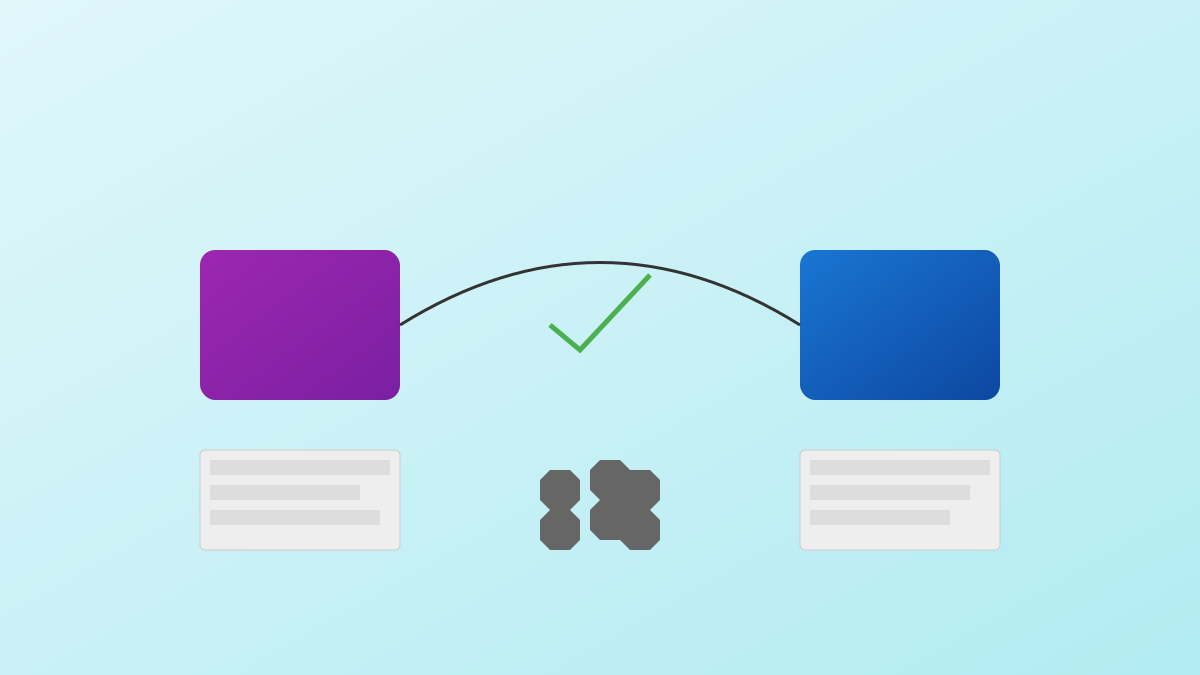
Role Division: 1. Builder (Claude Code): Requirement analysis, architecture design, code implementation, test generation; 2. Reviewer (Codex): Defect detection, security audit, performance evaluation, style check, maintainability assessment; 3. Standardizer (OpenSpec): Requirement specification, interface definition, acceptance criteria, process orchestration.

Workflow: 1. Requirement understanding and specification definition; 2. Initial implementation; 3. Code review; 4. Iterative optimization; 5. Final acceptance.

4

Section 04

Evidence: Application Effects of Dual-Agent Collaboration

  1. Code quality improvement: Reduced bug rate and improved handling of edge cases; 2. Knowledge complementarity: Claude Code excels in architecture and complex logic, while Codex is proficient in pattern recognition and trap detection; 3. Enhanced interpretability: Review reports provide issues, improvement suggestions, and decision-making basis, increasing code transparency.
5

Section 05

Challenges and Limitations: Current Issues

  1. Cost considerations: The cost of dual-agent API calls is relatively high, requiring optimized call strategies; 2. Consistency of review standards: Different agents may give conflicting suggestions, requiring integrated decision-making; 3. Limitations in complex architecture review: It is difficult to fully evaluate architectures with multi-system interactions, requiring more advanced analytical capabilities.
6

Section 06

Future Directions and Recommendations: Expansion and Usage Guide

Future Directions: 1. Multi-agent expansion (specialized agents for security, performance, etc.); 2. Deepening human-AI collaboration; 3. Domain specialization (Web, mobile development, etc.).

Usage Guide: The project adopts modular design (workflow engine, agent adapter, etc.), provides quick-start documentation and custom extension support, allowing users to adjust review rules, iteration strategies, etc.

7

Section 07

Conclusion: Project Significance and Outlook

Opsx-Codex-Squad is an important attempt in the evolution of AI-assisted development towards multi-agent collaboration. It achieves quality checks through role separation, enhances the reliability of AI-generated code, and provides references for human team collaboration. As AI capabilities improve, more intelligent development workflows will emerge, and this project offers practical experience for exploring the future form of AI-assisted development.

