Zing Forum

Reading

OpenTeam Studio: Building Reusable AI Team Collaboration Application Platform

Introducing OpenTeam Studio, an open platform that supports agent collaboration, team design, and shared workflows, helping developers quickly build reusable AI team applications.

AI智能体多智能体协作工作流编排团队设计大语言模型应用
Published 2026-05-04 02:45Recent activity 2026-05-04 02:50Estimated read 6 min
OpenTeam Studio: Building Reusable AI Team Collaboration Application Platform
1

Section 01

OpenTeam Studio: Building Reusable AI Team Collaboration Application Platform (Introduction)

OpenTeam Studio is an open-source AI team collaboration development platform aimed at reducing the complexity of multi-agent application development. The platform provides a complete toolchain from agent design to workflow orchestration, supporting visual team design, agent role definition, collaboration mode configuration, and creation and management of shared workflows, helping developers quickly build reusable AI team collaboration systems.


2

Section 02

Project Background: Needs and Challenges of Multi-Agent Collaboration

With the enhancement of large language model capabilities, a single AI agent can hardly meet the needs of complex business scenarios, making multi-agent collaboration an important trend in AI application development. However, the technical threshold for building and managing AI teams is relatively high, and there is a lack of standardized tools and frameworks. OpenTeam Studio emerged to address this issue.

3

Section 03

Core Features and Agent Collaboration Mechanisms

Overview of Core Features

OpenTeam Studio provides a complete toolchain from agent design to workflow orchestration, supporting visual team design, role definition, collaboration mode configuration, and shared workflow management.

Agent Collaboration Mechanisms

  • Role Definition and Division of Labor: Specify attributes such as an agent's professional field, behavioral style, and decision-making authority through role templates to simulate real team collaboration modes.
  • Collaboration Mode Configuration: Provide preset modes such as serial workflow, parallel processing, and master-slave collaboration, supporting custom rules and dynamic collaboration adjustments.
4

Section 04

Team Design Tools: Visualization and Template Support

Visual Editor

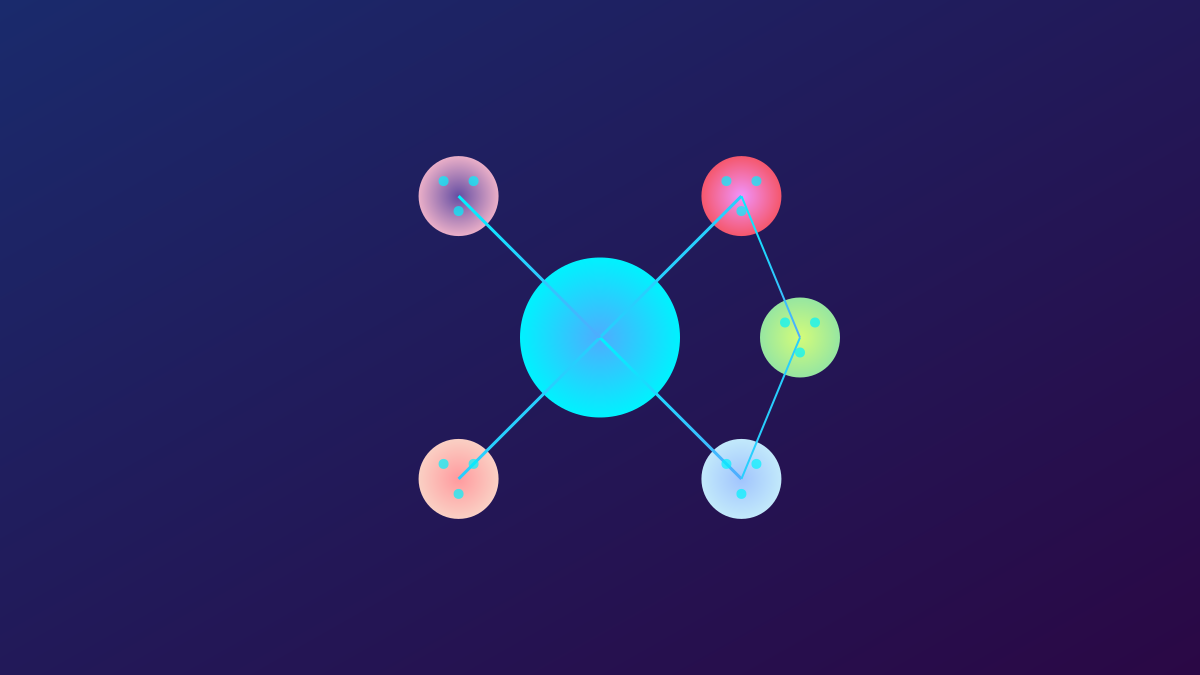
Developers can design AI team structures via drag-and-drop, intuitively displaying agent node connections and collaboration relationships.

Template Library and Best Practices

Built-in templates for common scenarios such as customer service support, content creation, and code review, providing a reliable starting point based on practical application experience.

5

Section 05

Shared Workflows: Reuse and Version Control

Workflow Definition and Reuse

Save complete collaboration processes as reusable templates, supporting cross-project sharing and community distribution to reduce repeated development costs.

Version Control and Iteration

Integrated version control功能 allows tracking workflow change history, rolling back to stable versions, or creating improvement branches.

6

Section 06

Application Scenarios and Practical Value

OpenTeam Studio is suitable for multiple scenarios:

  • Customer service field: Build a customer service team for reception, diagnosis, resolution, and follow-up;
  • Content production: Set up a pipeline for topic selection, writing, editing, and review;
  • Software development: Implement automated collaboration for requirement analysis, architecture design, code generation, and test verification.
7

Section 07

Technical Architecture and Extensibility

The platform adopts a modular architecture, with the core engine decoupled from model implementation, supporting access to different LLM providers or custom agents. The plugin system expands the boundary of capabilities, enabling seamless integration of third-party tools and services.

8

Section 08

Summary: Accelerating Innovation in AI Team Collaboration Applications

OpenTeam Studio provides a standardized and visual solution for multi-agent application development. By lowering the technical threshold and promoting the sharing of best practices, it is expected to accelerate the popularization and innovation of AI team collaboration applications.