Zing Forum

Reading

OpenCode: A Software Development Pipeline with Six Collaborative Agents

OpenCode is an innovative six-agent orchestration system that coordinates five specialized sub-agents through a Captain Agent, breaking down the software development process into five professional stages—planning, coding, testing, review, and submission—to achieve true team-collaborative AI programming.

OpenCode多智能体AI编程代码审查智能体协作软件开发自动化测试团队流水线
Published 2026-05-13 15:14Recent activity 2026-05-13 15:20Estimated read 9 min
OpenCode: A Software Development Pipeline with Six Collaborative Agents
1

Section 01

OpenCode: A New Paradigm for AI Programming with Six Collaborative Agents

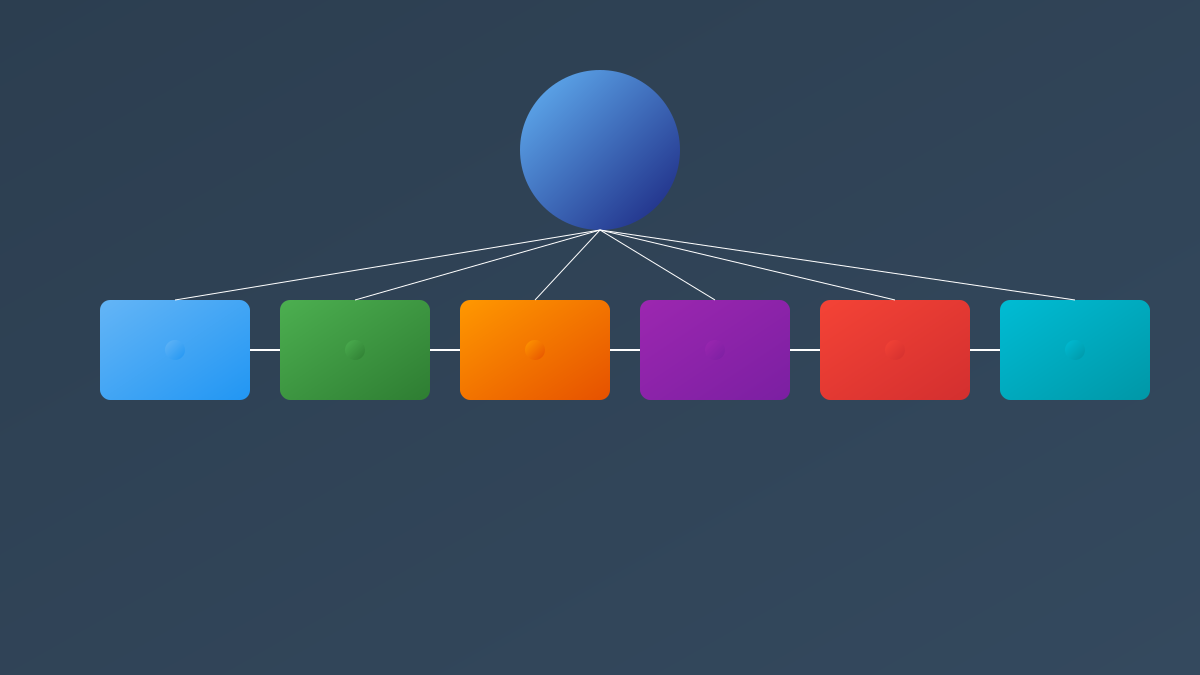
Today, most AI-assisted programming tools use a single-agent model. OpenCode innovatively proposes a six-agent collaborative architecture: through a Captain Agent, it coordinates five specialized sub-agents for planning, coding, testing, review, and submission, simulating the division of labor in human software development teams. This solves problems like heavy cognitive load and insufficient professional depth in single-agent systems, enabling structured and controllable team-collaborative AI programming and providing a more reliable development process for complex projects.


2

Section 02

Four Core Dilemmas of Single-Agent AI Programming

Current mainstream AI programming assistants (e.g., GitHub Copilot, Cursor) use a single-agent model, which has obvious limitations:

  1. Excessive cognitive load: A single model needs to handle multiple tasks simultaneously, such as requirement understanding, architecture design, and coding;
  2. Insufficient professional depth: Code generation and review require different thinking modes, which easily leads to the "both player and referee" problem;
  3. Context window pressure: The code volume and history of complex projects can easily exceed the model's context limit;
  4. Lack of process constraints: Key links like testing and specifications are easily skipped. These problems have prompted OpenCode to replace individual work with team collaboration.
3

Section 03

Six-Agent Architecture and Layered Model Strategy

OpenCode breaks down the development process into six professional roles:

  • Captain Agent: Coordination hub, responsible for task decomposition, process control, and quality check;
  • Planning Agent: Formulates technical solutions, architecture design, and task breakdown;
  • Coding Agent: Writes code and documentation, following best practices;
  • Testing Agent: Designs test cases, executes tests, and generates reports;
  • Review Agent: Checks specifications, security, performance, and maintainability;
  • Submission Agent: Organizes changes, generates commit messages, and triggers CI/CD.

Layered Model Strategy (matching appropriate models for each agent):

Agent Recommended Model Configuration Reason
Captain GPT-4/Claude Opus Strongest reasoning and decision-making ability
Planning GPT-4/Claude Sonnet Architecture design capability
Coding GPT-3.5/Claude Haiku Clear tasks, lightweight model is sufficient
Testing GPT-3.5/Claude Haiku Test generation has clear patterns
Review GPT-4/Claude Sonnet Deep analysis capability
Submission GPT-3.5/Claude Haiku Simple and direct tasks
4

Section 04

OpenCode Workflow Demo and Tool Comparison

Workflow Demo (User Registration Function):

  1. The Captain Agent receives the task and analyzes requirements;
  2. The Planning Agent formulates a technical solution (e.g., bcrypt encryption, email verification);
  3. The Coding Agent generates APIs, migration scripts, etc.;
  4. The Testing Agent generates test cases for normal/abnormal scenarios;
  5. The Review Agent identifies issues like weak password algorithms and missing Rate Limiting;
  6. The Coding Agent reworks and fixes the issues;
  7. The Submission Agent completes version control.

Comparison with Traditional Tools:

Feature Traditional AI Programming Assistants OpenCode
Architecture Model Single-agent Multi-agent collaboration
Process Control No fixed process Structured pipeline
Role Separation None Six professional roles
Quality Assurance Relies on model self-reflection Independent review stage
Customizability Limited Highly configurable
Cost Optimization Uses the strongest model uniformly Layered model strategy
5

Section 05

Applicable Scenarios and Limitations of OpenCode

Applicable Scenarios:

  • Teams with standardized development processes;
  • Complex feature development (multi-module collaboration, requiring architecture design);
  • Projects with strict requirements for code quality, security, and maintainability;
  • Long-term maintenance projects (needing complete documentation and testing).

Limitations:

  • Not suitable for rapid prototype verification (requires waiting for the complete process);
  • Not suitable for simple script tasks (no need for complete testing);
  • Not suitable for exploratory programming (frequent requirement changes).
6

Section 06

Future Outlook and Practical Suggestions for OpenCode

Future Outlook:

  • Smarter coordination: The Captain Agent learns best practices to optimize collaboration;
  • Dynamic role expansion: Automatically create new roles based on project needs;
  • Deep human-machine collaboration: Introduce human decision-making in key links;
  • Cross-project learning: Accumulate experience to form an organizational knowledge base.

Practical Suggestions: For teams pursuing code quality and development standards, OpenCode provides a new paradigm worth trying. Although it may not improve development speed, it can make the process more controllable and the output more reliable, which is a balanced choice of "slowing down to do each step well" in AI programming.

