Zing Forum

Reading

OpenClaw + n8n One-Stop Deployment Solution: Building a Local AI Automation Workflow Platform

A Docker integration solution for Windows users that combines OpenClaw AI Agent, n8n workflow automation, PostgreSQL database, and MCP tools into a single runnable stack, lowering the barrier to setting up a local AI automation environment.

OpenClawn8nDockerAI代理工作流自动化MCPPostgreSQL本地部署容器化自动化栈
Published 2026-05-25 06:45Recent activity 2026-05-25 06:48Estimated read 6 min
OpenClaw + n8n One-Stop Deployment Solution: Building a Local AI Automation Workflow Platform
1

Section 01

Introduction: Core Overview of the OpenClaw + n8n One-Stop Deployment Solution

This article introduces the openclaw-n8n-stack project developed by foot8319, a Docker integration solution for Windows users that connects OpenClaw AI Agent, n8n workflow automation, PostgreSQL database, and MCP tools into a single runnable stack, lowering the barrier to setting up a local AI automation environment. The project is from GitHub, released on May 24, 2026.


2

Section 02

Background: Pain Points of Local AI Automation

Setting up a local AI automation workflow faces three major challenges: scattered components (requiring multiple independent components), complex configuration (each component needs separate installation and communication), and environment differences (deployment and migration difficulties due to different system versions). This project addresses these pain points by integrating multiple components via Docker containerization.

3

Section 03

Core Components: Four Modules Integrated in One Stop

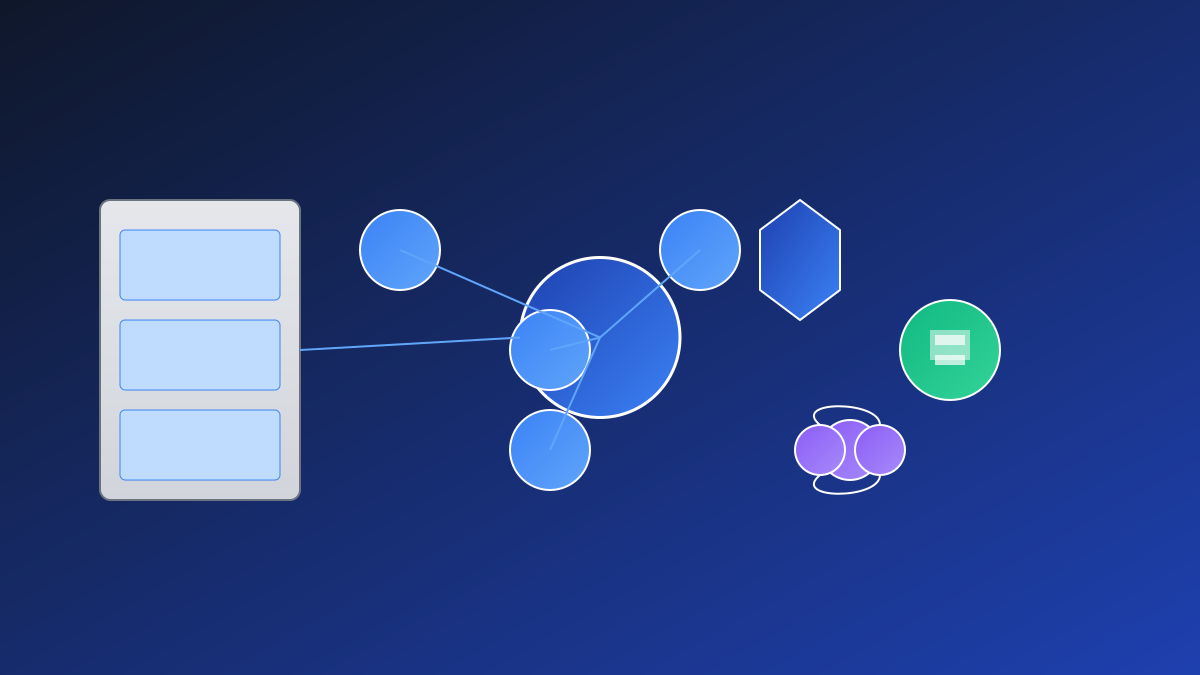
The solution integrates four core components:

  1. OpenClaw AI Agent: The intelligent core that supports multi-agent collaboration, handling AI tasks and orchestration.
  2. n8n Workflow Automation: A visual tool for building processes via drag-and-drop, connecting OpenClaw with external systems.
  3. PostgreSQL Database: The data persistence layer that stores workflow data, configurations, and task records.
  4. MCP Tool Connection Support: Anthropic's open protocol for standardizing connections between AI and external tools.
4

Section 04

Technical Architecture and Deployment Process

Technical Architecture: Uses Docker Compose for orchestration, with advantages including environment consistency (containers eliminate differences), simplified dependencies (images include all dependencies), one-click start/stop (managed via a single command), and data persistence (data saved via Docker Volume). Deployment Process:

  • System Requirements: Windows 10/11, 8GB RAM, 10GB storage space, Docker Desktop, network access.
  • Steps: Install Docker Desktop (enable WSL2) → Obtain project files → Configure .env variables → Start the stack → Access the application (n8n default: http://localhost:5678).
5

Section 05

Typical Application Scenarios

Applicable to multiple scenarios:

  1. Intelligent Notification System: After an event is triggered, OpenClaw analyzes the content, and n8n sends notifications to multiple channels.
  2. Data Synchronization and Conversion: Pull data regularly, OpenClaw analyzes and formats it, and n8n writes it to the target system.
  3. Multi-step Approval Flow: OpenClaw understands applications and checks rules, while n8n manages the approval routing.
  4. Intelligent Customer Service Assistance: MCP connects to the knowledge base, OpenClaw generates reply suggestions, and n8n sends them to the customer service system.
6

Section 06

Project Features and Limitations

Main Features: Ready-to-use (pre-configured), local-first (data stored locally), extension-friendly (Docker architecture makes adding components easy), community-driven (open-source and contributable). Current Limitations: Windows-focused (Linux/macOS require adjustments), resource-intensive (may not run smoothly on low-spec machines), learning curve (needs familiarity with n8n and OpenClaw).

7

Section 07

Summary and Recommendations

This project represents the direction of AI automation tool integration, reducing the complexity of multi-component deployment via containerization, making it suitable for individual developers and small teams. Recommended entry path: First, familiarize yourself with basic n8n workflows, then explore OpenClaw's agent capabilities, and finally extend functions via MCP.

