Zing Forum

Reading

open-webSearch: An Agent Network Search and Content Retrieval Solution Without API Keys

An open-source project that provides multi-engine MCP servers, CLI tools, and local daemons, supporting agents to perform real-time web search and content retrieval using multiple search engines without the need for API keys.

MCP服务器网络搜索智能体工具PlaywrightCLI工具本地守护进程多引擎搜索内容提取
Published 2026-05-16 11:16Recent activity 2026-05-16 11:22Estimated read 7 min
open-webSearch: An Agent Network Search and Content Retrieval Solution Without API Keys
1

Section 01

open-webSearch Project Guide: An Agent Search Solution Without API Keys

open-webSearch is an open-source project that provides multi-engine MCP servers, CLI tools, and local daemons, supporting agents to perform real-time web search and content retrieval using multiple search engines without API keys. It addresses issues such as cost, privacy compliance, and access restrictions associated with traditional reliance on commercial APIs. Its core values lie in 'openness' and 'zero threshold', enabling developers to quickly build local search capabilities.


2

Section 02

Project Background: Pain Points and Solutions for Real-Time Information Acquisition by Agents

With the rapid development of LLM and agent technologies today, obtaining real-time and accurate web information is a key bottleneck for improving agent capabilities. Traditional solutions rely on commercial search engine APIs, which have problems like cost, privacy compliance, and network access restrictions. Targeting this pain point, open-webSearch provides a fully open-source solution without API keys. Its core value proposition is 'openness' and 'zero threshold', integrating multiple public search engines and adopting a multi-mode architecture design, allowing developers to quickly build search capabilities locally without worrying about API quotas, fees, or data cross-border compliance issues.

3

Section 03

Architecture Design: Multi-Mode Architecture to Meet Diverse Needs

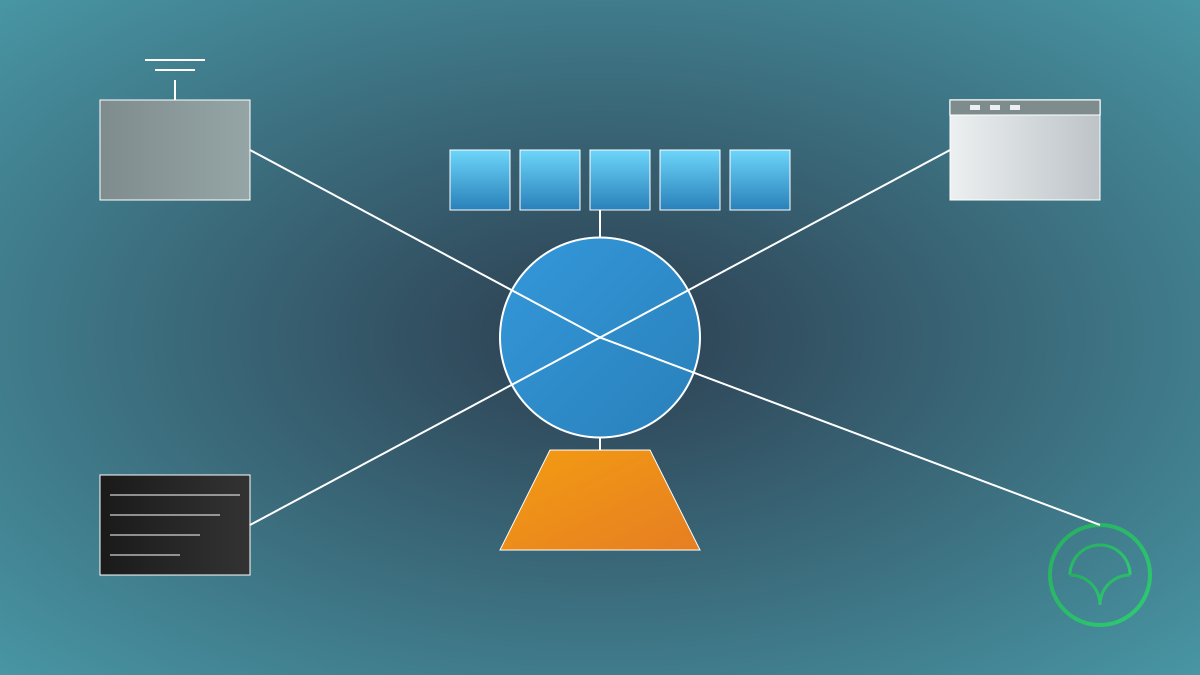
open-webSearch adopts a multi-mode architecture, offering four access methods:

  1. MCP Server Mode: Specifically integrated for MCP clients (such as Claude Desktop, Cherry Studio), exposed as a standard MCP tool to agents, following protocol specifications so that developers can focus on business logic.
  2. CLI Mode: For command-line users and script developers, supporting one-time tasks, concise and direct, ready to use out of the box.
  3. Local Daemon Mode: Optimized for high-frequency calls, providing local HTTP services after startup, reducing response latency and supporting status monitoring.
  4. Skill Mode: Guides agents to discover, activate, and use the minimum viable path, working in collaboration with other modes to assist agents in autonomous execution of operations.
4

Section 04

Core Features: Multi-Engine Search and Precise Content Extraction

open-webSearch supports more than ten search engines, covering international mainstream ones (Bing, DuckDuckGo, Brave, etc.) and Chinese regional ones (Baidu, CSDN, Juejin). Users can flexibly choose according to their needs, providing redundancy and fault tolerance. In addition, it supports content extraction, including CSDN articles, GitHub READMEs, general HTTP pages, etc. Best practices suggest searching first to obtain specific URLs before extracting content, avoiding direct access to JavaScript-heavy rendered pages.

5

Section 05

Technical Details: Network Adaptability and Browser Automation

open-webSearch has excellent network environment adaptability:

  • Proxy Configuration: Distinguishes between installation and runtime phases, supporting different proxy strategies.
  • Playwright Integration: Handles dynamic page rendering, providing configuration options such as package selection, browser path, and remote connection.
  • Environment Variable Configuration: Covers multiple aspects including core functions, network, service mode, Playwright, etc., facilitating migration across different environments and containerized deployment.
6

Section 06

Usage Scenarios and Best Practice Guidelines

open-webSearch is suitable for various scenarios: agent enhancement (providing real-time information), research assistance (multi-source information collection), content aggregation (theme content integration), and automated workflows (CI/CD or data pipeline integration). Best practices include: extracting content by first searching to get specific URLs; distinguishing proxy configuration between installation and runtime phases; selecting engines according to query type and region.

7

Section 07

Limitations, Improvement Directions, and Community Ecosystem

Current limitations: The quality of search results depends on the stability of underlying engines; extraction of some JS-heavy pages is limited; APIs and configurations may change. Improvement directions: Support more search engines (e.g., Google), expand social platform support, and optimize content extraction. The community ecosystem is distributed using the npm skill manager, allowing users to install and update via commands. The skill design concept is detection, guidance, verification, and execution, facilitating agent collaboration. The project has the potential to become an important part of the agent ecosystem.

