Zing Forum

Reading

Open-Cowork: An Open-Source Alternative to Claude Co-Work, Building an Autonomous AI Office Assistant

An open-source computer-use agent framework that supports browser automation, desktop control, and intelligent workflows, enabling AI to operate computers like humans to complete tasks.

AI代理浏览器自动化桌面控制开源Claude Co-Work计算机使用代理工作流自动化多模态AI
Published 2026-06-13 10:45Recent activity 2026-06-13 10:49Estimated read 6 min
Open-Cowork: An Open-Source Alternative to Claude Co-Work, Building an Autonomous AI Office Assistant
1

Section 01

【Introduction】Open-Cowork: An Open-Source Alternative to Claude Co-Work, Building an Autonomous AI Office Assistant

Open-Cowork is an open-source computer-use agent framework developed by the coasty-ai team, released on GitHub on June 13, 2026 (link: https://github.com/coasty-ai/open-cowork). It targets Anthropic's closed-source Claude Co-Work feature, supporting browser automation, desktop control, and intelligent workflows, allowing AI to operate computers like humans to complete tasks. Its core goal is to achieve true automated office work.


2

Section 02

【Background】The Need for AI to Operate Computers and the Limitations of Claude Co-Work

A Computer-Use Agent allows AI to operate computer interfaces like humans, such as organizing emails and processing data. Claude Co-Work is a revolutionary closed-source feature launched by Anthropic, but it is limited to specific platforms. As an open-source alternative, Open-Cowork aims to break this limitation and enable developers to build autonomous AI office assistants.

3

Section 03

【Core Capabilities】Browser Automation, Desktop Control, and Intelligent Workflows

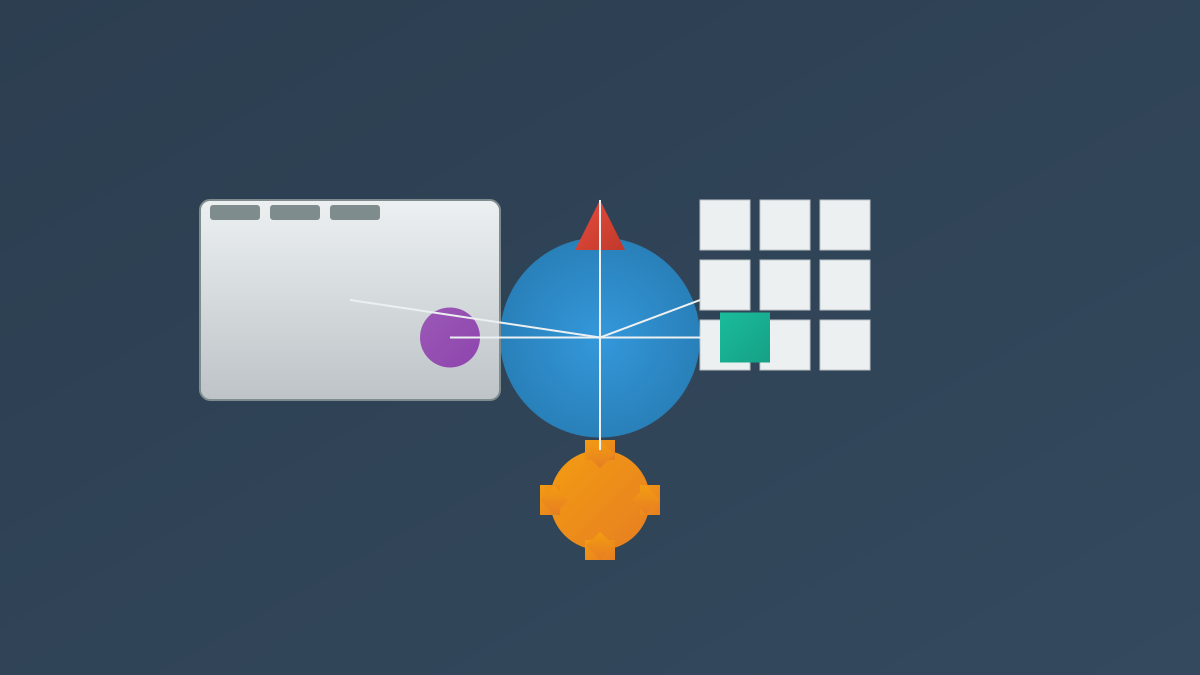
Open-Cowork has three core capabilities:

  1. Browser Automation: Automatically navigate web pages, fill forms, extract data, supporting dynamic content and single-page applications;
  2. Desktop Control: Open/close applications, switch windows, operate the file system, execute system commands;
  3. Intelligent Workflows: Define multi-step processes such as data collection pipelines, report generation, cross-system synchronization, etc. Unlike traditional scripts, it is based on multi-modal large model decision-making, capable of perceiving interfaces, understanding instructions, executing autonomously, and recovering from errors.
4

Section 04

【Technical Architecture】Multi-Modal Perception and Closed-Loop Decision-Making System

Open-Cowork's architecture includes:

  1. Multi-Modal Perception Layer: Obtain visual information via screenshots + OCR to understand interface status;
  2. Decision Planning Layer: Use large language models to decompose user instructions into operation sequences, with context understanding and task planning capabilities;
  3. Execution Control Layer: Control mouse and keyboard via system APIs, handle edge cases like page loading and pop-ups;
  4. Feedback Loop: Perceive environmental changes after operations, evaluate effects, and adjust plans, forming an observation-action-feedback closed loop.
5

Section 05

【Application Scenarios】Personal, Enterprise, and Accessibility Assistance

Open-Cowork's practical value covers multiple scenarios:

  • Personal Efficiency: Automatically organize files, batch process emails, data entry and filtering;
  • Enterprise Processes: Automated report generation, cross-system data synchronization, customer service assistance, UI testing;
  • Accessibility Assistance: Help users with mobility impairments control computers via voice commands.
6

Section 06

【Open-Source Ecosystem and Future Outlook】

As an open-source project, Open-Cowork has significant advantages: customizable (modify and extend functions), transparent (open-source code for secure control), community-driven (contributions from global developers), and cost-controllable (no SaaS subscription fees). Future outlooks include: more workflow templates, deep integration with mainstream office software, stronger multi-modal understanding, and improved error handling mechanisms.

7

Section 07

【Conclusion】Democratization of AI Agent Technology and the Future

Open-Cowork promotes the democratization of AI agent technology, opening up the computer operation capabilities of large tech companies to all developers and users. Although its current experience is not as polished as Claude Co-Work, the vitality of the open-source community gives it huge growth potential. In the era where AI is moving from "conversation" to "action", such tools are redefining the boundaries of human-computer collaboration, and the future is already here.

