Zing Forum

Reading

Notion CFD Harness: A Multi-Agent Computational Fluid Dynamics Workflow Combining Claude Code and Notion AI

This article introduces the notion-cfd-harness project, a multi-agent workflow system combining Claude Code and Notion AI, designed specifically for Computational Fluid Dynamics (CFD) simulations, demonstrating the collaborative potential of AI agents in the field of scientific computing.

计算流体力学CFD多智能体Claude CodeNotion AI科学计算工作流自动化工程仿真
Published 2026-04-09 15:11Recent activity 2026-04-09 15:16Estimated read 7 min
Notion CFD Harness: A Multi-Agent Computational Fluid Dynamics Workflow Combining Claude Code and Notion AI
1

Section 01

Introduction to the Notion CFD Harness Project: A New Paradigm for AI Multi-Agent Collaborative CFD

This article introduces the notion-cfd-harness project, a multi-agent workflow system combining Claude Code and Notion AI, designed specifically for Computational Fluid Dynamics (CFD) simulations. The core concept of the project is "Well-Harness", aiming to build a human-machine collaborative CFD simulation environment. Through agent division of labor, knowledge precipitation, human-machine collaboration, and process standardization, it amplifies the capabilities of human experts and demonstrates the collaborative potential of AI agents in the field of scientific computing.


2

Section 02

Pain Points of Traditional CFD Workflows and Project Background

Computational Fluid Dynamics (CFD) is a complex simulation technology in the engineering field, involving multiple links such as geometric modeling, mesh generation, physical parameter setting, solver configuration, and result analysis. The traditional workflow requires professional engineers to invest a lot of time, and it is prone to simulation failures due to human errors. The notion-cfd-harness project introduces a multi-agent AI system, collaborating through Claude Code and Notion AI to build an "AI-driven CFD simulation operating system" to solve these problems.

3

Section 03

System Architecture: Collaborative Division of Labor Between Two AI Engines

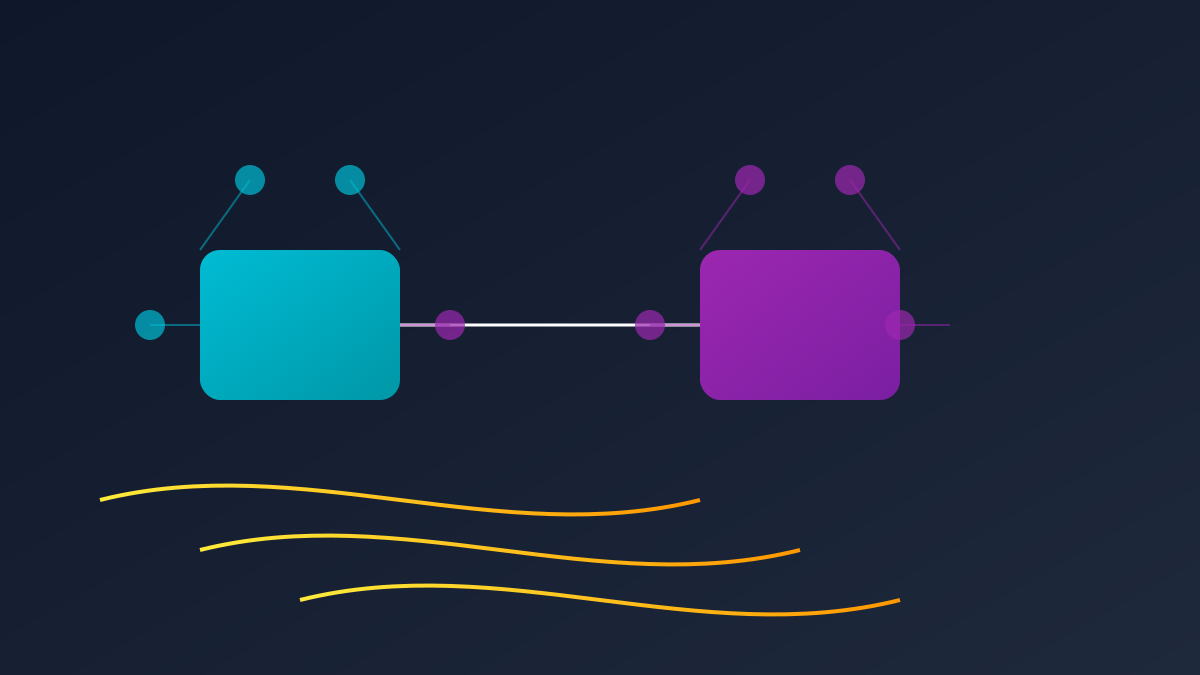
The system adopts a collaborative architecture of two AI engines:

  • Claude Code (Executor): Responsible for code generation (Python/Matlab/OpenFOAM, etc.), simulation driving, error handling, and result extraction, handling the technical parts of CFD;
  • Notion AI (Coordinator and Recorder): Responsible for project management, knowledge integration, context maintenance, and report generation, using Notion databases and document structures to provide a knowledge management foundation.
4

Section 04

Detailed Explanation of Multi-Agent Workflow: From Requirements to Knowledge Precipitation

The project workflow is divided into five stages:

  1. Requirements Analysis and Task Decomposition: Notion AI parses requirements, creates project pages, decomposes subtasks, and assigns agents;
  2. Geometry and Mesh Collaboration: Claude Code generates geometric models and divides meshes, and the agent verifies mesh quality;
  3. Physical Setting and Solver Configuration: Recommends turbulence models, sets boundary conditions, optimizes numerical parameters, and Notion AI records the reasons for decisions;
  4. Simulation Execution and Monitoring: Claude Code starts the solver and monitors it, adjusts or pauses in case of anomalies, and synchronizes intermediate results to Notion;
  5. Result Analysis and Knowledge Precipitation: Automatically generates visual content, interprets data, generates reports, and stores lessons learned in the knowledge base.
5

Section 05

Technical Implementation Highlights: Agent Communication and Domain Knowledge Integration

The project's technical highlights include:

  • Agent Communication Protocol: Synchronizes status through Notion databases, uses comment functions as message queues, and conflicts are arbitrated by humans;
  • Domain Knowledge Embedding: Built-in CFD best practice libraries, fault diagnosis manuals, and verification case sets, organized in Notion databases for easy update and expansion.
6

Section 06

Application Scenarios and Value: Empowering Education, Industry, and Research

The project has a wide range of application scenarios:

  • Education Field: Provides a learning-by-doing environment for learners, explains the physical meaning of settings, and turns errors into learning materials;
  • Industrial Design: Accelerates design iterations, quickly evaluates schemes, and accumulates organizational-level simulation knowledge bases;
  • Research Support: Ensures experiment reproducibility, supports batch processing of multiple working conditions, and automatically compares results with literature.
7

Section 07

Challenges and Future Outlook: From Current Limitations to Expansion Directions

The project faces challenges: high computing resource requirements, AI-generated settings needing verification, insufficient automation for complex geometries, and multi-physics coupling to be expanded. Future directions include: supporting more solvers (such as ANSYS Fluent, COMSOL), integrating digital twins, built-in optimization algorithms, and establishing a community knowledge sharing mechanism.

