Zing Forum

Reading

notes2audio: An AI Pipeline for Converting PDF Notes to High-Quality Podcasts

A Python-based pipeline tool that converts PDF study notes into high-quality listenable audio files. Unlike simple TTS tools, it uses large language models to rewrite messy key-point notes into natural and fluent spoken scripts before synthesis.

文本转语音TTS大语言模型PDF处理学习工具播客生成知识管理AI内容改写
Published 2026-06-07 00:13Recent activity 2026-06-07 00:20Estimated read 6 min
notes2audio: An AI Pipeline for Converting PDF Notes to High-Quality Podcasts
1

Section 01

[Introduction] notes2audio: An AI Pipeline Tool for Converting PDF Notes to High-Quality Podcasts

notes2audio is a Python-based pipeline tool that converts PDF study notes into high-quality listenable audio files. Unlike simple TTS tools, it introduces large language models as a 'content screenwriter'—first rewriting messy key-point notes into natural and fluent spoken scripts before speech synthesis, to adapt to fragmented learning scenarios. The project is maintained by tomsouri, with source code available on GitHub (link: https://github.com/tomsouri/notes2audio), and the update time is 2026-06-06T16:13:20Z.


2

Section 02

Project Background: Demand for Fragmented Learning and Pain Points of Traditional TTS

In the era of information explosion, people accumulate a large amount of learning materials but have fragmented reading time, making podcasts/audiobooks a popular way to acquire knowledge. Traditional TTS tools can convert text to audio, but they produce stiff and mechanical results when dealing with disorganized notes, which are hard to understand. The innovation of notes2audio lies in introducing large language models to intelligently rewrite content before speech synthesis, solving this pain point.

3

Section 03

Core Workflow: Three Steps to Convert PDF to Podcast

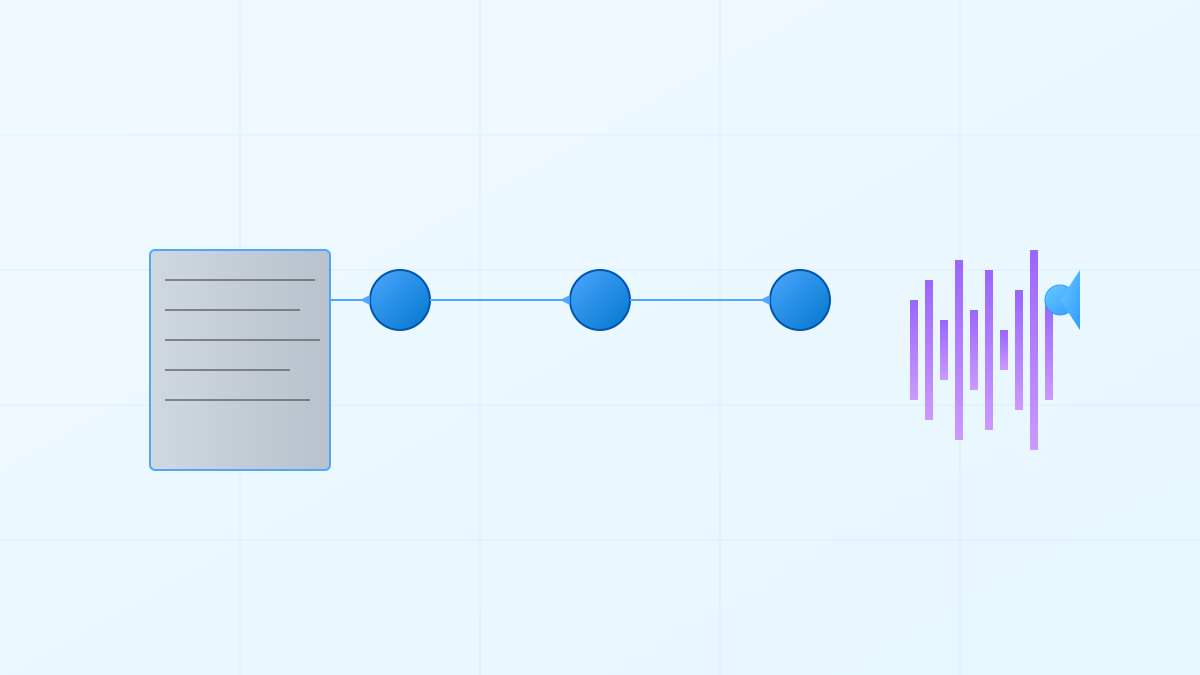
  1. PDF Parsing and Content Extraction: Extract text while preserving hierarchical structure, identify format elements, handle complex layouts, and filter irrelevant content; 2. LLM Content Rewriting: Expand fragmented key points into complete sentences, add transition words to improve coherence, adjust word order to fit spoken language (e.g., rewrite the list of the three elements of machine learning into a coherent paragraph); 3. Speech Synthesis and Output: Generate natural speech via TTS engines, output in MP3 format, support chapter segmentation, speed and tone adjustment, etc.
4

Section 04

Technical Innovations: Semantic Understanding and Structural Preservation

  1. Semantic Understanding Instead of Mechanical Conversion: Identify implicit logical relationships, supplement omitted components, expand abbreviated terms, and adjust information density to suit auditory perception; 2. Preserve Structural Information: Convert chapter structures into spoken transitions, turn key markers into emphasis prompts, transform list relationships into sequential/parallel expressions, and appropriately simplify citations and annotations.
5

Section 05

Application Scenarios: Covering Various Learning and Usage Needs

Applicable to: Student review (listening to notes during fragmented time), researchers (converting paper key points into podcasts to deepen memory), knowledge workers (learning technical documents during commutes), language learners (generating target language listening materials), and accessibility needs (providing an alternative for visually impaired/reading-impaired individuals).

6

Section 06

Implementation Details and Improvement Directions: Modular Design and Current Challenges

Implementation Details: Adopts a modular design, components can be replaced independently (PDF parsers, LLM backends, TTS engines, and output formats all support multiple options); Limitations and Improvements: 1. High LLM costs (local models can be considered); 2. Slow processing of long documents (need to add progress display); 3. Multilingual support needs optimization; 4. Mathematical formula processing remains to be solved.

7

Section 07

Conclusion: A New Paradigm for Content Production with AI Scriptwriting + Speech Synthesis

notes2audio demonstrates the innovative application of large language models in the field of content conversion—it is not just format conversion, but understanding and reconstructing content to adapt to new media. This 'AI scriptwriting + speech synthesis' model is expected to become a new paradigm for future content production.

